Bangladesh is once again in the grip of political violence, and the reverberations are being felt well beyond its borders. The killing of Sharif Osman Hadi, a youth leader associated with the post-2024 political upheaval, has triggered widespread unrest, mob attacks on media institutions, and overtly anti-India demonstrations.
The arson attacks on the offices of Prothom Alo and The Daily Star were not isolated acts of vandalism; they represented a direct assault on institutions that sustain democratic mediation, public accountability, and freedom of expression. For India, these events are not merely an internal crisis in a neighbouring country but a strategic test with long-term implications.
The immediate violence must be situated within the broader transformation of Bangladesh’s political landscape following the student-led uprising of 2024 and the subsequent collapse of established authority structures. In the vacuum that followed, competing street forces have gained prominence, often operating beyond the effective control of political parties or the state.
The targeting of major newspapers is particularly telling. Journalists trapped inside the burning buildings described the episode as one of the darkest moments in Bangladesh’s press history. One reporter recalled that “the smoke was so thick we could barely breathe,” underscoring how physical intimidation has begun to replace political contestation.
The interim government led by Nobel laureate Muhammad Yunus has condemned the attacks and promised accountability, describing the assaults on media houses as “attacks on truth itself.” Yet the state’s limited capacity to prevent or quickly contain the violence has raised concerns about the growing autonomy of street mobilisation.
A senior political analyst in Dhaka observed that “once crowds learn they can act with impunity, it becomes difficult to put the genie back in the bottle.” This observation captures the core challenge Bangladesh now faces: restoring institutional authority without reigniting further unrest.
For India, the most immediate manifestation of this instability has been diplomatic and operational. In December 2025, New Delhi temporarily shut visa application centres in Khulna and Rajshahi after protests by radical groups moved towards Indian assistant high commissions. Visa operations in Dhaka were also briefly suspended following a large demonstration near the Indian High Commission.
Indian officials stated that these steps were taken purely “in view of the prevailing security situation” and to ensure the safety of personnel and applicants. The Ministry of External Affairs simultaneously rejected what it called a “false and motivated narrative” being pushed by extremist elements that sought to portray India as an adversary of the Bangladeshi people.
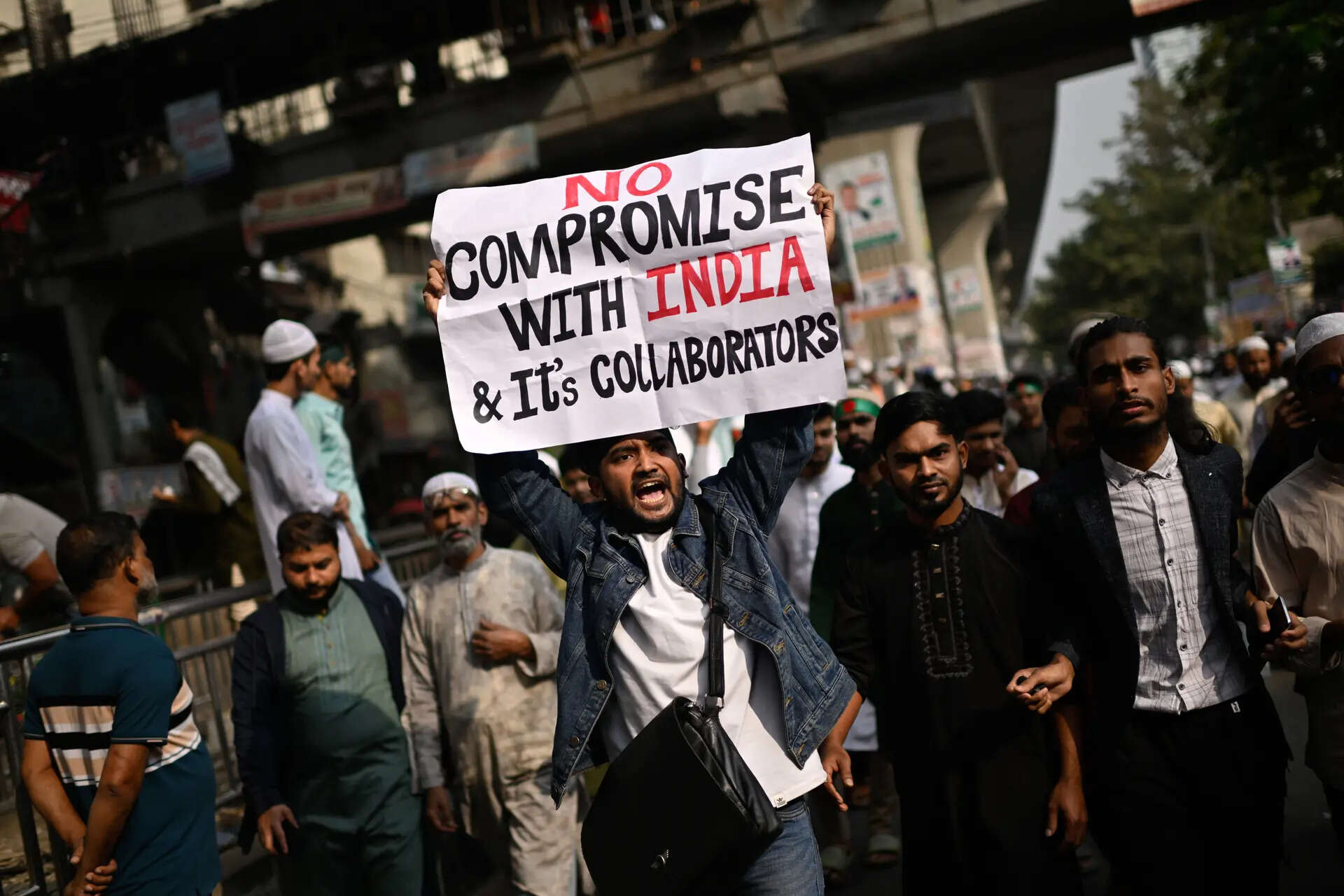
These protests were not limited to procedural grievances. Slogans raised during demonstrations included provocative references to India’s northeastern states, with fringe voices calling for their separation from India. While such rhetoric does not represent mainstream Bangladeshi opinion, its public articulation signals a worrying shift: anti-India sentiment is increasingly being normalised as a tool of political mobilisation.
The symbolism surrounding Sharif Osman Hadi’s death has further intensified tensions. Sections of the Bangladeshi public discourse have elevated him as a “martyr,” with emotionally charged narratives framing his killing as part of a larger struggle against perceived external influence.
Commentaries describing him as a figure for a “Greater Bangladesh” may be marginal, but they reveal how identity-laden narratives can quickly acquire traction in moments of political flux. For India, the concern is not the individual case but the precedent: martyrdom narratives have historically been effective in radicalising movements and legitimising sustained confrontation.
A balanced assessment requires careful distinction between what is observable and what is inferential. What is observable is a rise in street-level radical mobilisation, attacks on independent media, and repeated targeting of Indian diplomatic symbols. What remains inferential—but strategically significant—is the trajectory such forces could take if institutional fragility persists.
Bangladesh remains a plural society with strong secular traditions and a population deeply invested in economic stability. Islamist radical elements do not control the state. However, periods of instability often allow disciplined ideological groups to exert influence disproportionate to their numerical strength, particularly when mainstream politics is fragmented.
The implications for India are concrete rather than theoretical. A Bangladesh experiencing sustained radicalisation and political volatility poses challenges across multiple domains. Border security becomes more complex as instability can intersect with trafficking, smuggling, and infiltration networks. India’s eastern states—West Bengal, Assam, Tripura, Meghalaya, and Mizoram—are especially exposed to spillover effects, whether through migration pressures or digitally amplified misinformation.
Economic interdependence also suffers. Disruptions to visa services and cross-border movement have already affected businesses in eastern India that depend on Bangladeshi visitors, traders, and patients, demonstrating how political unrest can quickly translate into economic friction.
The external dimension adds another layer of complexity. China’s engagement with Bangladesh has been driven primarily by infrastructure investment, port development, and long-term strategic access to the Bay of Bengal. Pakistan’s interest, by contrast, is more explicitly geopolitical, shaped by its rivalry with India and its desire to dilute India’s influence in South Asia.
Recent trilateral interactions among Bangladesh, China, and Pakistan have attracted attention in strategic circles. These engagements do not in themselves constitute an anti-India alliance, nor do they negate Bangladesh’s strategic autonomy. However, they illustrate how internal instability can make a country’s foreign policy more elastic and susceptible to transactional influence at a time when multiple external actors are competing for space.
India’s challenge, therefore, is best understood as a test of strategic maturity rather than reflexive response. Historically, New Delhi’s approach to Bangladesh has rested on three pillars: effective border management, deepening economic and connectivity ties, and sustained political engagement that supports stability without overt interference. Each of these pillars is now under strain.
Border management increasingly requires anticipatory planning for humanitarian contingencies and organised crime. Economic initiatives, particularly those aimed at integrating India’s Northeast with regional supply chains, face uncertainty. Diplomatic engagement must navigate the fine line between legitimate concern and perceived interference.
The appropriate response lies neither in alarmism nor in detachment. Protective realism—securing diplomatic missions and personnel—is essential, but it must be paired with diplomatic breadth that engages multiple strands of Bangladeshi society rather than any single faction. India must also compete in the influence space through its comparative advantages: market access, development cooperation, education, healthcare linkages, and people-to-people ties that are deeper and more durable than transactional alignments.
Above all, conceptual clarity is crucial. The challenge India faces is not Islam as a faith or Bangladesh as a society, but political radicalisation operating within a fragile institutional environment and amplified by external interests. Conflating these distinctions would only strengthen extremist narratives and undermine India’s own social cohesion.
Bangladesh’s current unrest should thus be read both as a warning and a strategic indicator. It warns of the consequences when institutions weaken and street power fills the void. It also tests India’s ability to respond with firmness without hubris, vigilance without paranoia, and engagement without illusion.