

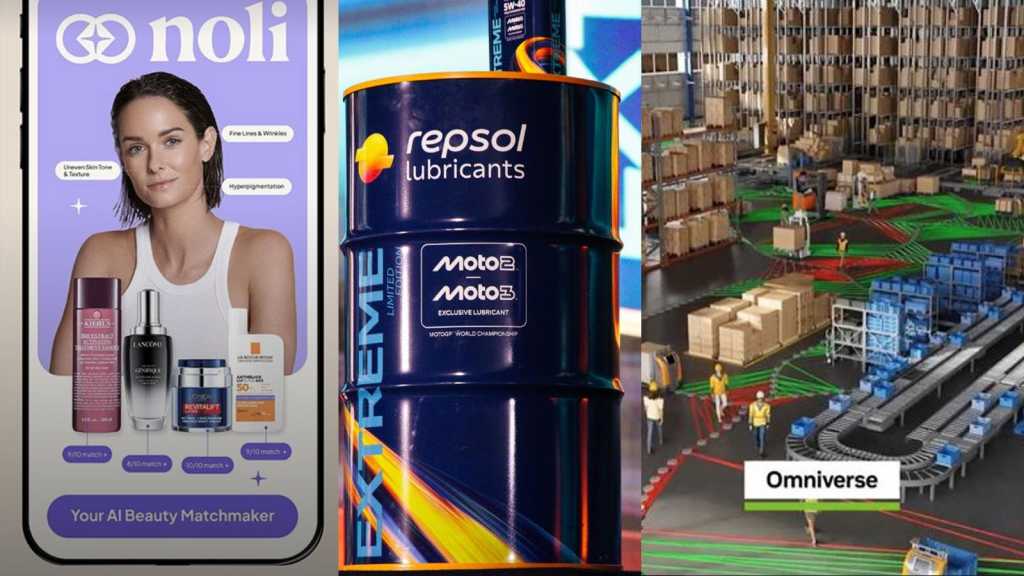

AI pilot projects are often executed quickly and successfully. But the real challenge is scaling the solution across the entire enterprise, says Mauro Macchi, Accenture’s EMEA CEO. And for AI to contribute genuine added value, a company-wide redesign, including processes, systems, skills, and ways of working, is often necessary.
Macchi adds that AI implementation should start with the problem that needs solving, not the technology. Use cases here from London-based beauty startup Noli, Spanish energy company Repsol, and supply chain specialist Kion illustrate the diverse challenges companies can face, whether it’s the data, processes, or regulations.
Using AI to combat beauty burnout
Noli, a personalized beauty platform backed by the L’Oréal Group, uses AI to reinvent the beauty industry with the help of an app to address the growing problem of skin anxiety and beauty burnout.
The aim is to end the feeling of being overwhelmed by beauty products. As a result, in the UK alone, such products worth over £1 billion ($1.35 billion) are wasted annually because they don’t deliver desired results.
So Noli aims to combat this with a vertical expert AI deeply rooted in beauty science, and based on a robust, multi-layered architecture that encompasses scientific research and multimodal consumer signals, including one million anonymized facial scan data points.
The biggest challenge for Noli wasn’t the AI but the data. Beauty data is so fragmented, with scientific research data, formulation information, insights from facial scans, user behavior, and sensory attributes all coming in different formats from various sources.
This complex mix needed to be transformed into something structured, trustworthy, and scalable. So the proprietary Beauty Knowledge Graph was developed, which structures raw data, validates outputs to prevent hallucinations, and matches products to the right needs in real time.
The name Noli, “No one like I,” is also the mission statement. Users can determine their personal beauty DNA profile by answering a questionnaire, undergoing an expert facial scan, or contacting Noli directly.
The company then creates personalized recommendations for trusted, scientifically sound beauty brands. To achieve this, Noli uses continuous learning loops as every match, review, purchase, or return improves the system.
The conversion rate seems to confirm the success of this approach. According to Noli CEO and co-founder Amos Susskind, website visitors are nearly four times more likely to make a purchase, and also buy more than usual. And the number of repeat customers has doubled in five months.
A multi-energy approach to AI
Repsol’s approach to AI is quite different. The gen AI journey for the multi-energy multinational, with over 25,000 employees, began as part of a broader digital transformation initiated in 2018.
The strategy comprises three main areas: personal productivity, improving current processes, and Gold Mine, considered key to redesign and reinvent projects and processes.
To achieve everything laid out, the company uses multi-agent systems designed to solve complex processes or workflows by enabling specialized agents to collaborate. Agents require skills such as knowledge, planning, reasoning, coordination, and execution, all supported by a shared short- and long-term memory.
The system also operates via an orchestrator that receives requests. It identifies the appropriate planner, who in turn defines the plan and selects suitable, highly specialized agents from a catalog. The system is currently operational and comprises 34 agents, with whom over 100 employees collaborate in a hybrid work environment.
Besides data quality, Repsol CIO Juanma García faced the key challenge of recognizing that AI is not a standard technology. Company executives had to learn that AI initiatives can fail if they’re implemented haphazardly, and their experience considered cognitive infrastructure.
Another ongoing priority is change management and helping users adapt to a new way of working, driven by AI. In order to be more effective and avoid problems, Repsol also defines agents with limited scope for specialized tasks instead of creating large agents that cover too much.
Repsol’s advice for other companies trying to get value from AI investments is to define a clear strategy. While increasing personal productivity, like through Copilot, is difficult to demonstrate in a profit and loss statement, completely redesigning processes is key to achieving significant added value.
Using physical AI to create new supply chains
As a provider of supply chain solutions, Kion aims to bring physical AI to the warehousing and distribution market. Given the significant pressure on global supply chains due to geopolitical tensions and disruptions, Kion is forced to rethink its approach to warehouse automation. The goal is to make them more real-time capable and resilient, replacing rigid structures with flexible, adaptable, and intelligent solutions.
Kion has Mega, an Omniverse blueprint from Nvidia, for this purpose, enabling large-scale development, testing, and optimization of physical AI and robot fleets using a digital twin. To quickly transfer physical locations into the digital system, Kion uses a scanner that captures a distribution or fulfillment center, and feeds the data into the Nvidia Omniverse. Subsequently, replicas of all AMRs, AGVs, and bots are integrated into the digital system.
The digital twin then allows Kion to simulate an unlimited number of scenarios and measure operational KPIs, such as throughput and utilization, before making changes to the physical warehouse. From there, the digital twin can instruct the physical twin on optimal steps to take.
While Kion CEO Rob Smith sees the company as technologically well-positioned, the regulatory environment in the EU is a headache as he feels it stifles innovation. This, he says, is one reason why the pace of AI adoption is significantly faster in North America and China, so he advocates allowing innovation first and regulating it later, rather than the other way around.
