

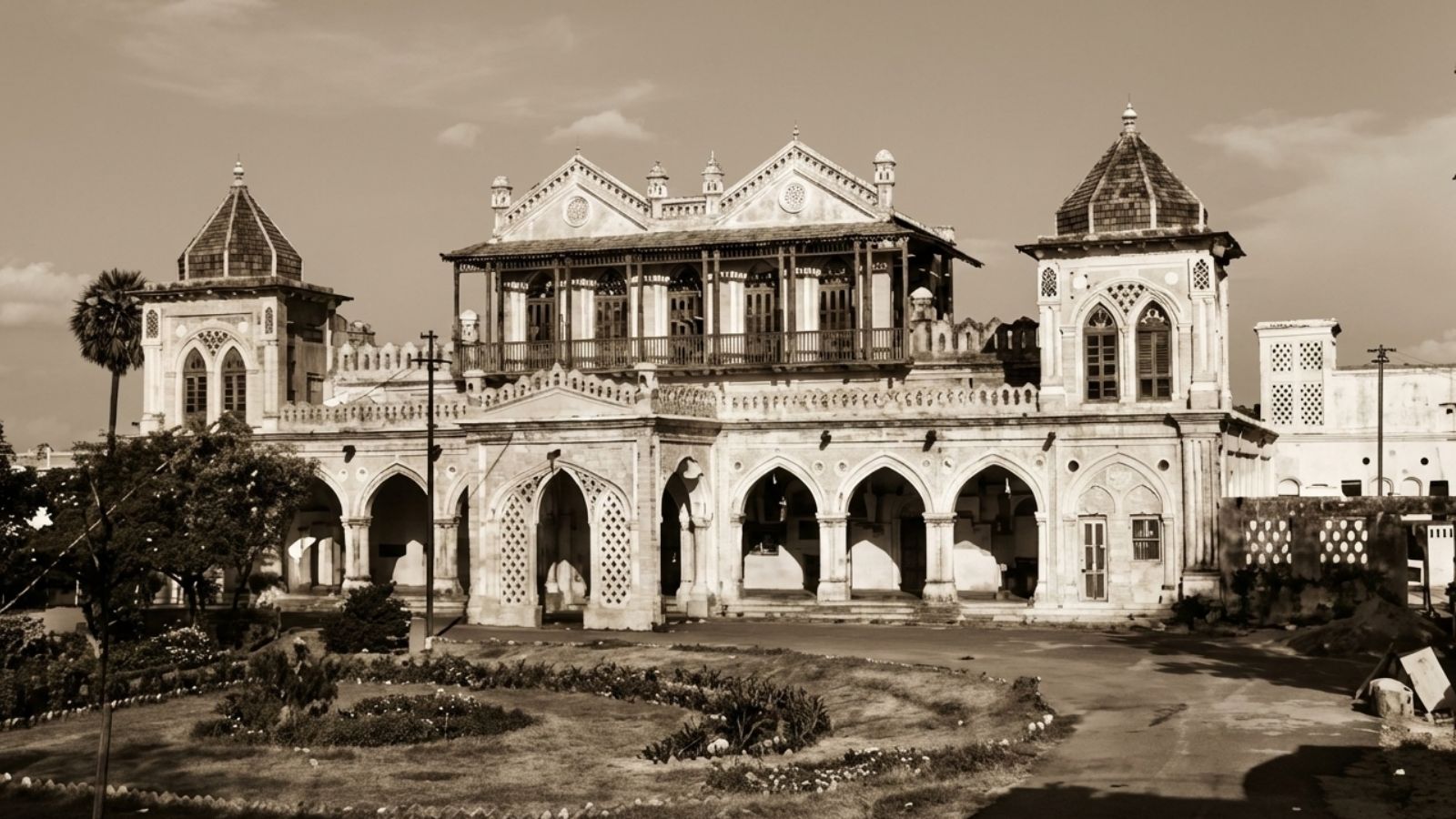
Delhi University’s Shri Ram College of Commerce (SRCC) on Friday turned a page in history as it marked the beginning of its centenary celebrations with a curtain-raiser ceremony at the North Campus. A hundred years ago, SRCC did not begin with imposing red-brick buildings or packed lecture halls. It started modestly, in a bungalow in Daryaganj, with just 12 students and four teachers. The year was 1926 — a time when commerce education was still an unfamiliar idea in North India, and the colonial curriculum left little room for practical, profession-oriented learning.
The seed, however, had been sown earlier. In 1920, industrialist Sir Shri Ram set up the Commercial Education Trust, driven by a belief that education in trade and economics could play a role in building economic self-reliance. Along with his brother-in-law Lala Sher Singh, his friend Lala Diwan Chand, and other associates, he imagined an institution that would teach commerce not merely as theory, but as a living discipline.

That vision took shape with the founding of the Commercial College in 1926. Renamed Shri Ram College of Commerce in 1951, the institution continued to grow in stature. In 1954, it found a new home at Delhi University’s Maurice Nagar — a move marked by the inauguration of its building by then Vice-President of India, Dr Sarvepalli Radhakrishnan.
A century on, the journey from that small bungalow to a campus known across the country remains at the heart of SRCC’s story.
Two undergraduate courses: Then and now
From its early years, SRCC focused on a limited set of academic offerings. At the undergraduate level, it has traditionally offered two programmes — BCom (Honours) and BA (Honours) Economics — a structure that continues to this day.
According to the college, the institution — then known as the Commercial College — received affiliation with the University of Delhi in 1926 and was upgraded to a degree college in 1932, when it began awarding the BA (Pass) degree in the Commerce Group. Academic diversification within the same discipline followed in phases. The BA (Hons) (Commerce Group) degree was introduced in 1943.
The same year, the college launched its MA (Economics) programme. A Master’s degree in Commerce followed in 1948, strengthening SRCC’s postgraduate footprint. When the University of Delhi instituted the BCom (Honours) programme in 1949, SRCC was among the first to offer it — a course that has since become central to the college’s identity. Later in 1958, the institute introduced the BA (Honours) Economics programme, completing the two-programme structure at the undergraduate level that continues today.
Story continues below this ad
While the college has added postgraduate diplomas and management-oriented programmes over time, particularly from the 2000s, its core undergraduate framework has remained unchanged. “The emphasis has been on depth and specialisation rather than expanding the number of degree options,” said principal Simrit Kaur.
Demand remains high in the CUET era
Despite offering only two undergraduate programmes, SRCC has consistently remained one of the most sought-after colleges in Delhi University. In the 2025 undergraduate admissions cycle, conducted through CUET-UG, the college emerged as the highest-grossing institution in the university in terms of preference count.
A total of 38,795 candidates listed SRCC as their top choice, followed by Hindu College with nearly 32,000 preferences. College officials have pointed out that the demand has remained steady even after the shift to centralised admissions and the introduction of the four-year undergraduate programme under the National Education Policy (NEP).
Principal Professor Simrit Kaur said that the college has prioritised specialisation over multiplicity of options. She noted that under the NEP framework, students also have the flexibility to take minor courses across colleges through the cluster system, though most SRCC students continue to stay within commerce and economics domains.
Story continues below this ad
Professor Kaur further explains how SRCC’s academic model rests on classroom teaching supported by student societies, internships, mentoring, and alumni engagement. “The alumni mentoring plays a significant role in student support, particularly in internships, placements, and career guidance. SRCC’s alumni network is estimated to include over 25,000 graduates working across public service, corporate leadership, policy, and entrepreneurship,” she added.
A few notable alumni of SRCC include former Finance Minister Arun Jaitley, IAS officer Sanjeev Sanyal, and film personalities Gulshan Grover and Nimrat Kaur.
The college has more than 70 active student societies spanning commerce, economics, finance, debating, dramatics and social initiatives.
Infrastructure pressure and expansion plans
At the centenary event, Delhi University Vice-Chancellor Yogesh Singh, SRCC Governing Body Chairman Ajay S Shriram, faculty members, policymakers, and alumni from across generations and professions were in attendance. Ajay S Shriram noted that SRCC’s student strength has grown significantly over the past decade and a half.
Story continues below this ad
“From around 1,700 students in 2007, enrolment has increased to nearly 4,000, driven by reservation policies and the transition to the four-year undergraduate programme,” he said.
Shriram added that the surge in student numbers has put pressure on existing infrastructure, leading the college to adopt interim solutions such as installing portacabins to create additional classroom space — a move supported by alumni funding. He also flagged regulatory constraints related to floor area ratio (FAR) norms and college categorisation that have limited physical expansion, but said processes are now underway to address these challenges.
According to Shriram, two major infrastructure projects have received approval from the Municipal Corporation of Delhi’s standing committee — a seven-storey academic block with a basement, and an expansion of the girls’ hostel by two floors. The college is in the process of securing funding from the Higher Education Financing Agency (HEFA) for these projects.
However, he clarified that there are no immediate plans to increase undergraduate seats for the upcoming admission cycle, as the four-year programme has already added approximately 450–500 students to the campus at any given time. Infrastructure expansion is being planned with a longer-term horizon.
Story continues below this ad
AI, entrepreneurship, and the next 100 years
Referring to the college’s standing within the University of Delhi and beyond, VC Yogesh Singh said the institution had evolved into a brand that carried national recognition. “SRCC today is not just a college, it is a brand, and a very powerful one,” he said.
He added that the strength of this brand brought with it institutional responsibility. “When an institution becomes a brand, expectations also rise. The challenge before SRCC is to protect that legacy while continuously reinventing itself,” Singh said.
Singh further said institutions such as SRCC would need to take on a larger role in entrepreneurship and business creation as India looks to expand its economic footprint globally. As the college enters its second century, he said the focus must shift from producing job-ready graduates to enabling enterprise creation.
“The question is what’s next for SRCC? Accomplished journey of 100 years, no doubt, but next 100 years, what we want to do — this is a question which should be discussed,” Singh said.
Story continues below this ad
While speaking to Indianexpress.com, Shriram said the college is exploring the integration of AI into teaching methods and the creation of centres of excellence where interested students can pursue advanced work. He added that faculty upskilling would be a prerequisite for such changes, and that entrepreneurship initiatives are under discussion, supported by alumni engagement.
Professor Kaur said SRCC’s approach to digitalisation and AI would be guided by ethical considerations, with an emphasis on preparing students to adapt to changing economic and technological conditions while retaining a focus on social responsibility.
“If you don’t take necessary steps today, those who will follow us will not forgive us for tardiness, negligence, complacency, and status quo attitude.”
