Seven years after its launch, Ayushman Bharat–Pradhan Mantri Jan Arogya Yojana (PMJAY) has evolved from a flagship health insurance scheme into one of the world’s largest digital public health platforms. Covering over 500 million Indians and processing healthcare transactions entirely online, the programme sits at the intersection of technology, data, and public policy.
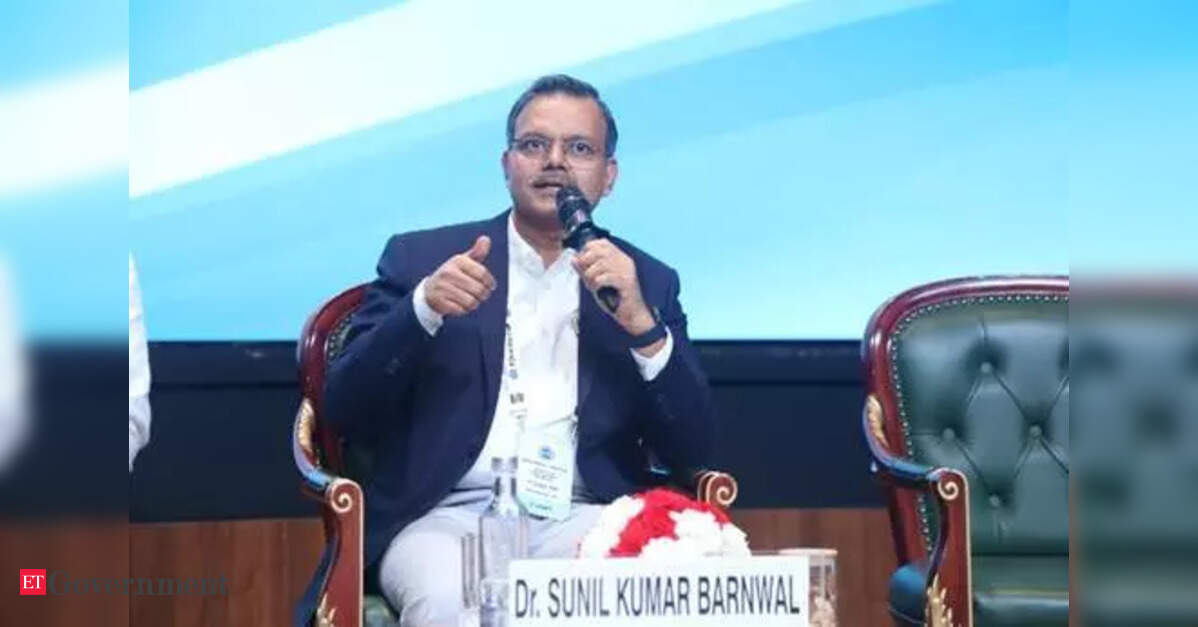
As artificial intelligence, real-world health data, and digital infrastructure begin to reshape how healthcare is financed, delivered, and monitored, PMJAY offers a rare case study of scale-driven innovation in the public sector. In an interview with ETGovernment’s Arpit Gupta, Dr. Sunil Kumar Barnwal, CEO of the National Health Authority, reflects on the scheme’s seven-year journey, its impact on transparency and outcomes, and how data and AI could define the next phase of India’s healthcare transformation.
Edited excerpts:
Ayushman Bharat–PMJAY recently completed seven years. How do you look back at this journey?
Ayushman Bharat–PMJAY, launched in 2018, has completed seven transformative years. What truly differentiates this scheme from most government programmes is that it is entirely digital and IT-driven. There is virtually no manual interface at any stage — from beneficiary identification and registration to hospital admission, treatment, claim processing and payments.
Every transaction happens online. Claims are processed on a blind, FIFO (first-in, first-out) basis, ensuring complete neutrality. Doctors processing claims do not know which hospital the claim is coming from. This removes discretion, eliminates bias, and builds trust. This architecture has delivered transparency, scalability, robustness, and above all, faith in the system — among hospitals, states, and beneficiaries.
How has this digital backbone helped states beyond PMJAY itself?
The IT platform has become a national health assurance infrastructure. States don’t need to build their own systems anymore. They can simply onboard their schemes onto the PMJAY platform.
As a result, around 13 states have moved to universal health coverage, expanding beneficiary categories and services using the same digital backbone. PMJAY has not just benefited the bottom 40% — it has created an ecosystem that enables health assurance and insurance programmes across India. Data seems to be emerging as a major strength of PMJAY. How is it being used?
Over seven years, PMJAY has generated over 110 million treatment records. This scale of real-world, pan-India health data is unprecedented. We use this data for advanced fraud and anomaly detection. Every new claim is checked against historical records using AI-driven rules and triggers — detecting duplicate claims, repeat treatments, manipulated reports, or reused diagnostic images.
In the last two years alone, this has helped us prevent fraudulent claims worth nearly ₹630 crore. Around 600 hospitals were de-empanelled, and several others were warned. Currently, about 30% of system-flagged suspicious claims are confirmed as irregular. As we move from rule-based systems to machine learning models, this accuracy will only improve.
Beyond fraud control, how can this data transform healthcare delivery?
This data opens doors to disease prediction, prevention, and policy planning. Because PMJAY data covers diverse geographies and populations, AI tools trained on it are far more suitable for India than those built on Western datasets or single-hospital data. We can generate disease heat maps, understand regional health patterns, and move from reactive care to predictive and preventive healthcare.
One challenge often cited is unstructured hospital data. How are you addressing that?
That is a real challenge. Many hospitals still upload scanned documents instead of structured electronic medical records because they don’t use Hospital Management Information Systems (HMIS). We are now deploying tools that can convert unstructured data into structured or semi-structured formats. We’ve started with packages like dialysis, where this enables auto-adjudication of claims — claims cleared directly by the system without human intervention. Auto-adjudication will significantly reduce workload for doctors and speed up payments, making the system more efficient.
There were reports of suspicious Ayushman cards and ghost beneficiaries. What is the reality?
This is largely about data cleansing, not verified beneficiaries. Initially, not all records were Aadhaar-seeded. Over time, through e-KYC and treatment-based verification, unverified or suspicious families — especially those that never availed treatment — are being filtered out. This process improves data quality and system integrity. PMJAY today is far more robust than it was in 2018.
Are there visible social and health outcomes from PMJAY?
Absolutely — and these are empirically documented, not anecdotal. The Economic Survey 2024-25 highlights earlier detection of cancers, enabled by PMJAY coverage. There are over 500 cancer treatment packages under the scheme.
Out-of-pocket expenditure has declined from 64% to around 39%, which is a massive shift. PMJAY provides security against the biggest risk poor households face — catastrophic health expenditure that pushes families back into poverty. Health-seeking behaviour has increased. People now come forward for cataract surgeries, cardiac stents, dialysis — treatments that were earlier delayed or avoided due to cost.
How do you assess the performance of Uttar Pradesh under PMJAY?
Uttar Pradesh is one of the largest and most critical states for PMJAY. Given its population size, it handles the largest beneficiary base and claim volumes, and has performed well overall. The next big opportunity for UP lies in fully leveraging public hospitals under PMJAY. When public hospitals treat patients under PMJAY, they receive reimbursements which can be reinvested — hiring doctors, paramedics, upgrading equipment, and improving digital systems. States like Kerala and Jharkhand have shown how public hospitals can dramatically build capacity through PMJAY revenues. UP can do the same at scale.
UP has also been experimenting with AI in healthcare. How significant is this?
Very significant. The state has piloted AI tools like smartphone-based cataract screening, with over 96% accuracy, enabling ASHA workers to identify patients at the grassroots level. UP has also tested AI-based screening for oral and breast cancer, with encouraging results. Early detection can dramatically improve survival rates and reduce treatment costs. With the Chief Minister announcing a ₹2,000-crore AI mission, UP is well-positioned to lead healthcare innovation nationally.
There is often debate around package rates and advanced procedures like robotic surgery. How do you respond?
Healthcare economics is driven by volume and cost-effectiveness. When volumes increase, costs come down — as we saw with stents and knee replacements. Advanced technologies, including robotic surgeries, are assessed through Health Technology Assessment India (HTA-India), involving clinicians and health economists. Only treatments proven to be cost-effective are considered. We are also revising the Health Benefit Package (HBP) framework. Some package rates will increase, some will decrease — depending on updated cost data and medical advances. States adopt revisions based on their fiscal capacity.
What about the “missing middle” — those not poor enough for PMJAY, but not wealthy either?
This is a valid concern. The government’s approach has been to create the platform first, enabling states to expand coverage. Today, 13 states offer near-universal coverage. Over time, as fiscal capacity grows, more states will follow. Healthcare is not just social welfare — it’s an economic investment. A healthy population is more productive. Additionally, all citizens above 70 years, ASHA and anganwadi workers are now covered, significantly reducing the “missing middle” gap.
How does PMJAY align with India’s long-term healthcare sustainability?
We cannot build a sustainable system by focusing only on secondary and tertiary care. Preventive and promotive healthcare is critical. That’s why health sub-centres are being transformed into Ayushman Arogya Mandirs (Health & Wellness Centres). With digital health records and disease surveillance, we can prevent illness rather than just treat it. India’s mixed public-private healthcare model makes this approach even more essential.
Does digital health also change individual responsibility?
Very much so. The biggest individual responsibility is to stay healthy — for oneself, society, and the country. PMJAY is a safety net for catastrophic health events, not a licence for misuse. Fraud is usually organised, not individual-driven. We are now empowering patients through apps, helplines, and access to treatment records, so they know hospitals are being paid by the government and should not demand extra money. This shifts power from providers to patients.
Awareness, transparency, and digital tools together will redefine healthcare accountability in India. If India wants to become a developed nation by 2047, it must become a healthy nation first. Digital health, AI, preventive care, and empowered citizens are not optional — they are foundational. PMJAY has laid the groundwork. The next phase is about using data wisely to keep Indians healthy, not just treat them when they fall ill.