
As India accelerates its push to become a global hub for artificial intelligence, the focus is shifting from experimentation to deployment at scale. Few places test that ambition as rigorously as Uttar Pradesh — a state whose size, diversity, and governance complexity mirror the challenges of nation-wide implementation.
Ahead of the India AI Impact Summit, senior government officials are taking the conversation beyond metros, signalling that India’s AI strategy will be shaped as much by states as by central policy.
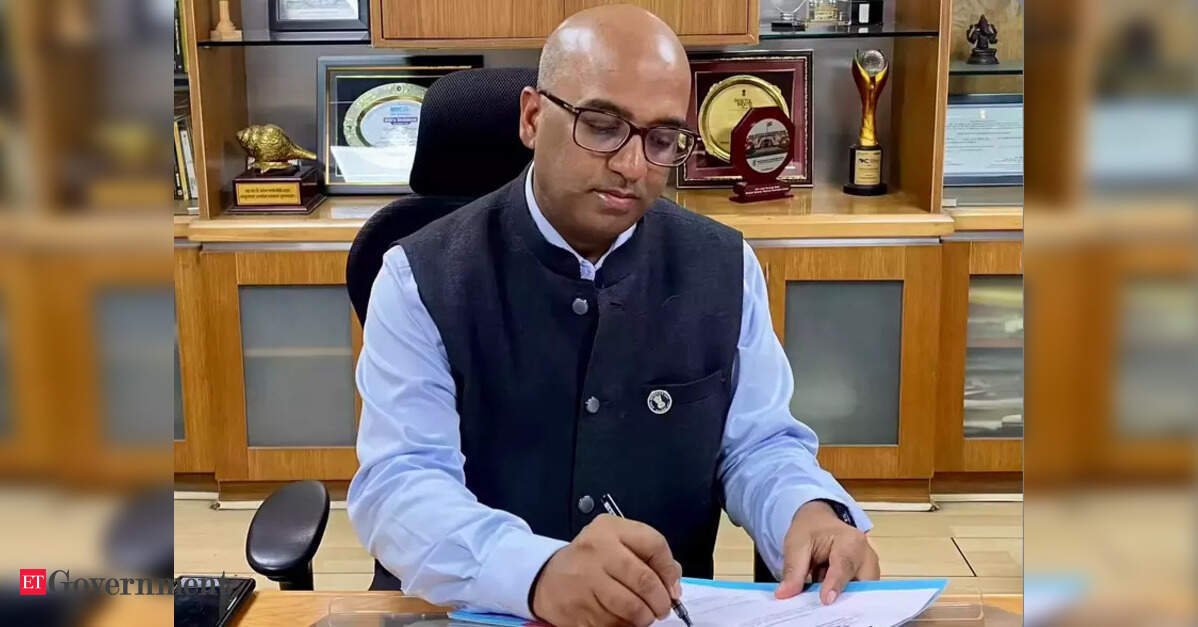
In an exclusive conversation with Arpit Gupta of ETGovernment, Abhishek Singh, CEO of the IndiaAI Mission, Director General of NIC, and Additional Secretary at MeitY, outlines how Uttar Pradesh is emerging as a proving ground for scalable AI solutions, the role of state-led investment in democratising AI, and why responsible, inclusive deployment will determine India’s position in the global AI economy.
Edited excerpts:
You are in Lucknow for a pre event ahead of the India AI Impact Summit. How does this visit fit into India’s broader AI roadmap?
The Government of India is hosting the India AI Impact Summit in February 2026, and the Honourable Prime Minister has clearly articulated that India’s AI strategy must be shaped by inputs from across the country, not just a few metros. That is why we are conducting regional AI Impact Summits in every state, and particularly in large states like Uttar Pradesh. UP is unique — it is almost a laboratory in itself. Any AI solution that is developed, deployed, and scaled successfully in UP can work anywhere in India and, in fact, anywhere in the world. The insights we gather from these regional summits will directly feed into the agenda and structure of the national summit in Delhi.Healthcare appears to be a key focus at the Lucknow summit. Why is AI especially critical in this sector?
Healthcare is one of the areas where AI can create immediate, large-scale societal impact. At this conference, we are discussing AI applications for disease diagnosis, early screening, voice-enabled healthcare services, extending care to underserved populations, drug discovery, and medical research. When you collaborate with a state like Uttar Pradesh — with its population scale and diversity — AI solutions are tested under real-world conditions. That is why the discussions and learnings from this summit will strongly shape the healthcare tracks at the main AI Impact Summit in Delhi.Uttar Pradesh has announced a State AI Mission with an allocation of around ₹2,000 crore. How significant is this move?
This is a very significant and forward-looking step. While many people today are familiar with global generative AI tools, what India is doing — through the IndiaAI Mission — is building Indian foundation models and India-specific AI solutions. Several Indian companies are developing models and applications, but the real challenge begins after development — deployment at scale. For AI to actually reach farmers, rural citizens, students, and patients, state governments must invest in deployment. The commitment made by the Government of Uttar Pradesh provides exactly that support, and it will play a critical role in democratising AI and taking it to the grassroots.
With scale also comes responsibility. How is the government approaching ethical and responsible AI?
Responsible AI is fundamental. AI is a dual-use technology — it can be used for tremendous good, but it can also be misused. India has put in place AI governance guidelines, legal frameworks, and regulatory guardrails to prevent misuse. Whenever there are instances of harmful or unethical use — such as generating obscene or harmful content — swift action is taken. Our approach is clear: encourage innovation, but with strong safeguards to protect citizens and society.
How prepared is India to harness AI talent, especially among the youth?
The potential is enormous. The data economy and AI economy will generate a massive number of jobs in the coming years, and individuals with AI skills will have a clear advantage. On January 8, we launched a four-and-a-half-hour foundational AI course for youth across the country. Today being National Youth Day, we are actively encouraging maximum participation so that young Indians acquire baseline AI skills that will prepare them for future opportunities.
How are you ensuring that AI skilling reaches rural areas and smaller cities?
This effort is not limited to English-speaking urban youth. The AI course is available in all Indian languages. Beyond that, we are setting up data labs in ITIs and polytechnics to train youth as data analysts, data scientists, and data annotators. In total, 600 data labs are being established nationwide, with around 40 labs in Uttar Pradesh alone. These institutions are being modernised with quality systems and trained resource persons, ensuring that youth from tier-two, tier-three cities and rural areas can participate meaningfully in the AI economy. We are also supporting startups in these regions. In UP, three Centres of Excellence (CoEs) have already been sanctioned, providing funding and incubation support.
Lucknow has been announced as an AI city. What role will the IndiaAI Mission play in this?
We will provide end-to-end support — whether it is access to compute, datasets, AI models, or specific use cases. For example, one AI application we are developing in Delhi uses real-time traffic data to dynamically adjust traffic signals — longer green lights where congestion exists, shorter cycles where traffic is light. Similar AI-driven urban solutions can be deployed in Lucknow. There are also AI-based systems for traffic management, DigiYatra, and municipal services. With these use cases, Lucknow can become a model AI-enabled city, whose solutions can be replicated across India.
India’s AI vision is about scale, inclusion, and real-world impact. Our goal is to ensure that AI does not remain limited to a few countries, a few cities, or a few companies. It must reach every state, every sector, and every citizen. Uttar Pradesh, with its ambition and scale, has a pivotal role to play in that journey.