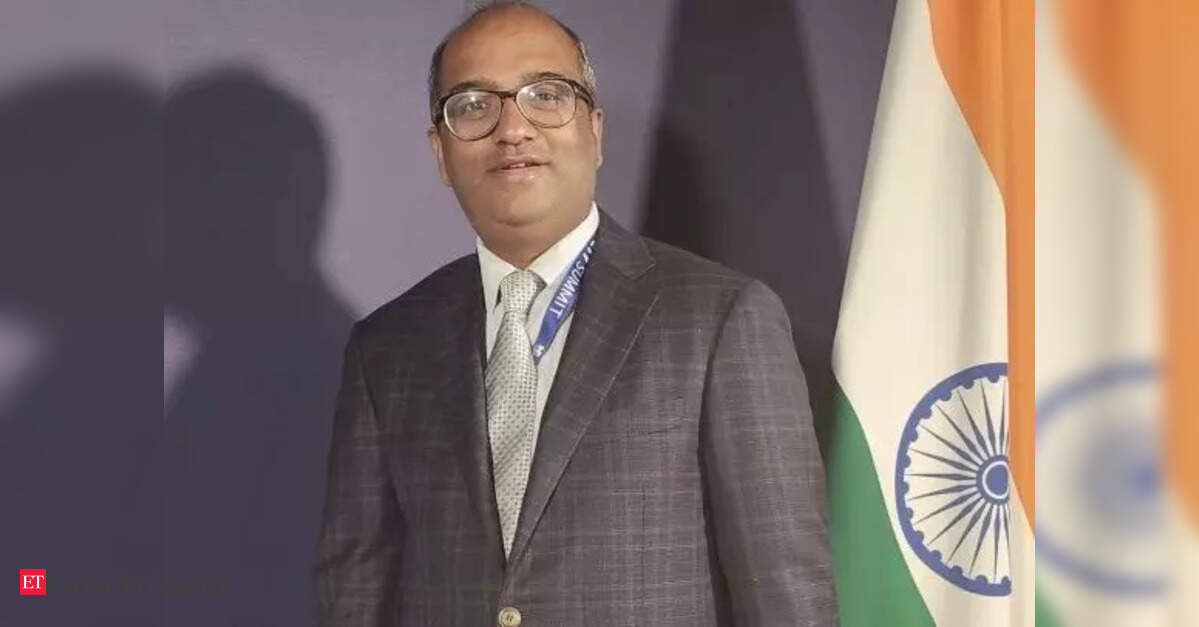
As India accelerates its journey toward becoming a global powerhouse in artificial intelligence, the IndiaAI Mission stands at the forefront of democratizing technology and fostering responsible innovation. Spearheading this ambitious national agenda is Abhishek Singh, Additional Secretary at the Ministry of Electronics and Information Technology (MeitY) and CEO of the IndiaAI Mission.
In this exclusive conversation with Sudhanshu Mishra, conducted on the sidelines of the Madhya Pradesh Regional AI Impact Conference 2026 in Bhopal, Singh discusses how the state is emerging as a critical hub in the national AI roadmap. From the establishment of specialized data labs in polytechnics to the deployment of AI in large-scale events like the Kumbh Mela, he outlines the strategic collaboration between the central and state governments.
Singh provides deep insights into the mission’s efforts to provide subsidized compute power, scale up AI skilling for millions of students and officials, and implement ethical governance frameworks to ensure that India’s AI future remains both innovative and inclusive.
Edited Excerpts:
How does Madhya Pradesh fit into India’s national AI roadmap?
Madhya Pradesh has been a pioneering state in adopting technology for improving governance and service delivery. The state has a vibrant startup ecosystem, particularly in Indore, with startups working closely with institutions such as IIT Indore and IIM Indore to develop AI-based applications.
Several of these solutions are being showcased here—ranging from AI-driven GIS platforms to applications addressing malnutrition, farmer services and healthcare delivery. This demonstrates the strong potential the state has in deploying AI at scale.
With upcoming large-scale events such as the Kumbh Mela, Madhya Pradesh also presents opportunities to deploy advanced AI use cases, similar to those implemented during the Prayagraj Mahakumbh. Beyond events, AI can play a transformative role in agriculture, education, healthcare and digital government services.
Can Madhya Pradesh become a pilot state for the IndiaAI Mission or AI sandboxes?
We are already working very closely with the state. Data labs are being set up, and Centres of Excellence are being established to support startups in incubation, solution development and scaling.
Two Centres of Excellence are coming up in the state, and data labs are being set up in polytechnics. These labs will help train youth in tier-2 and tier-3 cities as data scientists, data analysts and data annotators, enabling job creation in smaller cities.
Under the IndiaAI Mission, access to compute, datasets and algorithms is being enabled. Madhya Pradesh will benefit from national programs while also developing solutions that can be replicated across other states.
Will IndiaAI provide shared compute, funding or training support to the state and is large-scale AI training planned for government officials?
This support is already being provided. The compute infrastructure under IndiaAI is accessible to state government departments, startups, industry and researchers at a highly subsidised rate—around ₹65 per GPU per hour.
We are working with both central and state governments on large-scale AI training. The iGOT Karmayogi platform currently offers around 20 AI courses, five of which are mandatory for government employees. Additionally, under the nationwide “Yuva AI” initiative, we aim to train over 10 lakh students in the basics of artificial intelligence. Skilling government officials and youth is a top priority for the Government of India.
What ethical guidelines are being put in place for AI use in governance?
India has released AI governance guidelines focused on the responsible use of AI. These are based on principles of accountability, explainability, understandability and trust. We encourage innovation, but any AI usage that causes harm—such as deepfakes—is something we intend to restrict. That is why we have introduced guidelines for labelling AI-generated content. This balanced approach allows innovation while protecting citizens.