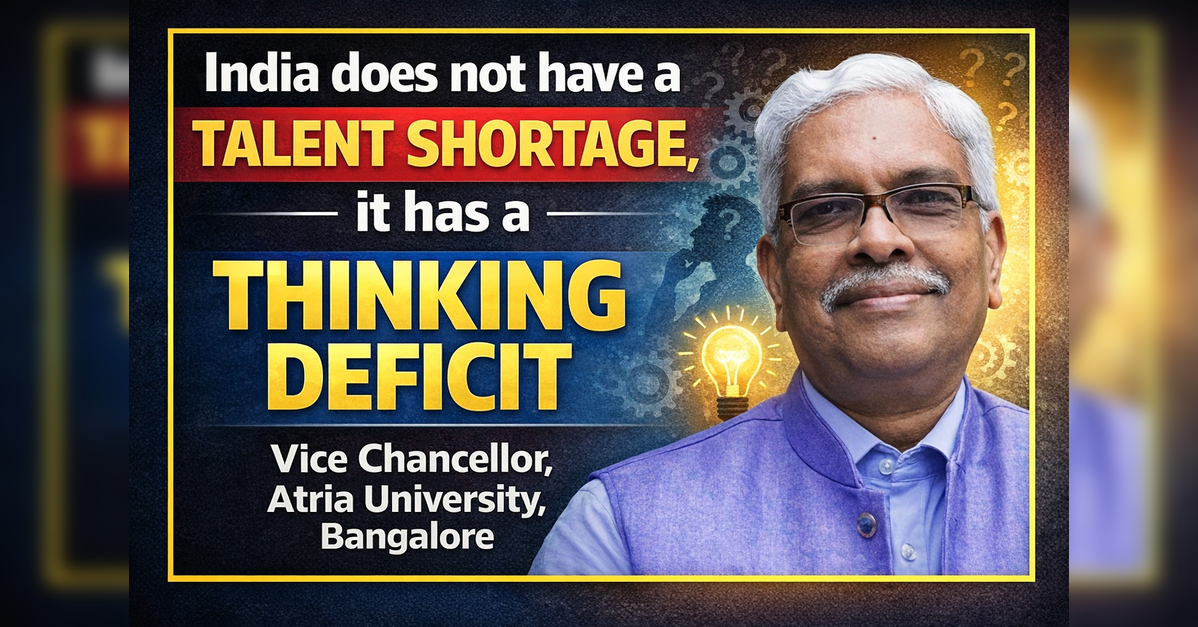
At a time when India produces more than 1.5 million engineering graduates every year, employers continue to report a persistent gap between academic credentials and real-world capability. According to multiple industry surveys, fewer than half of Indian graduates are considered job-ready, not due to a lack of intelligence, but because of limited exposure to interdisciplinary thinking, applied problem-solving and systems-level understanding. As artificial intelligence, climate volatility and geopolitical uncertainty reshape the contours of work and policy alike, the question confronting higher education is no longer about scale alone—but about relevance, rigour and responsibility.Globally, universities are being called upon to move beyond syllabus-driven instruction towards mission-driven education—where learning is closely aligned with societal challenges such as climate resilience, sustainability, public health, energy security and technological transformation. For India, a country navigating rapid development alongside environmental and demographic pressures, this shift is particularly urgent. The traditional model of education—largely exam-centric, siloed and detached from real-world application—has struggled to keep pace with the demands of an increasingly complex and interconnected world.It is against this backdrop that Dr Madhavan Nair Rajeevan, Vice Chancellor, Atria University, Bangalore, brings a rare and deeply informed perspective. With nearly four decades of leadership across institutions such as ISRO, his transition from policymaking to academia reflects a growing recognition that the future of India’s innovation capacity depends not only on research output, but on how universities train students to think, question and act in uncertain, real-world environments.
In this conversation with ETEducation, Dr Rajeevan shares why India needs a fundamentally new approach to higher education, one that integrates scientific rigour with interdisciplinary learning, embeds societal relevance into research, and uses technologies like AI as tools to deepen understanding rather than replace it. From reimagining curricula and research incentives to addressing sustainability as an engineering, economic and policy challenge, his insights offer a compelling blueprint for how Indian universities can evolve from degree-granting institutions into engines of long-term national capability. Here is the edited excerpt:
1. After nearly four decades across IMD, ISRO, and the Ministry of Earth Sciences—institutions that directly influence national policy—what gaps did you observe that convinced you India needed a new kind of university like Atria?
During nearly four decades of work, I became aware of serious gaps in our conventional education system. Much of higher education remains exam-centric, with students trained primarily to master a static syllabus, clear examinations, and secure a job. They graduate without understanding how the theories they learn apply in real-world contexts.
More critically, students are seldom trained to think independently, question assumptions, or cultivate the ability to learn continuously. In today’s rapidly changing scientific and technological landscape, this is a fundamental limitation. A science graduate should be able to adapt quickly to entirely new environments, contribute meaningfully to research and product development, and approach unfamiliar problems with confidence—without resorting to the refrain, “this was not in my syllabus.”
These persistent gaps convinced me of the need for a new kind of university—one that emphasises interdisciplinary learning, critical thinking, real-world problem solving, and lifelong learning—values that lie at the core of Atria University.
2. India often struggles to bridge the gap between research papers and deployable solutions. How can structurally rethinking incentives, timelines, and evaluation to close this gap?
This is a critically important issue. India continues to face a significant gap between research publications and deployable solutions largely because much of our research ecosystem is oriented towards producing papers rather than solving problems. Research is often undertaken for its own sake, with limited emphasis on real-world impact.
We place disproportionate weight on the quantity of publications and on statistical metrics such as the h-index and citation counts. They are poor proxies for societal relevance or practical usefulness. What matters far more is whether research helps address a real societal challenge, informs policy, or can be developed into a viable product or tool.
Closing this gap requires a structural rethinking of incentives, timelines, and evaluation frameworks. Funding agencies should prioritise mission-driven research with clear societal implications and longer, more realistic timelines for translation and deployment. Equally important, recruitment, promotions, and awards must move beyond narrow bibliometric measures and explicitly recognise research that demonstrates impact, usability, and scalability.
3. In a country where scale is everything, how do you ensure that innovations emerging from a university environment remain practical, affordable, and scalable beyond the campus?
This is a good point. In a country like India, scale has to be built into innovation from the very beginning. Universities must design solutions with real-world constraints in mind. To achieve this, innovation must be deeply anchored in field realities. Faculty and students should ensure that the problems are clearly defined and solutions are co-created with end users. Early field trials, pilot deployments, and iterative feedback loops are essential. Equally important is creating enabling pathways beyond the campus. This includes strong technology-transfer mechanisms and support for entrepreneurship and policy linkages that allow successful pilots to be adopted at scale through public systems. Universities should measure success not just by patents or publications, but by adoption, impact, and sustained use.
4. You have spent your career translating complex climate science into actionable public policy. How does that experience shape the way you think about curriculum design and research priorities of higher education in India?
We live in a fast-changing world marked by accelerating climate and environmental change, geopolitical uncertainties, population pressures, and rapidly evolving lifestyles. Together, these forces are creating complex societal challenges—some of which may even threaten our long-term sustainability.
Throughout my career, I have consistently emphasised that scientific research must ultimately serve society. Translating climate science into public policy taught me that knowledge has the greatest value when it informs decisions, reduces risk, and improves people’s lives. This perspective strongly shapes how I think about curriculum design and research priorities in higher education.
Academic curricula and research must be consciously aligned with the real problems we confront in everyday life—climate change impacts, public health, drinking water availability, food and energy security, and national security, among others. While basic research remains essential, a greater share of our intellectual effort should be directed towards solving large, mission-driven societal challenges that are critical to India’s future.
5. AI is increasingly layered onto existing disciplines, sometimes superficially. How do you think, we can avoid “AI-washing” and ensure that artificial intelligence meaningfully strengthens core sciences rather than replacing scientific rigour?
The risk of “AI-washing” arises when artificial intelligence is treated as a label or add-on rather than as a rigorous scientific tool. To avoid this, AI must be grounded firmly in domain knowledge. Strong foundations in mathematics, statistics, physics, biology, and the social sciences are non-negotiable. AI should complement these disciplines, not substitute for them. Meaningful use of AI begins with well-posed scientific questions.
Universities also need to rethink training and evaluation. Students should be taught when and why to use AI, not just how. Research must be assessed on scientific insight, robustness, and reproducibility—not on the mere presence of AI techniques. Interdisciplinary teams, where domain experts and AI specialists work together, are essential to maintain rigour.
Ultimately, AI should be viewed as a powerful accelerator of scientific discovery—helping us ask better questions, analyse complex systems, and scale insights—while the core principles of scientific reasoning, and validation remain firmly in human hands.
6. Weather, climate, agriculture, energy—these are deeply complex, system-level challenges. Where do you see AI making the most transformative difference today, and where is human scientific intuition still irreplaceable?
In complex domains such as weather, climate, agriculture, and energy, AI is already making its most transformative contributions. AI is proving highly effective in assimilating vast volumes of observational data, improving short- and medium-range weather forecasts and climate predictions, downscaling climate projections, optimising energy systems, and supporting precision agriculture through early warning and decision-support tools. These are tasks where handling high-dimensional data and exploring large solution spaces exceed human capacity.
However, human scientific intuition remains irreplaceable when it comes to framing the right questions, understanding causality, and interpreting results in physically and socially meaningful ways. Complex Earth systems are governed by non-linear processes, feedbacks, and thresholds that demand deep domain understanding. Deciding when a model is producing physically implausible outcomes and translating scientific insights into policy-relevant advice requires human judgment and experience. AI can accelerate discovery and enhance predictive skill, but it is human intuition that ensures robustness, credibility, and responsible use.
7. Sustainability is often treated as an academic theme. How can HEIs be trained to treat it as an engineering, economic, and policy challenge simultaneously?
Sustainability cannot be approached as a stand-alone academic theme; it must be treated as a real-world challenge that cuts across engineering, economics, and public policy. Higher education institutions need to redesign curricula and research structures to reflect this reality.
Sustainability problems should be framed as mission-driven challenges—clean energy transitions, water security, resilient cities, sustainable agriculture—where technical feasibility, economic viability, and policy implementation are addressed together. Engineers should be exposed to cost–benefit analysis, regulatory frameworks, and behavioural economics, while policy and economics students should gain a working understanding of technologies and system constraints. Project-based learning anchored in real societal problems is essential to make this integration meaningful. When universities align engineering design, economic reasoning, and policy insight within a single problem-solving framework, sustainability naturally shifts from an abstract concept to a deliverable national outcome.
8. India produces a large number of STEM graduates, yet industry continues to report a talent gap. What is fundamentally broken in our higher education model that universities are still trying to fix?
The core problem is not the number of STEM graduates India produces, but the way they are educated. Our higher education model remains largely content-heavy, exam-driven, and siloed, while industry and society need graduates who can think critically, work across disciplines, and apply knowledge in uncertain, real-world settings.
Too many students graduate with theoretical knowledge but limited exposure to problem-solving, systems thinking, teamwork, or hands-on experience. Curricula are slow to adapt to technological and societal change, and assessment systems continue to reward memorisation over reasoning and creativity. In the curricula, industry engagement is often episodic rather than embedded in curriculum design.
Fixing this requires a shift from the current conventional teaching methods to the pedagogy that Atria University follows. Universities must see employability not as placement statistics, but as the ability of graduates to learn, adapt, and add value over a lifetime.