

Every year before the Union Budget is presented in Parliament, the Government of India releases an important document known as the Economic Survey. This report provides an official assessment of how the Indian economy has performed over the past year and what major challenges and opportunities lie ahead. It analyzes growth trends, inflation, government finances, banking health, infrastructure development, external trade, and employment conditions.
Economic Survey 2026
The Economic Survey 2026 was tabled in Parliament on 29 January 2026 during the Budget Session. It was prepared by the Department of Economic Affairs in the Ministry of Finance under the guidance of the Chief Economic Adviser. For aspirants preparing for IBPS, SBI PO/Clerk, RBI Grade B, NABARD, SEBI and Insurance exams, the Survey is a core current-affairs source because it contains authentic government data that is frequently asked in objective and descriptive papers.
Economic Survey 2026 Key Highlights
Before going into detailed explanations, candidates should first understand the major messages coming from this year’s survey. These numbers and themes form the backbone of most exam questions.
| Area | Major message from Economic Survey 2026 |
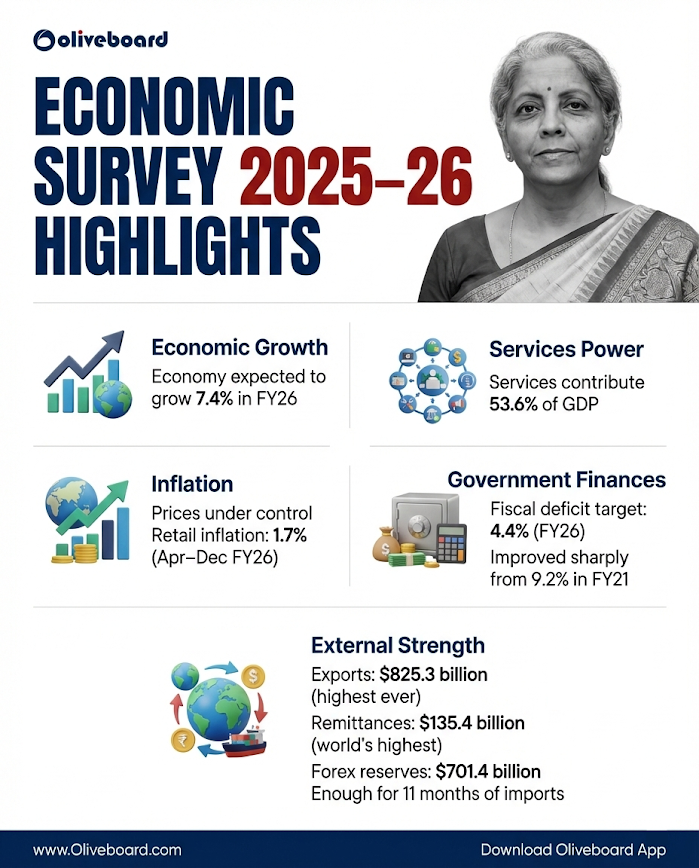
| Growth outlook | India remains one of the fastest-growing major economies; FY26 around 7.4% |
| Fiscal position | Fiscal deficit narrowed close to 4% of GDP |
| Banking sector | NPAs declined sharply; credit growth strong |
| Inflation | Moderated but closely monitored |
| Infrastructure | Public capital expenditure rising steadily |
| Manufacturing | Shift towards electronics and high-tech sectors |
| Services | Services exports continue to lead growth |
| External sector | Current account deficit manageable |
| Agriculture | Allied activities driving output |
| Employment | Poverty reduction and skilling focus |
| Emerging themes | AI, urbanization, and climate resilience |
What is the Economic Survey?
The Economic Survey is the Government of India’s annual review of the economy. Unlike the Union Budget, it does not announce new tax rates or welfare schemes. Instead, it diagnoses the condition of the economy and evaluates how various sectors have performed. It also highlights medium-term challenges and reform priorities that may influence government policy in the coming years. The survey broadly focuses on:
- Overall GDP growth and macro-economic stability
- Agriculture, industry and services
- Investment trends and infrastructure creation
- Fiscal and monetary developments
- Banking system health
- Inflation behaviour
- Trade and external sector
- Employment conditions and social indicators
- Emerging policy themes such as digitalisation and artificial intelligence
Who prepares the Economic Survey?
The Economic Survey is prepared by the Economic Division of the Department of Economic Affairs in the Ministry of Finance under the supervision of the Chief Economic Adviser. It reflects the government’s institutional assessment of macroeconomic conditions and long-term policy thinking.
Because it is drafted by the country’s top official economic advisory body, the Survey carries significant credibility and is widely used by policymakers, financial institutions, exam bodies and research organisations.
When and how is the Economic Survey presented in Parliament?
Traditionally, the Economic Survey is released one day before the Union Budget and tabled in both Houses of Parliament. It is usually published in two volumes—one containing analytical chapters and the other consisting of detailed statistical tables. The Economic Survey 2026 followed this practice and was presented on 29 January 2026, just ahead of the Union Budget for the next financial year.
What does the Economic Survey 2026 say about India’s growth outlook?
The survey notes that India continues to perform strongly even amid global economic uncertainty. Domestic demand, government-led infrastructure investment, and services exports are identified as the main growth engines. It highlights three broad drivers:
- Resilient household consumption
- Rising capital expenditure
- Strong services-sector exports
What is the position of government finances and fiscal deficit in 2026?
Fiscal consolidation is one of the most important themes of the Economic Survey 2026. The report explains that after pandemic-related stress, public finances have strengthened due to higher tax collections, better compliance, and more efficient expenditure management. According to the survey:
- The fiscal deficit has declined close to 4% of GDP
- The revenue-to-GDP ratio has improved
- The share of direct taxes has risen
- Expenditure quality has strengthened
What is the condition of the banking sector and monetary policy in 2026?
For bank exams, this section is extremely important. The survey presents a significantly stronger banking system compared to earlier years. Asset quality has improved, capital adequacy has risen, and lending activity remains robust. Key takeaways include:
- Sharp decline in gross NPAs
- Sustained double-digit credit growth
- Better capital buffers
- RBI maintaining inflation-focused monetary policy
How is India’s external sector performing according to the Survey?
The Economic Survey 2026 states that India’s external position remains comfortable despite geopolitical tensions and global slowdown concerns. Service exports—particularly IT and business services—along with remittances continue to offset merchandise trade deficits. The Survey points to:
- Stable foreign-exchange reserves
- Manageable current account deficit
- Growing services exports
What does the Survey say about inflation trends?
Inflation remains a key macroeconomic variable for policymakers and competitive-exam aspirants. The Survey explains that headline inflation has moderated compared to previous years, helped by supply-side measures and easing commodity prices. However, it also stresses close monitoring of:
- Food prices
- Weather-related risks
- Global energy markets
What are the findings on agriculture and allied sectors?
Agriculture remains central to livelihoods, and the survey highlights that growth is increasingly driven by allied activities such as livestock, dairy and fisheries. Productivity improvements, diversification and irrigation expansion remain long-term priorities.
It focuses on:
- Food-security measures
- Climate-resilient farming
- Income diversification
What does the Economic Survey 2026 say about industry, manufacturing, and infrastructure?
The survey observes that manufacturing is shifting towards higher-technology activities, especially electronics production and export-oriented industries. Industrial policy support has contributed to this structural change.
Infrastructure creation is described as a long-term growth multiplier, with emphasis on highways, railways, ports, logistics, and digital networks to attract private investment.
What is the difference between the Economic Survey and Union Budget?
Many candidates confuse the Economic Survey with the Union Budget, but they serve very different purposes in India’s fiscal system.
The Economic Survey is an analytical document. It reviews past economic performance, explains trends in growth, inflation, banking and trade, and identifies challenges that policymakers must address. It does not make financial announcements.
The Union Budget is a financial and legal statement. It sets out how much the government will spend, how it will raise money, which taxes will change and which sectors will receive priority funding.
| Aspect | Economic Survey | Union Budget |
| Nature | Analytical review | Financial plan |
| Purpose | Diagnose economy | Decide spending and taxation |
| Timing | Released before Budget | Presented after Survey |
| Announcements | No tax or scheme announcements | Taxes, subsidies, allocations |
| Legal status | Advisory | Legally binding |
| Focus | Trends and challenges | Policy action |
In simple terms:
- Economic Survey = diagnosis.
- Union Budget = treatment plan.
How should bank exam aspirants study the Economic Survey 2026?
For banking and regulatory exams, aspirants should treat the survey as an official source of statistics and trends rather than memorizing the entire document. Priority areas include:
- GDP growth projections
- Inflation movement
- Fiscal-deficit trends
- Banking-sector health
- Capital-expenditure figures
- Export and CAD data
- Agriculture and manufacturing performance
- Employment indicators
- Emerging themes like artificial intelligence
Frequently Asked Questions (FAQs) on Economic Survey 2026
1. What is the Economic Survey 2026?
The Economic Survey 2026 is the Government of India’s annual report that reviews the country’s economic performance, growth trends, inflation, fiscal position, banking sector and future challenges.
2. When was the Economic Survey 2026 released?
The Economic Survey 2026 was released and tabled in Parliament on 29 January 2026, one day before the presentation of the Union Budget.
3. Who prepares the Economic Survey in India?
The Economic Survey is prepared by the Department of Economic Affairs in the Ministry of Finance under the guidance of the Chief Economic Adviser (CEA).
4. Why is the Economic Survey important for bank exams?
The Economic Survey is important for bank exams because it provides official data on GDP growth, inflation, fiscal deficit, banking-sector health, exports and government finances—topics frequently asked in IBPS, SBI and RBI exams.
5. What are the key highlights of Economic Survey 2026?
Major highlights include strong GDP growth outlook, improved fiscal position, healthier banks, moderated inflation, rising infrastructure spending and resilient services exports.
6. Where can I download the Economic Survey 2026 PDF?
The Economic Survey 2026 PDF can be downloaded from the official India Budget website of the Ministry of Finance after its presentation in Parliament.
7. What is the structure of the Economic Survey document?
The Economic Survey is usually published in two volumes—analytical chapters explaining economic trends and a statistical appendix containing detailed data tables.
8. What is the significance of the Economic Survey before the Union Budget?
The Economic Survey provides the economic assessment that helps shape Budget priorities. It explains current conditions, challenges and reform needs before financial decisions are announced.
9. What is the difference between Economic Survey and Union Budget?
The Economic Survey analyses the economy and identifies challenges, while the Union Budget announces taxes, spending and policy measures for the coming year.
10. What is the history of the Economic Survey in India?
The Economic Survey was first presented in 1950–51 as part of the Budget documents and later became a separate report in 1964 to provide independent economic analysis.
11. Which sections of Economic Survey 2026 are most important for exams?
Important sections include GDP growth outlook, inflation trends, fiscal deficit, banking sector condition, external sector, infrastructure spending and employment indicators.
12. How should candidates revise the Economic Survey 2026 for banking exams?
Candidates should focus on headline numbers, sector-wise conclusions, fiscal and banking indicators, and emerging themes rather than memorising the entire report.

Hi, I’m Tripti, a senior content writer at Oliveboard, where I manage blog content along with community engagement across platforms like Telegram and WhatsApp. With 3+ years of experience in content and SEO optimization related to banking exams, I have led content for popular exams like SSC, banking, railways, and state exams.
