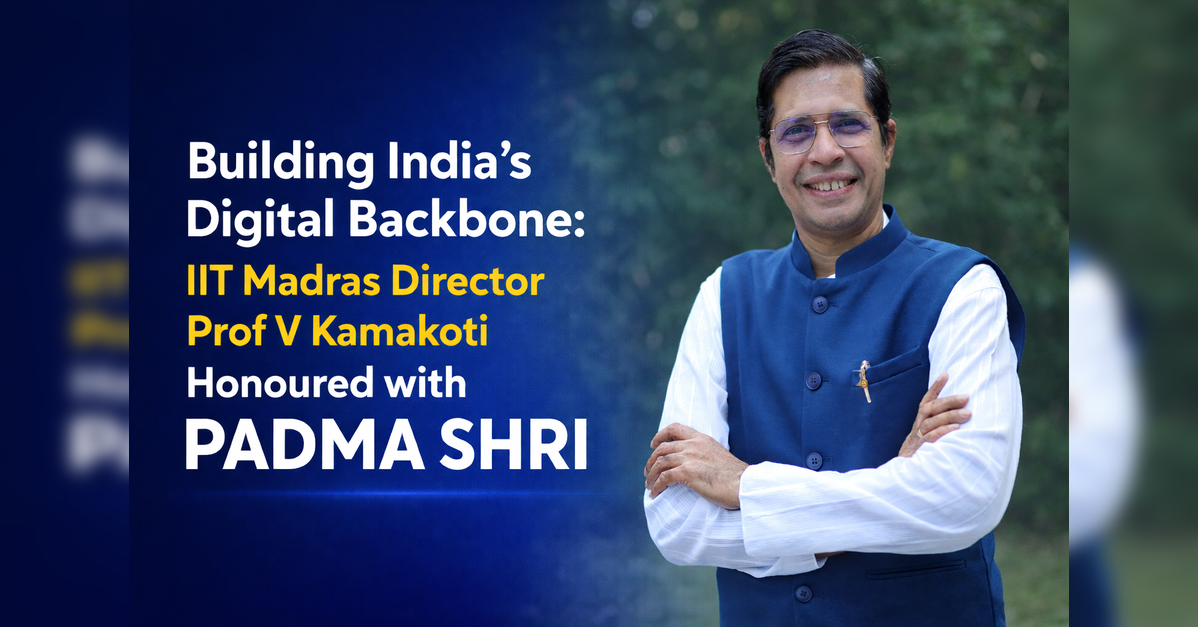
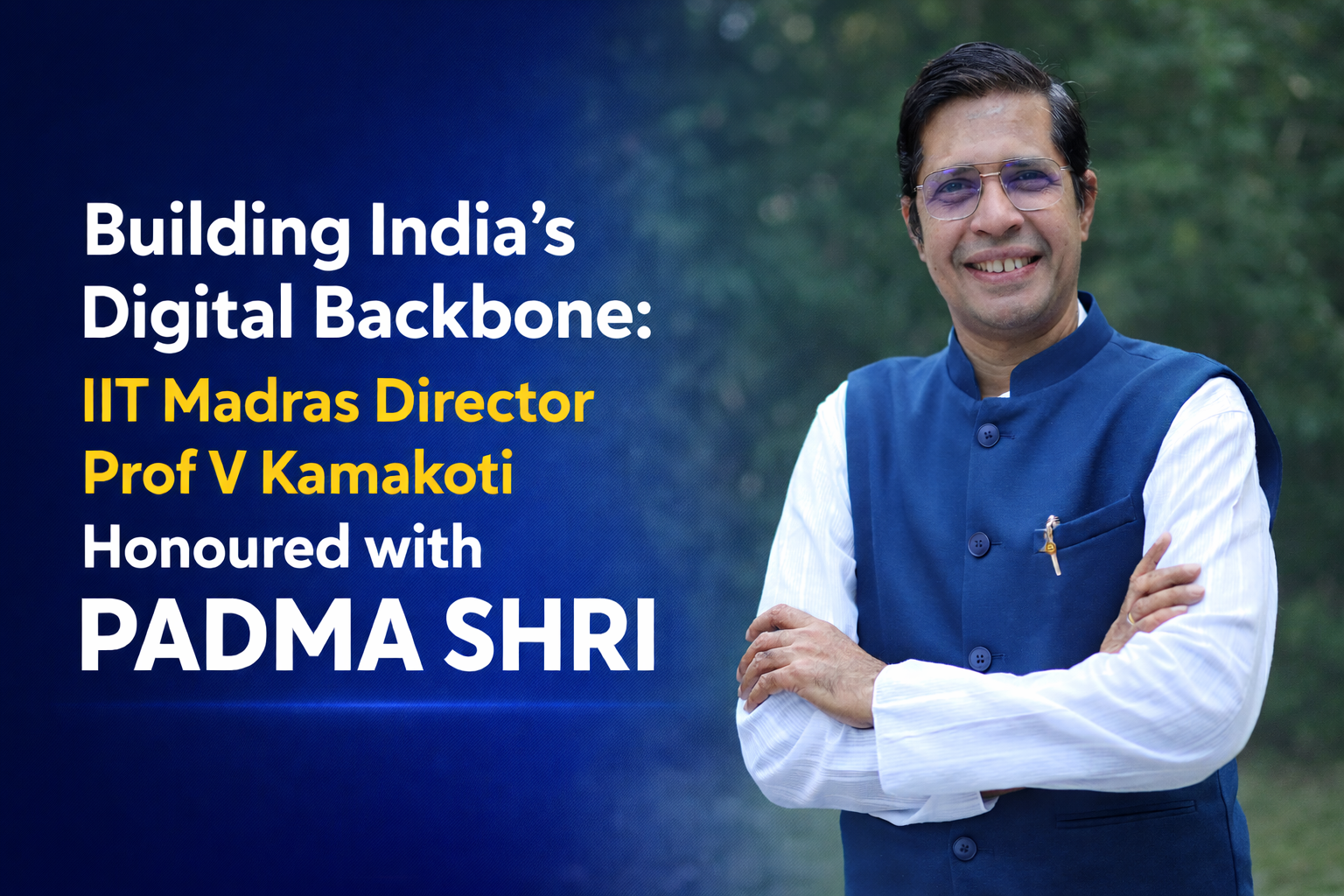
When the Government of India announced the recipients of the Padma Shri Awards 2026, the name of Prof V Kamakoti, Director of the Indian Institute of Technology Madras, stood out as a recognition not merely of individual excellence, but of a lifelong commitment to strengthening India’s scientific and technological backbone.
Awarded for his outstanding service in Science and Technology, the Padma Shri acknowledges Prof Kamakoti’s far-reaching impact as an academician, institution-builder and national thought leader, one whose work sits at the intersection of research, policy and nation-building.
From the classroom to the national stage!
An alumnus of IIT Madras, Prof Kamakoti earned his M S and Ph D in Computer Science and Engineering before joining the institute’s faculty in 2001. Over the next two decades, he emerged as a leading voice in computer architecture, information security and VLSI design, fields that are increasingly central to India’s strategic and economic ambitions.
His appointment as Director of IIT Madras in January 2022 marked a new chapter; one defined by a renewed emphasis on cutting-edge research, indigenous technology development and an ecosystem that seamlessly links academia, industry and entrepreneurship.
Under his leadership, IIT Madras has further consolidated its position as one of India’s most influential research institutions, playing a pivotal role in deep-tech innovation and startup incubation.
Driving indigenous technology and digital sovereignty
Among Prof Kamakoti’s most consequential contributions is his leadership of the Microprocessor Development Programme and the Information Security Education and Awareness Programme, both funded by the Ministry of Electronics and Information Technology. These initiatives align directly with India’s push for technological self-reliance, particularly in critical digital infrastructure.His expertise has also been sought at the highest levels of governance. He is a member of the National Security Advisory Board, has served as Chairman of the Artificial Intelligence Task Force constituted by the Ministry of Commerce and Industry, and is a member of the institute body of AIIMS Madurai. His presence on technology committees of the National Stock Exchange and the Reserve Bank of India further underlines the breadth of his influence.
A scholar with enduring impact
With over 150 publications in leading international journals and conferences, Prof Kamakoti’s academic footprint is both deep and global. He has guided numerous doctoral and postgraduate researchers and successfully coordinated nearly 50 projects with industry and government R&D establishments, bridging theory with real-world application.
At IIT Madras, his earlier roles as Chairman, JEE, and Associate Dean (Industrial Consultancy and Sponsored Research) strengthened institutional engagement with national priorities and industry-led innovation.
National recognition, shared pride
The Padma Shri list this year also included Prof Mamidala Jagadesh Kumar, former Chairman of the University Grants Commission, honoured for his contribution to literature and education, and Gambhir Singh Yonzone, a botanist and environmental scientist recognised in the ‘unsung heroes’ category for his work in the Darjeeling-Sikkim Himalayas. Together, the awards highlight the diversity of scholarship and service shaping India’s intellectual landscape.
For IIT Madras, Prof Kamakoti’s recognition is a moment of collective pride, affirming the institute’s role in advancing science that serves both national security and societal progress.
As India charts its course towards Viksit Bharat 2047, leaders like Prof V Kamakoti exemplify how rigorous scholarship, visionary leadership and public service can converge to create lasting national impact.
Leadership rooted in collective purpose
Reacting to the honour, Prof Kamakoti struck a characteristically grounded note.
“The Padma Shri Award means only one thing to me—that I will put all my best efforts towards Viksit Bharat @ 2047. Whatever I have achieved is all because of collective effort, and I dedicate this award to everyone who has been a part of this journey.”
The sentiment reflects a leadership style that emphasises collaboration over individual acclaim, an approach that has resonated strongly within the IIT Madras community. While talking to ETEducation about receiving the prestigious award, he send one very prominent and specific message — “ Be Swadeshi — to generate knowledge in India, deploy it in India, and protect intellectual property within the country.” Here is the edited excerpt from the exclusive interview with ETEducation:
1. Congratulations on being conferred the Padma Shri 2026. What does this national recognition mean to you personally at this stage of your journey?
This honour is deeply humbling. At this stage of my journey, I see the Padma Shri not as a personal achievement, but as a recognition of the work done collectively over decades. It validates a lifelong commitment to building capabilities in areas that are foundational to the nation’s technological future. I consider myself fortunate to have had the opportunity to contribute meaningfully, and I view this recognition as encouragement to continue working towards strengthening India’s self-reliance in critical technologies.
2. In your statement, you dedicated the award to collective effort. Looking back, which institutions, teams, or defining moments have most shaped this journey?
My journey has been shaped at every stage by institutions, mentors, and teams who believed in nurturing curiosity and rigorous thinking. My schooling starting from Vidya Bharati and my senior secondary education, played a crucial role in developing my interest in mathematics, which later became the foundation for my work in computer science. I remain deeply grateful to my teachers who instilled this discipline early on.
My academic years at the College of Engineering, Andhra University, and later at IIT Madras during my Master’s and PhD were defining. I had the privilege of working under outstanding faculty and engaging with theoretical problems that had strong practical relevance. That grounding shaped my approach to research.
Professionally, my work at institutions such as the Supercomputer Education and Research Centre and later exposure to parallel and distributed computing during the early days of supercomputing in India were transformative. I was fortunate to work under leaders who trusted me with responsibility at critical moments.
One of the most defining phases was working with a dedicated group of students and researchers who stayed committed to long-term goals, even when the ecosystem was still evolving. Many of them chose to continue working together for years, eventually launching a semiconductor startup at a time when such ventures were still rare in India. The successful design and fabrication of a complex microprocessor, entirely conceived and developed in India—stands out as a pivotal moment. It demonstrated that world-class semiconductor design is possible within the country and reinforced our collective belief in indigenous capability.
3. Your work spans computer architecture, information security, and VLSI design. What initially drew you to these domains, and why are they critical for India today?
What drew me to these areas was a very clear realisation: computing systems form the backbone of modern life, and without control over their design and security, true independence is not possible. When we rely entirely on imported hardware, we may know what a system is designed to do, but we cannot always be certain about what it might do beyond that.
Historical experiences, including periods of international sanctions, made it evident that technological dependence can severely limit national progress. If a country does not own its core technologies, it remains vulnerable to external pressures. This conviction motivated my focus on computer architecture, semiconductors, and information security.
These domains are even more critical today. As systems grow more complex and pervasive, ensuring trust, security, and self-reliance in computing infrastructure is essential. Indigenous capability in these areas is not optional, it is foundational to national security, economic growth, and technological sovereignty.
4. You linked the Padma Shri to Viksit Bharat @ 2047. As an academic leader, what one message would you like to share with your fellow colleagues?
My message to my academic colleagues is simple but urgent: a developed nation must develop its own technologies. Without ownership and control over technology, we will always remain dependent. As life becomes increasingly technology-driven, this dependence can create serious long-term challenges.
I urge faculty and researchers to focus on Swadeshi – to generate knowledge in India, deploy it in India, and protect intellectual property within the country. Work hard on problems that matter to the nation. Build technologies that are affordable, adaptable, and scalable for Indian needs. These are principles I share with young faculty members whenever I interact with them, and I believe they are central to achieving the vision of Viksit Bharat @ 2047.