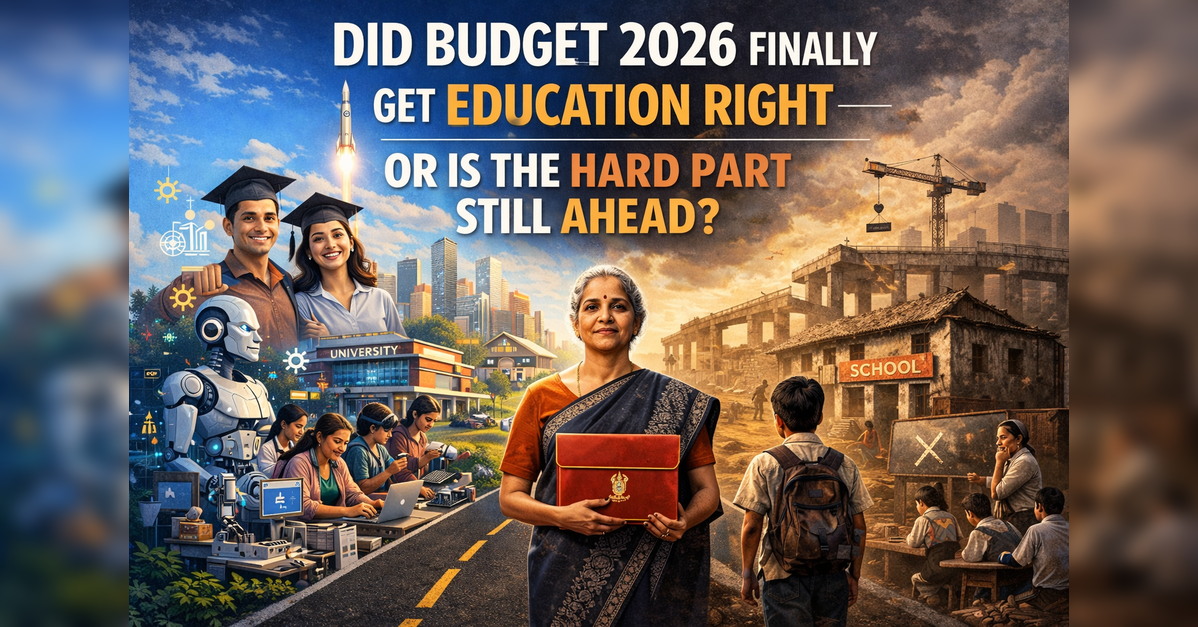
For decades, India has expanded access to education, yet one uncomfortable question has remained unanswered: what exactly are we educating for?
Degrees have multiplied, institutions have scaled, and enrolments have widened. Yet employability, industry readiness and real-world skills continue to lag behind aspiration. The disconnect between classrooms and careers has been discussed endlessly, but rarely confronted decisively.
Union Budget 2026, presented by Finance Minister Nirmala Sitharaman, appears to confront this contradiction head-on.
Education-to-Employment Linkages | AI & Future Skills | Creative Economy | University Townships | Girls’ Hostels & Inclusion
Together, these pillars form the backbone of this year’s education narrative. Instead of treating education as a standalone social sector, the Budget positions it as economic infrastructure, deeply connected to employment, enterprise, technology and creativity.
The intent is visible in the proposed Education-to-Employment and Enterprise Standing Committee, AI-driven curriculum reform, AVGC content creator labs in schools and colleges, university townships aligned with industrial corridors, and the announcement of girls’ hostels in every district, particularly to expand access to STEM education.
The message is unmistakable: learning must lead somewhere.
The larger question, however, remains open. Does this Budget genuinely bridge India’s long-standing gap between classrooms and careers, or is it another ambitious vision waiting for execution?
As voices from edtech and education leadership weigh in, a clearer and more nuanced picture begins to emerge.
EdTech leaders: Learning meets livelihoods
For edtech leaders, Budget 2026 feels like a long-awaited acknowledgement of a reality they have lived for years: education cannot be divorced from employability.
The proposal to establish a High-Powered Education-to-Employment and Enterprise Standing Committee signals a structural rethink. Suresh Kalpathi, CEO, Veranda Learning, views this as a move to bridge the traditional divide between learning and work, particularly across services and emerging technologies such as AI. He also sees AVGC content creator labs and university townships as recognition of India’s creative and industrial ambitions, provided implementation matches intent.
That youth-first framing runs consistently through the Budget. Jeel Gandhi, CEO, Under25, notes that empowering young Indians, many of whom are choosing unconventional and global career paths, sits at the heart of this year’s announcements. From Khelo India’s employment pathways to simplified tax compliance and reduced deductions on education and overseas packages, the signals reflect a changing work culture shaped by Gen Z aspirations.
The Budget also expands the definition of growth beyond engineering and IT. Alison Barrett MBE, Country Director India, British Council, highlights how education, skills and the creative economy are being woven together, with women in STEM, youth in technology, research and the Orange Economy gaining prominence. Creativity, she observes, is no longer peripheral to India’s growth story but increasingly central to it.
For mass learning platforms, employability remains the defining lens. Prateek Maheshwari, Co-Founder, PhysicsWallah, describes Budget 2026 as a clear signal that education must lead to jobs. From AI integration in curricula to AVGC labs in schools and colleges, the emphasis marks a shift away from rote learning towards skill-based outcomes. While welcoming the reduced TCS on overseas education, he also flags affordability within India as the next critical policy challenge.
Technology providers see this as the moment infrastructure finally begins to align with ambition. Muneer Ahmad Khan, Managing Director, ViewSonic India, points to sustained capital expenditure, domestic manufacturing and semiconductor momentum as foundations for future-ready campuses and digitally immersive classrooms where education, industry and technology converge.
Yet optimism is tempered with realism. Vinay Kumar Swamy, Country Head, Pearson India, stresses that curriculum reform, credentials and funding must translate into measurable, industry-relevant skills. Without strong execution, he cautions, intent risks remaining aspirational.
Skilling-focused institutions see this as one of the Budget’s clearest pivots. Pravesh Dudani, Founder and Chancellor, Medhavi Skills University, says Union Budget 2026 places skilling at the core of India’s growth agenda, recognising that infrastructure alone cannot deliver inclusive growth without employable skills. He points to a shift from building campuses to building outcomes through NSQF-aligned education, allied health disciplines and para-professional pathways, with healthcare skilling receiving a major boost. Dudani adds that embedding skills within mainstream higher education, backed by skill universities and public private partnerships, is critical to translating policy intent into livelihoods.
From an AI-first perspective, Ramana Prasad, Founder and Chairman, Meritus AI, describes the Budget as a decisive shift from education as qualification to education as capability. University townships, creative labs, AI and STEM focus, and teacher empowerment together point to a vision of India as a global talent and innovation hub.
School-focused edtech voices echo this sentiment while emphasising inclusion. Vinod Sharma, COO, Ryan Edunation, highlights creativity labs, AI-enabled personalised learning, reduced TCS and girls’ hostels as reinforcing a learner-centric approach. Ambrish Sinha, CEO, UNext Learning, sees particular promise in extending AI-led skilling and professional training to Tier II and Tier III cities, strengthening the education-to-employment pipeline nationwide.
Education leaders: Applause, appraisal and unease
While higher education and skilling find strong footing in the Budget, school education emerges as a key point of concern.
Dr Rahul Mehra, National Representative of India, UNESCO Chair for Global Health and Education, offers a stark assessment. Despite NEP 2020’s recommendation of allocating 6 percent of GDP to school education, the sector remains underfunded. Learning outcomes, health education and teacher development continue to receive limited attention, raising concerns that foundational education may be overshadowed by employability narratives.
In contrast, university leaders largely welcome the long-term vision. Dr Ramakrishnan Raman, Vice-Chancellor, Symbiosis International University, views the Budget as a holistic roadmap that blends research, healthcare, university townships and Indian Knowledge Systems. Prof Dilip Kumar Patnaik, Vice Chancellor, Medicaps University, adds that digital infrastructure, innovation and industry-aligned learning can help institutions move beyond traditional teaching models.
From an employability lens, Vipanchi Handa, Co-founder and CPO, Novatr, underscores the growing importance of modular credentials and continuous upskilling as automation reshapes roles. Praneet Mungali, Trustee, Sanskriti Group of Schools, highlights investments in AI Centres of Excellence, AVGC labs, connectivity and flagship schemes, while reminding that learning outcomes and teacher readiness will ultimately define success.
School leaders strike a note of caution on implementation. Preethi Rajeev Nair, Principal, Lancers Army Schools, argues that faculty upskilling and responsible use of technology must take precedence over hardware-heavy rollouts. Shishir Jaipuria, Chairman, Jaipuria Group of Educational Institutions, frames the Budget as a shift from education as an end to education as an enabler, spanning STEM, sports, science, inclusivity and inquiry. Kunal Vasudeva, Managing Director and Co-Founder, Indian School of Hospitality, concludes that education is now being treated as national infrastructure, but scale, standards and teacher capability will determine its real impact.
The road ahead: Vision is clear. Execution will decide the verdict
Budget 2026 sets the direction unmistakably. India’s future will be built as much in classrooms as in factories, labs and studios. By aligning education with employment, creativity with commerce, and learning with livelihoods, the government has articulated a bold and necessary vision.
The hardest work, however, begins now.
Execution across states, institutions and classrooms will determine whether AI-led curricula empower teachers, whether creative labs become genuine skill incubators rather than symbolic infrastructure, and whether education-to-employment pathways deliver outcomes for students across urban and rural India.
If intent meets implementation, Budget 2026 could mark the moment education stopped being viewed as expenditure and started being treated as economic strategy. If not, it risks becoming another well-articulated promise in India’s long policy history.
For now, the signal is clear. The country has chosen education as its engine of growth. The question is no longer what should be done, but how fast and how well India can deliver.