The third day of the India AI Impact Summit 2026 signaled a structural shift in India’s artificial intelligence strategy—from high-level vision to deployable national infrastructure. At Bharat Mandapam in New Delhi, the agenda moved decisively across three axes: governance frameworks, frontier research, and population-scale digital implementation.
The day began with the presentation of outcomes from seven thematic working groups structured around Human Capital, Inclusion for Social Empowerment, Safe and Trusted AI, Resilience, Innovation and Efficiency, Science, Democratizing AI Resources, and AI for Economic Development and Social Good.
Developed through months of multi-stakeholder consultations, these frameworks seek to translate broad AI principles into implementable standards and institutional pathways. Anchored in the guiding principles of People, Planet and Progress, the effort reflects India’s attempt to embed ethical architecture into technological acceleration.
Ashwini Vaishnaw positioned India’s AI journey around practical deployment rather than speculative milestones. Interacting with innovators at the Summit’s Expo, he noted a palpable optimism among young technologists, but emphasized that optimism must convert into real-world outcomes.
India’s strategic focus, he said, is on “AI at the edge”—systems that improve enterprise productivity and address population-scale challenges in healthcare, agriculture and climate resilience. He urged global leaders to move beyond abstract discussions and offer concrete ideas to make AI safe and socially beneficial.
S. Krishnan, Secretary, Ministry of Electronics and Information Technology, described the moment as one of cautious optimism. AI’s transformative capacity is evident, but governance, standards and inclusive participation must evolve at comparable speed. Ensuring that emerging economies shape global AI norms, rather than merely consuming them, remains central to India’s diplomatic and technological positioning.
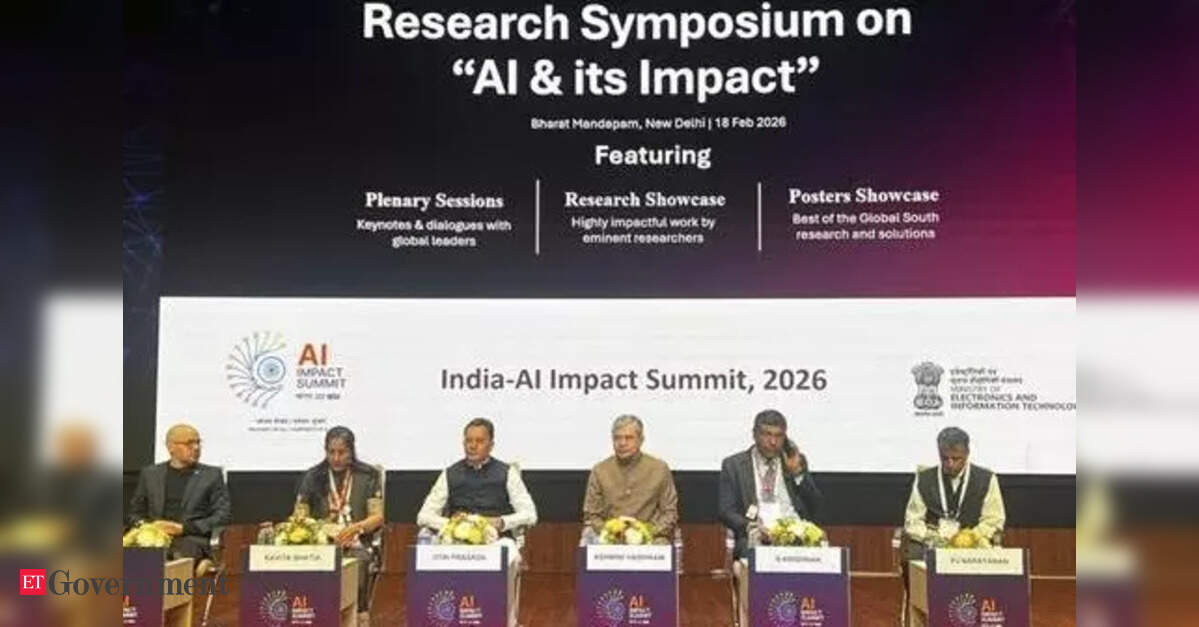
The Research Symposium on AI & Its Impact deepened the intellectual engagement. Designed to bridge frontier research and public interest, it brought together some of the most influential voices in artificial intelligence.
Demis Hassabis, Co-Founder and CEO of Google DeepMind, characterized the present as a threshold moment, with artificial general intelligence on the horizon. AI, he argued, could catalyse breakthroughs in science and medicine, yet unresolved challenges persist in continual learning, long-term planning and cross-task coherence. The appropriate posture is “cautious optimism”—pairing innovation with sustained international cooperation to manage systemic risks.
Wendy Hall, Professor of Computer Science at the University of Southampton, examined AI through the lens of governance and inclusion. AI systems, she argued, must be built “for humanity,” grounded in safety frameworks, equitable access and sovereign capability. For countries in the Global South, AI strategies must reflect linguistic diversity and local data ecosystems to ensure long-term legitimacy.
Yoshua Bengio of Université de Montréal warned that rapidly advancing AI capabilities are outpacing existing evaluation and safeguard mechanisms. Issues such as bias, sycophancy, cyber misuse and emergent self-preserving behaviours expose weaknesses in current design paradigms. He called for a fundamental redesign of AI architectures toward scientifically grounded reasoning systems with stronger alignment safeguards.
Yann LeCun, Executive Chairman of AMI Labs and Professor at New York University, challenged narratives of imminent human-level AI. Current large language models, he argued, lack deep physical understanding, persistent memory and robust planning. He proposed the development of predictive “world models” capable of simulating environmental consequences, enabling AI systems to operate within clearer safety guardrails.
While the Symposium debated the future of safe and transformative intelligence, India simultaneously advanced a concrete pillar of its Digital Public Infrastructure. The Digital India BHASHINI Division under the Digital India Corporation launched VoicERA, an open-source, end-to-end Voice AI stack deployed on the BHASHINI National Language Infrastructure.
Led by Amitabh Nag, CEO of the Digital India BHASHINI Division, in collaboration with EkStep Foundation, COSS, IIIT Bengaluru and AI4Bharat, VoicERA establishes a national execution layer for multilingual Voice and Language AI.
Architected to be open, interoperable, cloud-deployable and on-premise ready, the stack reduces duplication of effort and minimizes vendor lock-in. By modularising the voice layer, it enables secure and scalable deployment of speech systems across government departments, research institutions and innovation ecosystems.
The integration significantly expands BHASHINI’s capabilities beyond translation to real-time speech systems, conversational AI and multilingual telephony at population scale. Departments can rapidly deploy voice-enabled citizen services across agriculture advisories, education support, livelihood services, grievance redressal and scheme discovery. With BHASHINI as the national language infrastructure and VoicERA as the execution stack, voice is positioned as a natural interface for inclusive governance.
The convergence of these strands—global research dialogue, governance frameworks and deployable digital public goods—illustrates the distinctiveness of India’s AI model. Rather than pursuing frontier capability in isolation, the approach seeks to embed innovation within a population-scale infrastructure anchored in sovereignty, openness and inclusion.
As AI systems grow more powerful, the central test will not be technological capability alone, but institutional design and normative clarity. At the India AI Impact Summit 2026, the message was unambiguous: the future of artificial intelligence must be powerful yet trustworthy, innovative yet inclusive, and globally connected yet rooted in national priorities.