The conclusion of the India AI Impact Summit on 20 February 2026 marked a defining moment in India’s digital governance trajectory.
Over several days in New Delhi, policymakers, global AI pioneers, industry leaders and Global South representatives deliberated on sovereign compute, foundational models, Digital Public Infrastructure, multilingual AI, and trusted deployment frameworks. The Summit reinforced a central proposition: emerging technologies must be embedded within institutional architecture if they are to transform governance at scale.
Within days of the Summit’s close, the Ministry of Electronics & Information Technology (MeitY) initiated a complementary institutional intervention—this time in the domain of blockchain.
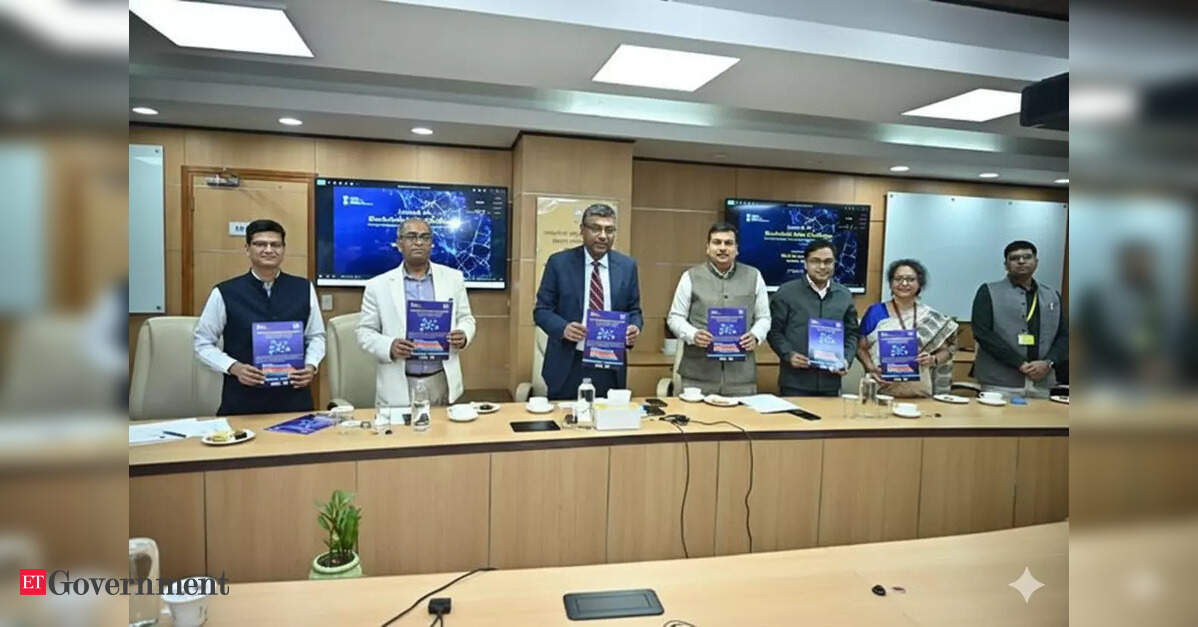
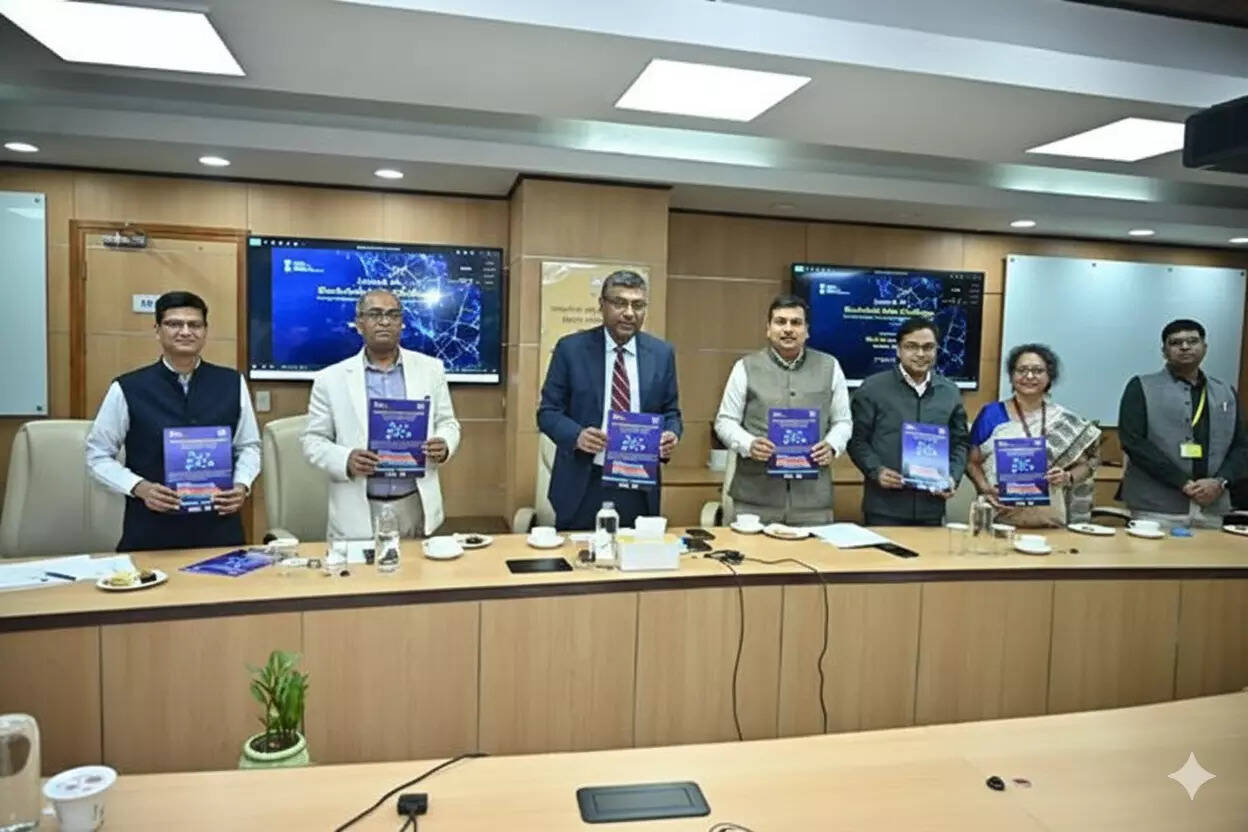
On 23 February 2026, S. Krishnan, Secretary, MeitY, launched the Blockchain India Challenge at MeitY headquarters in New Delhi. The event was attended by Abhishek Singh, Additional Secretary, MeitY; Sudeep Srivastava, Joint Secretary, MeitY; Sunita Verma, Group Coordinator, MeitY; Manoj Kumar Jain, Group Coordinator, MeitY; and P. R. Lakshmi Eswari, Scientist G and Centre Head, C-DAC Hyderabad, along with other officials of MeitY and C-DAC, representatives of government departments, and members of the startup ecosystem.
Implemented by Centre for Development of Advanced Computing (C-DAC) with MeitY’s support, the Blockchain India Challenge is designed as a national platform to encourage Indian startups to develop and pilot permissioned blockchain-based solutions for government use cases. The initiative focuses on domains such as e-procurement, supply chain management, public distribution systems, education, healthcare, agriculture, power, IoT-enabled governance, land records, and sustainability, while allowing flexibility for departments and startups to co-create additional impactful applications.
In his address, Krishnan underlined the governance logic of blockchain adoption.
“Blockchain plays an important role in Government services,” he said, noting that it enables verifiability and establishes a single source of truth across multiple data repositories. He emphasised that transparency, auditability, and tamper-proof record management are not merely technical attributes but foundational requirements for modern public administration.
He further encouraged startups to move beyond the ten identified categories and explore any use case relevant to government departments, while directing MeitY and C-DAC teams to ensure wider outreach across the startup ecosystem and to focus on developing field-ready, deployable solutions capable of national scale.
The Challenge includes a structured funding framework. DPIIT-recognised startups, working in collaboration with government departments, will receive stage-wise financial support to develop ten impactful blockchain-based use cases across ten categories. This phased model is intended to reduce innovation risk while ensuring accountability, departmental alignment, and measurable outcomes.
The strategic importance of this initiative must be viewed in the broader context of India’s digital transformation. Over the past decade, India has built one of the world’s most expansive Digital Public Infrastructure stacks—anchored in identity, payments, and document authentication systems. Blockchain introduces an additional cryptographic trust layer to this architecture.
In practical terms, permissioned blockchain systems can significantly enhance governance in India in multiple ways. In procurement, they can ensure immutable bidding records and transparent contract execution, reducing disputes and corruption risks. In land administration, blockchain-based registries can secure ownership records against tampering, addressing one of India’s most persistent sources of litigation.
In public distribution systems, distributed ledgers can improve traceability of food grains and welfare transfers, minimising leakages. In agriculture and pharmaceuticals, blockchain can strengthen supply chain traceability, improving quality control and export credibility. For IoT-enabled utilities and power systems, blockchain can ensure secure data exchange across distributed infrastructure nodes.
Unlike public, permissionless blockchains associated with cryptocurrencies, the emphasis here is on permissioned architectures that preserve regulatory oversight while enabling distributed validation. This model aligns with India’s governance philosophy: technological innovation embedded within sovereign control frameworks.
The Blockchain India Challenge, therefore, is not an isolated competition but an institutional mechanism to integrate blockchain into India’s public digital backbone. If the India AI Impact Summit articulated a vision of intelligence at scale through sovereign AI, this initiative addresses integrity at scale through cryptographic trust. Together, they reflect a calibrated strategy in which emerging technologies are not pursued as abstract innovation narratives, but as instruments of accountable, transparent, and scalable governance.
Applications for the Challenge are now open through the official C-DAC portal, with detailed guidelines on eligibility, intellectual property rights, and use-case collaboration frameworks. In the weeks following the AI Summit, MeitY’s rapid pivot to blockchain implementation signals that India’s digital statecraft is increasingly defined by execution discipline rather than policy rhetoric.