

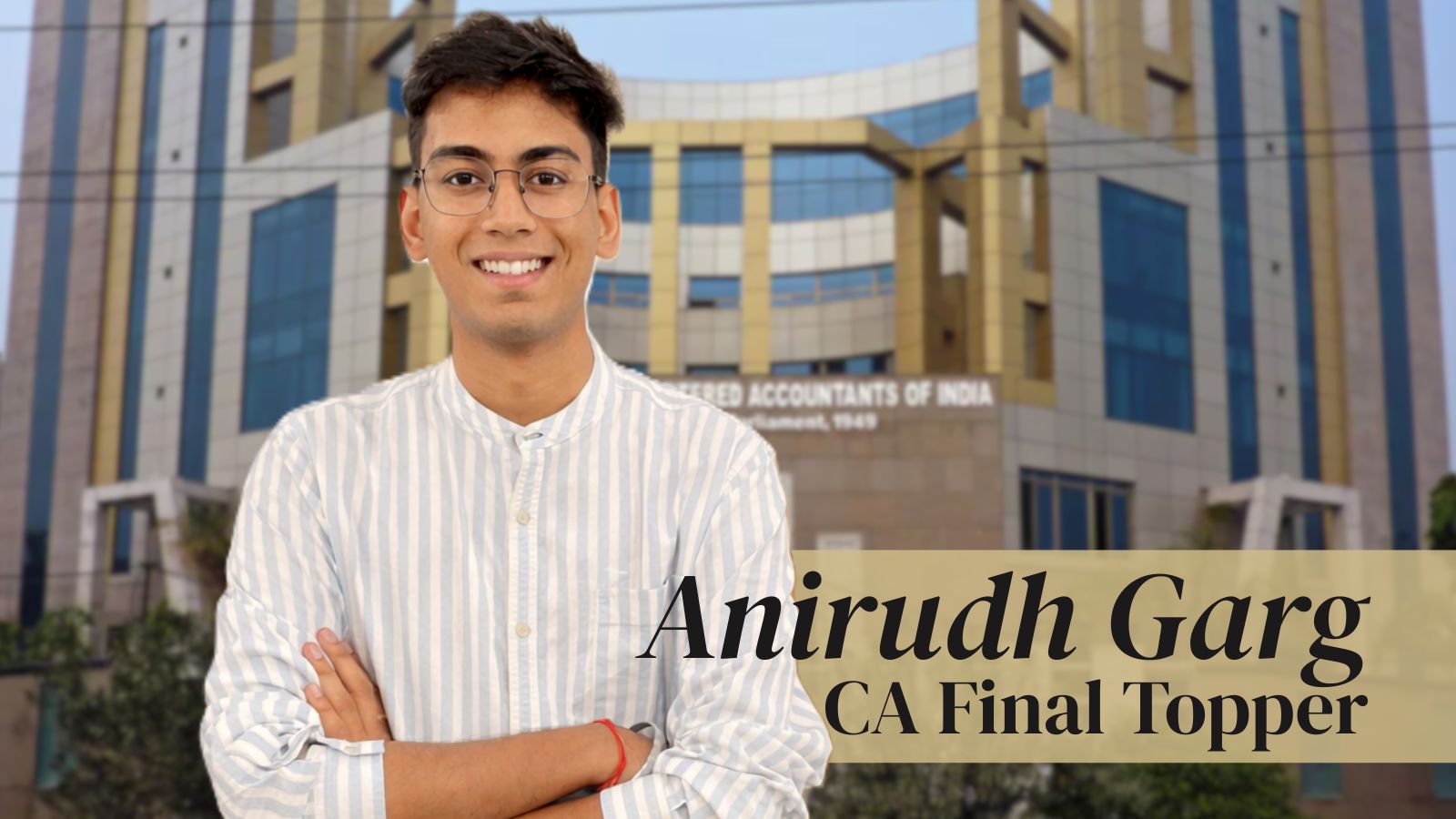
The Institute of Chartered Accountants of India (ICAI) declared the CA Final January 2026 results on Sunday. Along with 7590 candidates who became Chartered Accountants, Anirudh Garg from Himachal Pradesh secured an All India Rank (AIR) of 2 with 452 marks (75.33 per cent). However, when the ICAI result first appeared on his screen, he did not believe it.
“I refreshed the page four or five times. I thought it was a technical glitch,” he says. “I saw the marks and felt it was a good score. The papers had gone well, but the standard was higher than in September. I was honestly not expecting a rank,” he says. He was at home in Paonta Sahib for Holi when the results were announced, and his parents were sitting behind him.
It was only after a call from the ICAI President confirming his rank that it began to sink in. “I was like, it’s me only, not someone else.”
Himachal to Delhi-Gurgaon’s bustle
Anirudh’s hometown, Paonta Sahib in Himachal Pradesh’s Sirmour district, is known as a Sikh pilgrimage town. His academic journey, however, has spanned across cities.
He completed his schooling in Chandigarh, under the CBSE board in 2020, scoring 97.75 per cent. He then pursued a BCom (Hons) at Hansraj College, Delhi University, after which he began his articleship at the global accounting firm Ernst & Young.
Also read | ICAI CA Final Result January 2026: 7,590 candidates qualify, Diksha Goyal tops with 81%
Chartered Accountancy was never a general idea. “As my father is a CA, I had decided in Class 9 that I would take commerce and pursue this course,” he says.
Story continues below this ad
He cleared the CA Foundation with 320 out of 400. For Intermediate, he appeared for both groups separately as his college had just begun, and he had joined a society. He secured an aggregate of 538 out of 800.
Anirudh began his articleship in April 2023 in the Assurance division at EY Gurgaon. He started his final-level coaching in late June 2023. “The syllabus is vast. If you don’t start early, you fall behind. Being in Assurance means dealing with peak seasons, so I wanted to finish my classes before study leave,” he says.
He ensured all classes were completed before going on study leave six months before the exam.
During articleship, he aimed to complete at least one class a day. “Each class was around three hours. If I had time in the morning, I did 1.5 hours then and 1.5 in the evening. In peak season, I tried finishing it in the morning because nights get tough.”
Story continues below this ad
He tried waking up around 7 or 8 am, watched lectures at 1.5x speed, went to the office, and managed revision alongside.
Preparing for the January attempt
The January attempt came with added pressure. The CA exam is now conducted three times a year instead of two, and there was talk that January papers might be tougher. “After the first exam, I felt the standard was high. Financial Management was tougher compared to past exams. The pressure was high in all papers.”
Unlike many candidates, he did not calculate expected marks. “Once the test is over, I don’t return to the question papers. I was sure I would pass, but 452 was unexpected.”
Handling burnout and mental pressure
Anirudh says burnout was inevitable. “Six months is a big period. You feel burnt out at least once every month.”
Story continues below this ad
On such days, he reduced self-study instead of quitting completely. “I would watch lectures instead. Or pick up a subject I liked — I enjoy financial management — and solve a few questions. It gives a break but doesn’t break the flow.”
His support system played a crucial role. He maintained a small circle of two to three friends. One of them, Uday, secured AIR 36 in the same exam, and another friend, Himanshi, also cleared.
“We used to track each other’s preparation. If you feel low, you talk. A small group helps — not a big group.”
When asked if he had a plan B, he clarified that there was none. “It was clear. I had to do CA first. I might consider an MBA later, but CA had to be completed.”
Trust teachers, trust yourself
Story continues below this ad
Asked about three key principles that worked for him, Anirudh lists them around the teacher and one’s own self. “First, trust your teachers. If you don’t trust your teacher, you’ll stay inconsistent.” He chose teachers after watching demo lectures on YouTube. “You should not go only by word of mouth. What works for someone else may not work for you.”
“Second, trust yourself. In the first three months, I was not very confident. But once you build confidence, it changes everything. Third, your study material should be stable. Don’t keep switching them close to the exam. If you switch, do it at least three to four months before.”
For consistency, he avoided daily targets. “You cannot be consistent every day. So I set weekly targets. You can adjust a week. You cannot adjust a day.”
Social media, leisure, and a balancing act
During study leave, he deactivated Instagram for six months. He is not much into OTT platforms. “I’m more of a cinema person.”
Story continues below this ad
Balancing articleship and studies required planning around peak and off-seasons. “Managers were supportive. They are CAs, so they understand.”
Practical exposure helped mainly in financial reporting through the Indian Accounting Standards (Ind AS) application, though other areas like tax had limited direct overlap.
How the CA topper uses AI in preparation
Anirudh believes artificial intelligence will support, not replace, professionals. In assurance, AI can help in auditing, but it cannot replace manual checks. We should work with AI, not be frightened of it.”
He used ChatGPT during preparation. “If I had a query that felt silly to ask peers, I would ask ChatGPT. It doesn’t judge.”
Story continues below this ad
For now, he says he is still absorbing the result and would weigh his options, “The pumped-up energy is very high right now.”
