

When people ask me where I am from, the answer is never entirely straightforward. My family is originally from Thrissur in Kerala, but I grew up in Bengaluru. I also spent part of my early childhood in the United States before moving back to India, so my life, even before university, has been shaped by movement across borders, cultures, and ways of living.
That constant shifting meant I grew up learning how to adapt — how to belong in new places while carrying pieces of old ones with me. It also meant that the idea of stepping into a foreign university never felt completely unfamiliar, even if it was daunting. Long before I boarded a flight to Melbourne, my story had already been shaped by multiple worlds, each quietly preparing me for the life I would eventually build far from home.
Read More | India-Canada education push: PM Mark Carney announces 13 university pacts; McGill to set up AI centre in India
For my schooling, I studied Classes 2 to 10 at Cluny Convent High School, Malleswaram. After that, I decided to prepare for Indian competitive exams, especially the IIT-JEE, so I completed my Class 11 and 12 at BASE PU College, which is known for its exam-focused curriculum. At that stage, my life was structured, exam-oriented, and firmly rooted in the Indian education system. But somewhere along the way, I knew I wanted something different.
Why I chose to study abroad — and why Australia felt right
When I started thinking about university, I knew very early on that I wanted to study abroad. I really wanted to be in an environment where I could meet people from different cultures, hear perspectives different from mine, and challenge some of the assumptions I’d grown up with. I felt that studying overseas would give me experiences and exposure that I might not be able to get in India.
Once I decided to look abroad, the next question was where. For me, it came down to the US or Australia, mainly because I had already lived in both places at different points in my life and felt comfortable with the idea of studying there. In the end, Australia made the most sense. I had the opportunity to study at a reputable, globally recognised institution, and I had heard great things about Melbourne specifically — that it’s one of the best cities for students, with a vibrant culture and an amazing academic environment. All of that made it feel like the right choice.
Story continues below this ad
Read More | National College of Ireland announces Rs 75 lakh scholarship for Indian students
After deciding on Australia, choosing the university was the next step. I applied to a few universities in Sydney, Brisbane, and Melbourne. What really stood out to me about the University of Melbourne was the curriculum. At 18, I genuinely didn’t know exactly what I wanted to specialise in, and the University of Melbourne offered the flexibility to explore different subjects before committing. I won’t pretend rankings didn’t matter at all — the University of Melbourne being ranked one of the best in Australia helped. I also considered scholarships and the practicalities of the offers I received, and it all aligned well for me.
I eventually chose to pursue a Bachelor of Science, majoring in Computing and Software Systems — or, as I usually say, computer science. It felt like the right combination of flexibility, quality, and opportunity.
Applications, admissions, and navigating different systems
Yes, I did apply to other universities as well. Since I was initially preparing to study in India, all the major institutions like the IITs were on my priority list. For overseas options, I applied to a few universities in the United States. At that time, I was particularly interested in space sciences, so I focused on schools known for strong programmes in that area, especially universities in Arizona and Maryland.
Story continues below this ad
Beyond academics, I was also thinking about practical aspects — whether I knew anyone living in those states and whether I’d have a support system if I moved there. That played an important role in evaluating where I could realistically see myself studying and living.
Read More | International student’s guide to working in Australia after graduation
The admission processes varied significantly. In India, everything is exam-driven. The US system emphasises extracurriculars, recommendations, and detailed applications, which was new for me. Australia, in contrast, was much more straightforward, focusing mainly on academic performance.
I did choose to use a counsellor, mainly because applying to multiple countries with different procedures felt overwhelming. I went with IDP, since I’d heard they were one of the most reputable and widely used education agencies for overseas applications.
Story continues below this ad
For Australia, the key documents were my official Class 12 marksheet and an English proficiency test. I chose IELTS and made sure to take the academic version — something students often overlook. Beyond that, visa documentation came later and varied depending on individual circumstances.
Read More | ETS dismisses TOEFL, GRE sale
Scholarships and making it financially possible
Yes, I did apply for scholarships, and receiving one was a very important part of my decision-making process. One of the main reasons I chose the University of Melbourne was that their international scholarships were automatically awarded based on academic performance, with no extra application required.
Read More | From Delhi’s underprivileged communities to a global stage: Nancy’s journey to University of Melbourne
Once I submitted my official grades, the assessment happened automatically, and a couple of weeks later, I received an email confirming my scholarship. That clarity made a huge difference. I was fortunate to receive a significant scholarship that covered a substantial portion of my tuition, with the remaining costs supported by my family and me.
Story continues below this ad
Arriving in Melbourne: Cold winds and small victories
My very first day in Melbourne is something I’ll never forget. I arrived in winter, which, in hindsight, wasn’t exactly fortunate. Coming from a country close to the equator, the cold, the wind, and how early it got dark were shocking. It was only 5 pm, and I remember thinking, “Why is it pitch dark already?”
Thankfully, my friends picked me up from the airport, which made everything feel a little less overwhelming. But the reality really hit during my first week. There was so much admin to get through — phone plans, groceries, self-checkouts. One embarrassing but funny moment still stands out: on my first day at the university, I didn’t have a phone plan and couldn’t connect to the Wi-Fi. I ended up sitting in the library, visibly stressed, until a girl came up and helped me. I laugh about it now.
Socially, it took time. Slowly, faces became familiar, conversations grew easier, and a sense of belonging followed.
Learning to live independently
Groceries, accommodation, cooking — all of these became learning curves. I had never lived with a roommate before, so learning to communicate openly and set boundaries was essential. Passive aggressiveness doesn’t work in shared living; honest communication does.
Story continues below this ad
University life was also far more self-directed. No one forces attendance or reminds you of deadlines. Balancing academics with everyday life was overwhelming at first, but eventually, routines formed and things fell into place.
University, teachers, and unexpected mentorship
The learning environment at Melbourne is very much “you get out what you put in.” All the resources are there, but it’s up to you to use them.
The teachers have been one of the highlights of my time here. Tutors, often just a few years ahead, became informal mentors. Professors were deeply invested. My academic advisor, whom I met regularly for casual coffee chats, eventually invited me to join a research project. We worked together for almost a year, submitted a paper, and won an award for it. That level of support changed how I saw myself and my potential.
Student life, friendships, and belonging
What I love most about my college is the people and student life. Clubs and societies truly shape your experience. Being part of the Melbourne Uni Maths and Stats Society gave me friends for life. Our Friday game nights — sometimes lasting until 2 am — are some of my most cherished memories.
Story continues below this ad
My daily routine varied between uni and work. Volunteering became a huge part of my life. Through the Girls Programming Network, I ran Python workshops for high school girls and nonbinary students, which became deeply meaningful to me.
Read More | 30% fewer Indian students are opting to study abroad: Govt
Between classes, my friends and I wandered down Lygon Street hunting for desserts, spent hours in the Maths Building, or relaxed at Melbourne Connect. Those places became our second homes.
Working, outreach, and finding purpose
I worked part-time at a science centre, running STEM outreach programmes and using space as a hook to spark curiosity. The job took me across regional Victoria, where I saw kangaroos, wombats, and night skies full of stars for the first time. Beyond finances, the experience shaped my career and outlook.
Story continues below this ad
Studying abroad deepened my passion for STEM. I realised how awe-inducing science truly is — and how important it is to show young people, especially girls, that they belong in it. There is not one way a scientist should look or act. Everyone can belong.
Opportunities that changed everything
My university journey opened doors I never imagined:
– A research project on AI in higher education that won Best Research Paper at an international conference
– An internship at CSIRO’s Space and Astronomy division, working with major radio telescopes and observing a supernova
– Papers accepted at global conferences
– Being part of a student satellite-building program
– Leading and contributing to Women in STEM initiatives
– Participating in the Milo Mission Academy and meeting NASA professionals
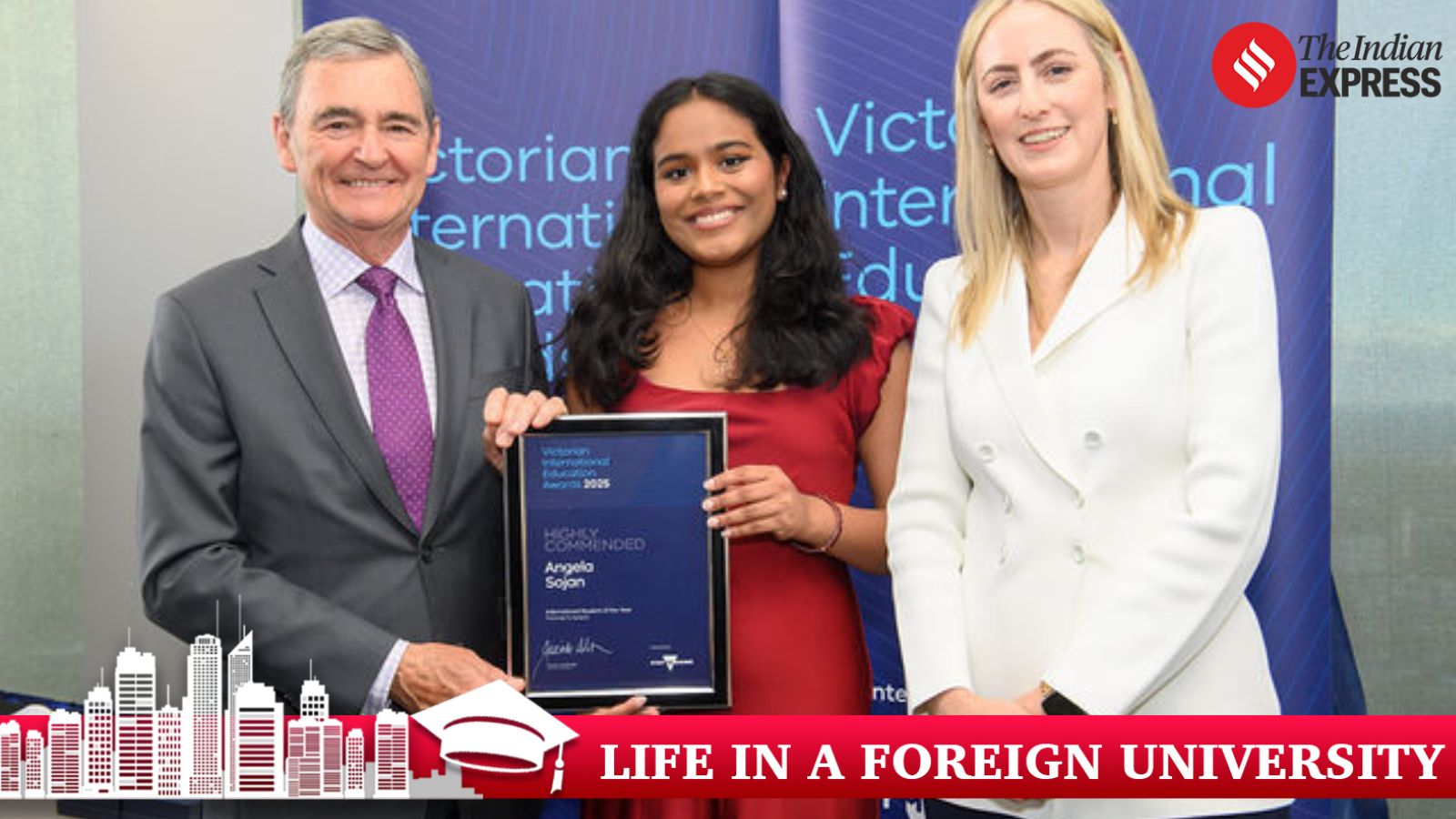
These experiences culminated in recognitions I never expected, including being named International Student of the Year (Higher Education).
Looking ahead
I am not entirely sure what my long-term plan looks like, and I am okay with that. I will be working in technology for now, exploring project management, data, and AI. I may return to India, especially given the growth of the space sector, or I may return to university for further study.
What I do know is this: studying abroad didn’t just change where I live or what I study. It changed how I see myself — and how I hope to help others see their own potential too.
(This letter is part of a series by The Indian Express where we bring to you the experiences of students at different foreign universities. From scholarships and loans to food and cultural experiences — students tell us how life is different in those countries and things they are learning other than academics)
