International Women’s Day is not merely a celebration – it is a global checkpoint. A moment that asks whether societies are truly progressing or simply applauding symbolic wins. Each year, March 8 reminds the world that gender equity is not charity; it is a matter of rights, justice, and structural reform. From classrooms to corporate boardrooms, from police academies to parliamentary chambers, women continue to confront invisible systems that quietly dictate who leads and who waits.
The conversation in 2026 is sharper, more urgent, and less patient with tokenism. Representation without power is cosmetic. Access without authority is conditional. Around the world, women enter institutions in growing numbers, yet decision-making tables remain disproportionately male. The pipeline to leadership narrows not because of lack of merit, but because of entrenched networks, cultural conditioning, and institutional inertia.
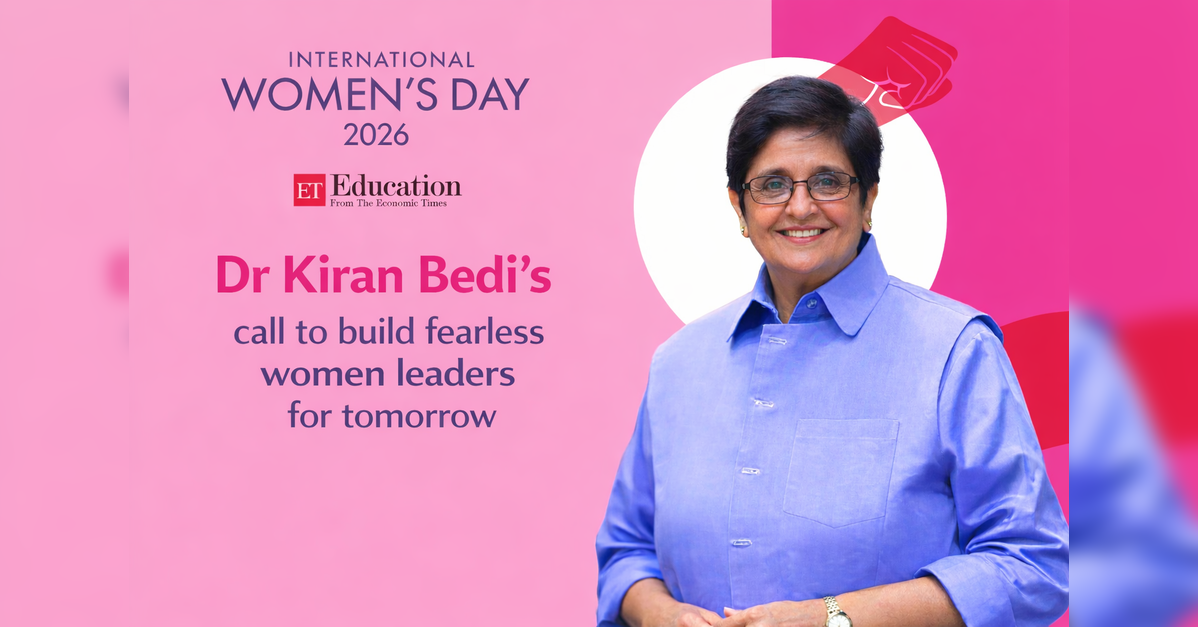
Few Indian leaders embody this confrontation with systemic resistance as powerfully as Dr Kiran Bedi – India’s first woman IPS officer, a reform-driven administrator, and former Lieutenant Governor of Puducherry. A pioneer who carved space in one of the country’s most male-dominated services, Dr Bedi’s journey is not merely personal triumph; it is a lens into the structural barriers that still shape women’s leadership trajectories.
In this exclusive conversation with ETEducation on International Women’s Day, she speaks with characteristic candour about power structures, institutional failures, and the urgent need to re-engineer leadership pathways for women.
Leadership still operates within closed power networks
Across professions and public systems, leadership ecosystems often function through invisible yet deeply entrenched networks. Influence flows through circles built over decades – determining credibility, sponsorship, and access to opportunity. While women increasingly occupy professional spaces, they are frequently excluded from these inner networks where critical decisions are shaped.
“The decision makers are still male dominated and are networked. Women are not. This is the reality across the board. Women are not in power to make the structural changes. Women neither have the muscle nor the money power nor the lung power. Unless this equation changes, women will continue to lose out.”
Her words reveal a stark truth: leadership inequality is sustained not by gaps in competence, but by unequal access to power structures.
Symbolic representation cannot replace real authority
Milestone appointments and visible representation often signal progress, but visibility alone cannot transform institutions. Leadership must carry authority – the power to influence policy, shape systems, and direct resources. Without structural backing, representation risks becoming ceremonial rather than consequential.
“Pipelines for empowered leadership of women does not exist. The will and the intention is missing. Women are lone voices even when they are the vote bank today in getting governments formed.”
Dr Bedi’s observation highlights the difference between inclusion in numbers and inclusion in influence — a gap institutions must urgently bridge.
The leadership pipeline fractures long before the workplace
Leadership inequality does not begin in offices or boardrooms. It often takes root within homes and social structures that quietly shape aspirations and mobility. Life transitions, especially marriage, frequently disrupt women’s career momentum during their most productive years, forcing compromises that men are rarely expected to make.
“Pipelines are broken from within homes itself. Women lose key support after marriage. Husbands’ support and their families is not assured. Wherever it does happen is a rare exception. Women thus become migrants in the peak of their energy lives. And start adjusting, compromising, or surrendering.”
This silent migration – across cities, roles, and ambitions – narrows leadership possibilities long before institutional policies can intervene.
Mentorship must be institutional, not accidental
Mentorship can transform careers, but informal systems often make guidance uneven and inaccessible. Women navigating high-pressure environments need structured support systems that guarantee continuity, fairness, and accountability.
“By having standard operating procedures monitored by the Boards which also need to be more representative. Presence of qualified women is still bare minimum.”
Dr Bedi advocates for mentorship frameworks embedded in governance itself — ensuring that support becomes a right, not a privilege.
Justice must include women beyond urban privilege
True gender justice must reach beyond metropolitan success stories. Women from rural, underserved, and marginalised communities face layered challenges shaped by access, resources, and social constraints. Equity cannot remain urban-centric.
“By providing better and more holistic education to boys and entrepreneurial and leadership training to girls.”
Her approach calls for transforming mindsets among boys while equipping girls with the tools for independence, enterprise, and leadership.
Leadership confidence grows through early responsibility
Leadership is not built through protection alone. It develops through challenge, exposure, and opportunities to make decisions under pressure. Early responsibility builds resilience and self-belief – essential traits for navigating authority in demanding environments.
“Position them in challenging assignments which prepares them for uncertainty. With travels and decision making early on.”
Exposure to complexity, she emphasises, prepares young women not just to participate, but to lead with confidence.
Real growth happens beyond protected spaces
Comfort zones may nurture security, but leadership requires adaptability. Experiential learning in unfamiliar environments builds courage, independence, and the ability to respond to real-world unpredictability.
“Provide more outdoor and experiential learning, beyond protected indoors.”
Dr Bedi urges education systems to cultivate strength through exposure rather than shelter.
Future leaders should not have to build alone
Pioneers often advance by creating pathways where none exist. Dr Bedi’s own journey was defined by resilience and self-made systems. But she believes future generations deserve institutional scaffolding that supports ambition rather than leaving women to navigate isolation.
“Nobody built for me. I reconstructed them as I went along. Despite the pushbacks I held on. Not waiting for approvals where they were not required.”
Her reflection captures both determination and the cost of institutional absence.
“We must groom girls and women to take bouquets and brickbats for cultivating growth mindsets.”
Leadership demands emotional strength – the courage to accept praise with humility and resistance with composure.
A moment of institutional reckoning
Dr Kiran Bedi’s reflections resonate far beyond policing or public administration. They speak to a universal institutional truth: progress for women cannot depend on exceptional individuals navigating flawed systems.
Systems themselves must evolve.
As International Women’s Day calls for “Rights. Justice. Action.”, the message is clear — leadership equity must be designed, embedded, and sustained. When institutions create genuine pathways, build accountable mentorship structures, and normalise women in positions of authority, leadership stops being a rarity.
It becomes the norm.
And that is when justice moves from promise to practice.