

Key Takeaways
- The RRB Group D Vacancy Trend reflects changes in recruitment and organisational dynamics in Indian Railways over the years.
- Major factors for vacancy fluctuations include backlog hiring, administrative delays, and shifts to more controlled recruitment processes.
- The peak in vacancies occurred around 2018-2019 due to consolidation efforts to address long-pending posts.
- Post-2019, factors like COVID-19 and budget constraints led to a reduction in vacancies and a shift in recruitment strategy.
- Aspirants should focus on long-term preparation and stay updated with official notifications to adapt to changing vacancy patterns.
The RRB Group D Vacancy Trend has long been a subject of interest for railway exam aspirants, educators, and employment analysts. The Railway Recruitment Board (RRB) Group D exam is one of the most competitive government job tests in India, drawing millions of applicants every time vacancies are announced. Understanding how vacancies have shifted over time reveals not only recruitment patterns but also broader organisational, economic, and workforce trends within Indian Railways. In this comprehensive analysis, we’ll explore the RRB Group D vacancy trend over the past years.
What are RRB Group D Vacancies?
RRB Group D Vacancies refer to the posts available in a particular year for candidates. Before diving into trends, it’s critical to understand what RRB Group D vacancies represent:
- Group D posts were traditionally the entry-level positions in Indian Railways, encompassing categories such as track maintainer, helper, assistant pointsman, and level-crossing operator, among others.
- These roles involve physically demanding work across zones and divisions.
- Vacancies are released by various RRBs (Railway Recruitment Boards) simultaneously for all zones across India.
- The recruitment process typically includes CBT (Computer-Based Test), Physical Efficiency Test, Document Verification, and Medical Examination.
RRB Group D Vacancy Trends in Major Recruitment Drives
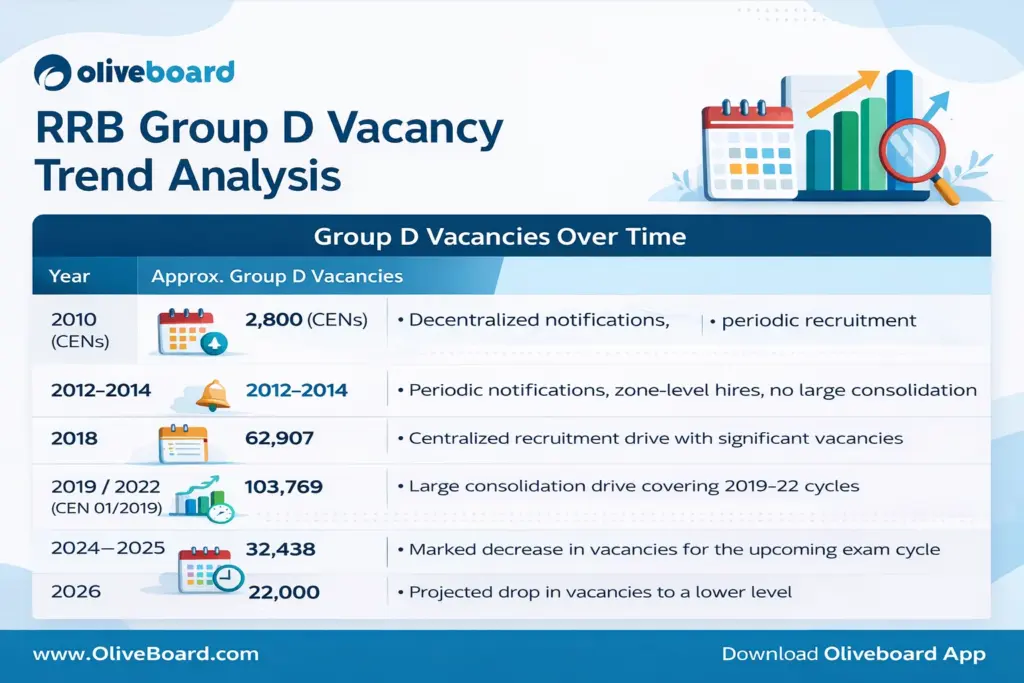
The table below shows the vacancy trends as per the RRB Group D Notification in major recruitment drives:
Why did RRB Group D Vacancy increase around 2018–2019?
The RRB Group D vacancy increased around 2018-19 due to various factors such as backlog hiring, retirement and attrition waves. Check out the details:
Consolidation of backlog hiring
A major factor was the Railways’ effort to clear a backlog of long-pending vacancies – instead of many small zone-level notifications, they issued consolidated large drives (e.g., RRC CEN 01/2019). That produced the 2018–2019 spike in advertised vacancies.
Retirement & attrition waves
Natural attrition (retirements, resignations, re-deployments) increased hiring need in several zones. Parliamentary data and internal audits over the decade showed large numbers of sanctioned posts and consequential vacancies that needed filling. (See parliamentary zone-wise vacancy statements from earlier years.)
Why have RRB Group D Vacancies reduced after 2019?
The RRB Group D Vacancies reduced after 2019 due to factors like Covid 19, budgetary issues, and more. Check out the detailed explanation below:
- COVID-19 & administrative delays (2020–2021): lockdowns and staff constraints delayed exam schedules, verification and medicals, slowing down the conversion of notified vacancies into joined posts.
- Budgetary and policy recalibration: hiring plans depend on annual budgets and workforce planning; some recruitment was deferred or redistributed.
- Operational re-engineering & automation: gradual mechanisation and improved maintenance techniques reduce some routine manpower demand in specific tasks (though many front-line posts like Track Maintainer remain manpower-intensive).
- Shift to staged drives rather than a single mega drive: after the large 2019 drive, Railways shifted to more controlled, periodic notifications – hence the 2024–25 numbers are sizable but below the 2019 peak.
Zone & Category Nuances:
The zone and category nuances are given below for the candidates:
- High-growth zones (dense networks, heavy traffic) historically show larger vacancy counts and faster refilling rates.
- Lower-demand zones sometimes hold vacancies unfilled longer due to lesser applicant interest or posting reluctance.
- Reservation & local hiring rules cause different category-wise vacancy patterns (UR / OBC / SC / ST / EWS / Ex-SM / PwBD). Official CENs list these distribution details for each drive.
What is the State-Wise recruitment movement for RRB Group D Vacancies?
The state-wise recruitment movement for RRB Group D vacancies varies according to the railway zone. The table below shows the zone-wise trends:
| Railway Zone | Trend | Notes |
| Eastern Railway (ER) | Moderate fluctuations | Industrial growth spiked recruitments earlier, later optimized |
| Northern Railway (NR) | Peak in 2018–19, drop post-2020 | Major workforce, reflects national trend |
| South Eastern Railway (SER) | More stable comparatively | Balanced hiring and less volatility |
| Western Railway (WR) | High early, fall later | Automation reduced routine work |
What is the impact of RRB Group D Vacancy Trend on Aspirants?
The impact of RRB Group D Vacancies directly influences competition levels, exam difficulty and cut-offs. Given below are the details:
| Aspects | Details |
| Competition Levels | High Vacancy Years (e.g., 2018): Slightly lower competition per post due to more available seats. Low Vacancy Years (e.g., 2022–23): Fierce competition as aspirants accumulate from previous cycles with fewer posts. |
| Exam Difficulty & Cutoffs | Lower number of vacancies generally results in higher cutoffs, especially for the General category. 2018: Cutoffs were moderate due to higher vacancies. 2022: Cutoffs increased sharply because of limited seats. |
| Preparation Strategy | Aspirants should adopt long-term preparation due to unpredictable vacancy notifications.Emphasis should be on conceptual clarity, regular practice, and consistency rather than relying only on exam dates. |
The past decade’s RRB Group D Vacancy Trend tells a story of burst recruitment to clear accumulated vacancies and a subsequent return to more controlled, periodic hiring. For aspirants, this means the opportunity to get employed through Railways remains solid – but it pays to prepare proactively, follow official notifications closely, and not depend on a repeat of any single-year surge.
FAQs
The RRB Group D Vacancy Trend refers to the pattern or changes in the number of vacancies announced by the Railway Recruitment Board (RRB) for Group D (Level-1) posts over the years. It shows whether recruitment numbers have increased, decreased, or remained stable due to administrative, economic, or operational factors.
The massive spike in vacancies during 2018–2019 (with over 1 lakh posts) occurred because the Indian Railways decided to consolidate multiple zone-level recruitments into one large national drive. This was aimed at clearing backlogs, accommodating retirement replacements, and addressing the expanding workforce requirements across various zones.
Vacancies dropped after 2019 mainly due to:
Completion of backlog recruitment from earlier cycles
COVID-19 disruptions that delayed exams and appointment processes
Automation and digitalization in railway operations, reducing manual labor needs
Budget constraints and phased hiring policies under workforce rationalization measures
The year 2019 (RRC CEN 01/2019) saw the highest-ever recruitment drive for Group D posts with approximately 103,769 vacancies announced across India. This remains the largest single recruitment cycle for Group D posts in Indian Railways’ history.
Candidates should understand that the number of vacancies fluctuates based on internal policy changes, technology adoption, and retirements. Therefore:
Never depend on one major notification – keep preparation continuous.
Monitor zone-wise announcements as vacancies differ regionally.
Stay updated with official RRB portals for accurate data rather than social media rumours.

Hello! This is Arijit Dutta. I am a skilled Content Writer at Oliveboard with nearly 3+ years of experience in crafting engaging, informative, and exam-focused content for the Railways Domain. With a strong command of language and a keen understanding of learner needs, I contribute significantly to Oliveboard’s mission of delivering high-quality educational resources. Passionate about clear communication and continuous learning, I consistently create content that helps government job aspirants achieve their goals. Outside of work, I enjoy playing cricket and listening to music, which helps me stay balanced and creative in my professional journey.
