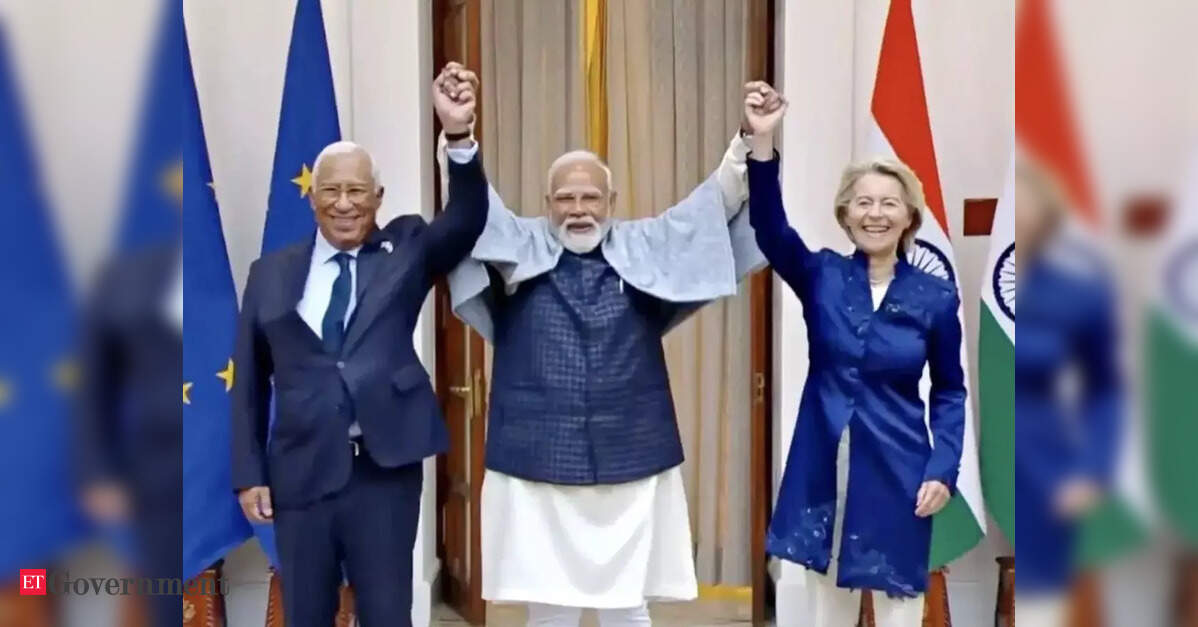
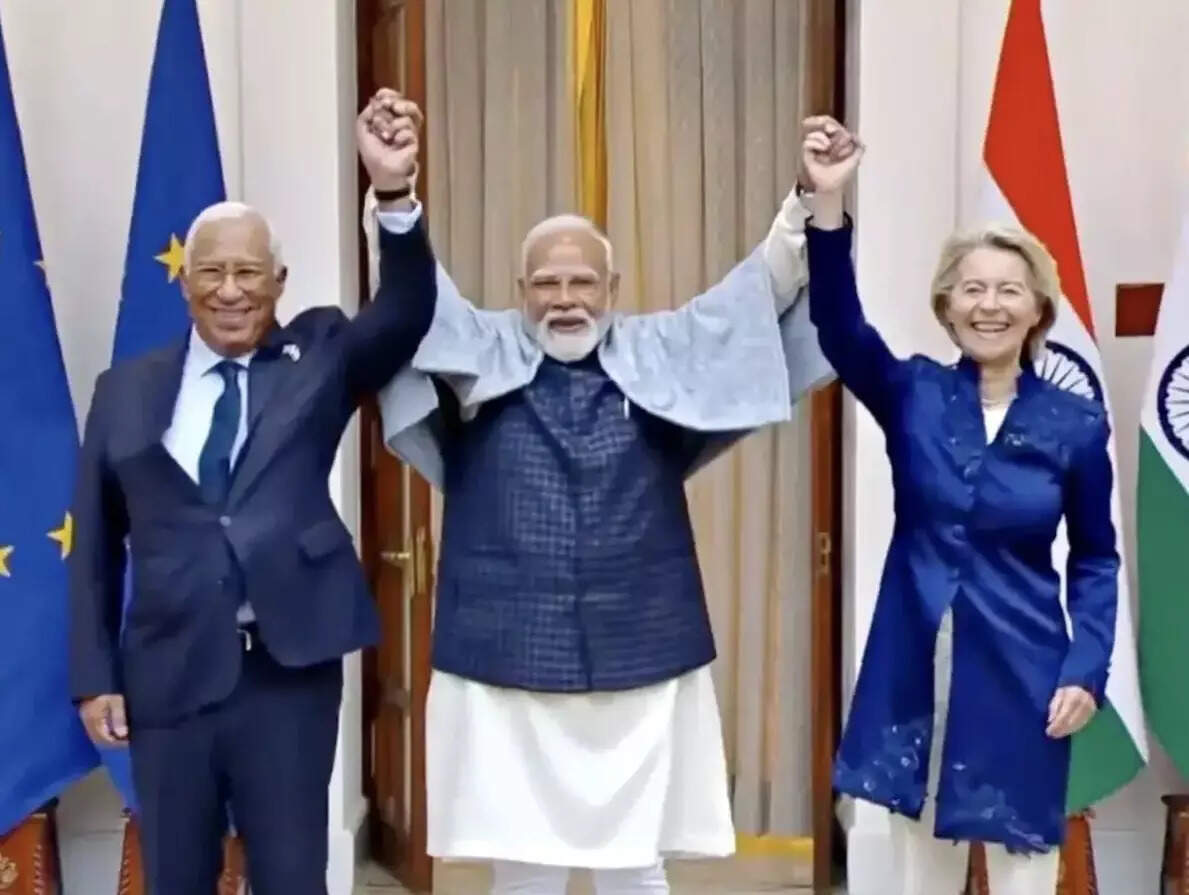
On 27 January 2026, India and the European Union concluded a landmark Free Trade Agreement (FTA) that negotiators and leaders have described as historic, forward-looking, and strategically consequential.
After nearly two decades of on-off bargaining, New Delhi and Brussels finalised a comprehensive trade pact that, once implemented, will reshape global commerce, recalibrate geopolitical alignments, and deepen economic interdependence between two of the world’s largest markets.
The signing took place against the backdrop of intensive diplomacy: European Commission President Ursula von der Leyen and European Council President António Costa attended India’s Republic Day celebrations in New Delhi on 26 January 2026 as chief guests — a symbolic affirmation of shared democratic values and cooperative intent.
The Economic Architecture of the Deal
The India–EU FTA is engineered to liberalise trade in goods and services, reduce tariffs, and harmonize regulatory frameworks. According to official summaries, the agreement will:
- Eliminate or liberalize tariffs on over 96% of trade value in goods within seven years.
- India will remove tariffs immediately on about 30% of EU exports and eventually reduce or abolish duties on over 90% of tariff lines.
- EU exporters will gain improved access to Indian markets in key sectors such as automobiles, machinery, pharmaceuticals, chemicals, and processed foods, while Indian exporters will see reduced duties on textiles, leather, gems, fisheries, and certain industrial goods.
Reuters reporting notes that tariffs on European automobiles — previously as high as 110% — will be significantly cut, potentially to as low as 10% over a phased period, augmenting EU auto access to India’s rapidly expanding vehicle market.
Commerce Minister Piyush Goyal framed this achievement as an expansive corrective to decades of protectionism: “The FTA will cover 99% of Indian exports and 97% of EU exports,” reflecting the breadth of tariff reduction and market opening envisaged.
Geopolitical Resonance: Strategic Hedging and Global Alliances
From a geopolitical perspective, the deal signals a strategic recalibration of global trade networks. India and the EU together represent a market of approximately 2 billion consumers and roughly one-quarter of global GDP — a bloc that can serve as a counterweight to the rising economic assertiveness of China and the volatility of U.S.–China trade dynamics.
Prime Minister Narendra Modi said the pact will “bring major opportunities for the 1.4 billion people of India and the millions of people in Europe,” and, at Republic Day events, characterised India–EU ties as a “double engine of growth” for the world economy.
In Brussels, Ursula von der Leyen lauded the agreement as “the mother of all deals,” noting that it creates “a free market of two billion people” and expands strategic cooperation beyond commerce into areas such as regulatory coherence, digital trade, and sustainability standards.
Strategic dialogues alongside the FTA include cooperation on defense, maritime security, cybersecurity, and counterterrorism, articulated in a separate Security and Defence Partnership signed contemporaneously. These frameworks suggest a broader security alignment underpinning the economic pact.
U.S. Reaction: Tensions and Strategic Trade Competition
The United States response to the India–EU deal has been notably critical from official quarters in Washington. U.S. Treasury Secretary Scott Bessent, speaking amid ongoing U.S.–India tariff tensions, argued that Europe’s embrace of the pact risked inadvertently undermining Western economic and geopolitical posture.
He stated provocatively, “the Russian oil goes into India, the refined products come out, and the Europeans buy the refined products — they are financing the war against themselves.”
These comments underscore deeper strains in the U.S.–India economic relations following the Trump administration’s imposition of steep tariffs — in some cases up to 50% — on Indian exports as part of broader trade and political disputes.
While official U.S. rhetoric frames these positions within trade policy debates, analysts see them as reflective of larger strategic divergence between the U.S. and both India and the EU as they seek diversified economic networks in a multipolar era.
Cultural and Social Dimensions
The Republic Day participation of European leaders, including von der Leyen and Costa, was more than ceremonial: it marked an unprecedented cultural affirmation of India–EU relations and lent a high-profile backdrop to FTA announcements. Their presence reinforced the narrative of shared democratic values, reflecting a people-to-people dimension that complements economic and strategic cooperation.
Indian President Droupadi Murmu honoured the guests during the parade, underlining the symbolic resonance of the partnership among democratic societies with deep cultural histories and modern aspirations — a reminder that economic agreements are also expressions of shared values and mutual respect.
Technology Cooperation and Future Trajectories
A salient potential outcome of the deal lies in technology and innovation exchange. Beyond traditional market access, the agreement is designed to facilitate collaboration in digital trade, research partnerships, and standards harmonisation.
Indian participation in programmes like Horizon Europe — the EU’s flagship research and innovation framework — is anticipated and expected to open new avenues for co-development in sectors such as clean energy, AI, biotechnology, and advanced manufacturing.
Such cooperation could help bridge innovation ecosystems on both sides, enabling Indian tech firms and research institutions to access deep European capital, standards expertise, and cross-border partnerships, while European enterprises benefit from India’s growing digital economy and engineering talent pool.
Risks, Implementation, and Sectoral Sensitivities
Despite the euphoria, the pact’s implementation will require ratification by EU member states, the European Parliament, and the Indian cabinet — a process that could take up to a year. Sensitive sectors, especially agriculture and dairy, remain partly shielded through safeguards.
Critics caution that uneven regulatory burdens, compliance challenges, and competition impacts on small farmers and MSMEs will require careful domestic policy responses to ensure inclusive gains from liberalised markets.
Toward a New Trade Architecture
The India–EU trade deal constitutes a seminal development in global trade architecture — balancing economic liberalisation with strategic diversification in a fracturing international system. It amalgamates trade policy, geopolitical strategy, and technocultural exchange in a manner rarely seen in contemporary agreements.
As India and the EU proceed to implementation, the FTA’s success will hinge on effective domestic adaptation, cross-border institutional cooperation, and the capacity of both regions to leverage this partnership for sustainable, equitable growth. For global stakeholders — from Washington to Beijing — the pact signals a recalibrated axis of trade and influence in the 21st century.