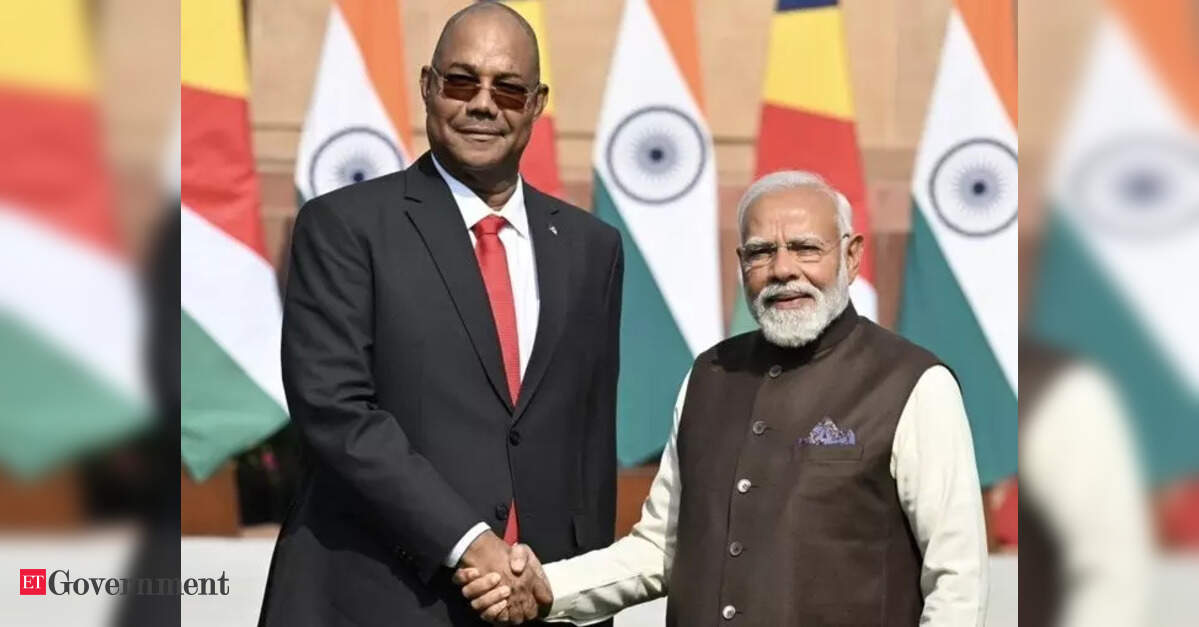
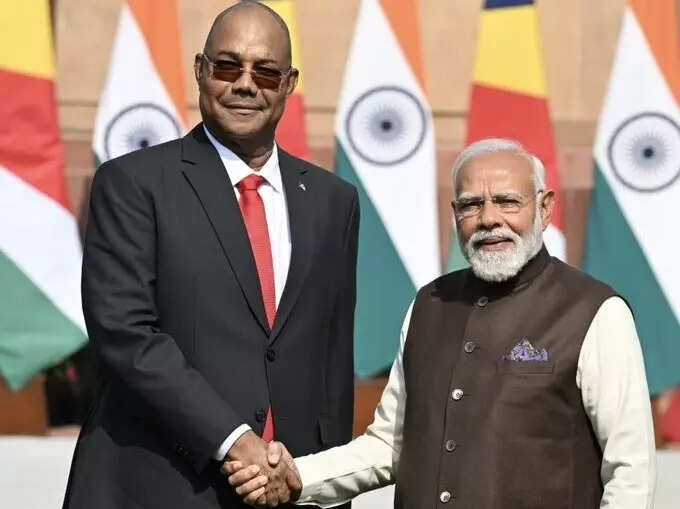
The State Visit of Dr. Patrick Herminie, President of the Republic of Seychelles, to India from 5 to 10 February 2026 has emerged as a defining moment in the contemporary trajectory of India–Seychelles relations.
Coming barely a hundred days after President Herminie’s inauguration, and coinciding with the fiftieth anniversary of both Seychelles’ independence and the establishment of diplomatic relations between the two countries, the visit carried a symbolism that extended well beyond protocol. It signalled intent—strategic, economic, and civilisational—to elevate a time-tested partnership into a forward-looking compact for the Indian Ocean era.
At the heart of the visit was the meeting between President Herminie and Narendra Modi, which produced the India–Seychelles Joint Vision for Sustainability, Economic Growth and Security through Enhanced Linkages. The document is not merely declaratory. It reflects a convergence of priorities between a major regional power and a Small Island Developing State, anchored in the recognition that maritime geography today is inseparable from questions of security, climate resilience, digital capacity, and economic sovereignty.
In his statement, Prime Minister Modi framed the relationship in historical and civilisational terms, noting that “the waves of the Indian Ocean have connected our peoples for centuries,” and emphasising that India and Seychelles are bound “not just by geography, but by history, trust and a shared vision for the future.”
This articulation matters. It situates the bilateral relationship within India’s evolving maritime doctrine, particularly its Vision MAHASAGAR, which seeks mutual and holistic advancement for security and growth across the Indian Ocean Region.
From the Seychellois perspective, President Herminie was unambiguous in underlining India’s role as a trusted and dependable partner. He expressed gratitude for India’s consistent development assistance and security cooperation, underscoring that India has supported Seychelles not episodically but structurally, across successive phases of its national development. The visit reinforced this sentiment through tangible commitments rather than rhetorical assurances.
Economically, the most consequential outcome of the visit was India’s announcement of a Special Economic Package amounting to $175 million, structured as a blend of a rupee-denominated line of credit and grant assistance. This package is designed to support projects in social housing, health infrastructure, e-mobility, vocational training, defence, and maritime security—sectors that directly intersect with Seychelles’ developmental vulnerabilities and aspirations.
Prime Minister Modi described the package as one that would “create new employment and skill opportunities for the people of Seychelles, especially for the youth,” signalling an emphasis on long-term capacity rather than short-term relief.
Equally significant is the decision to deepen cooperation in digital transformation. India’s offer to assist Seychelles in building Digital Public Infrastructure, including digital payments and governance platforms, reflects New Delhi’s emerging role as a provider of digital public goods to the Global South. For Seychelles, where administrative efficiency and service delivery are constrained by scale and geography, this collaboration has the potential to be transformative. It aligns digitalisation not with abstract modernisation but with citizen-centric governance.
The visit also foregrounded cooperation in health and essential commodities, an area where the people-centric ethos of the partnership is most visible. The donation of advanced ambulances, support for affordable access to quality medicines through recognition of the Indian Pharmacopoeia, and discussions on constructing a new hospital together underscore a model of cooperation that directly impacts everyday life.
President Herminie acknowledged that high living costs remain a structural challenge for Seychelles, and welcomed India’s readiness to institutionalise mechanisms for the supply of affordable food grains and essential commodities. The donation of one thousand metric tonnes of grains was thus not symbolic charity, but a calibrated intervention in food security and inflation management.
Capacity building formed another central pillar of the visit. Both leaders reaffirmed the importance of human resource development through training programmes for civil servants, defence personnel, health professionals, and technical experts. The expansion of customised training through Indian institutions, including in cybersecurity, financial intelligence, marine sciences, and climate adaptation, reflects a shared understanding that sovereignty in the twenty-first century is as much about skills and institutions as it is about territory.
On climate action and sustainability, the discussions reflected the asymmetry of vulnerability between a continental power and an island state, while also highlighting their complementary strengths. President Herminie acknowledged India’s support for renewable energy projects under the International Solar Alliance, noting their tangible impact in agriculture and healthcare. The agreement to support multi-hazard early warning systems and grid management for green transport signals a pragmatic approach to climate resilience—one that combines technology, finance, and institutional coordination.
Geopolitically, the visit reaffirmed Seychelles’ centrality in India’s Indian Ocean strategy. Maritime security and defence cooperation, long a cornerstone of the bilateral relationship, were explicitly linked to regional stability and the maintenance of a rules-based maritime order. Prime Minister Modi welcomed Seychelles as a full member of the Colombo Security Conclave, reinforcing its role in cooperative security architectures. Both leaders reiterated their commitment to countering piracy, narcotics trafficking, illegal fishing, and other transnational maritime crimes through enhanced surveillance, information sharing, and capacity building.
President Herminie’s appreciation of India’s support to the Seychelles Defence Forces—from joint maritime surveillance and hydrographic surveys to the refit of naval assets—underscored the depth of operational trust between the two countries. This trust is not merely bilateral; it has wider implications for the security of sea lanes and the balance of influence in the Western Indian Ocean.
Culturally and socially, the visit reaffirmed the human foundations of the relationship. Both leaders acknowledged the contributions of Seychellois of Indian origin to the social and economic fabric of Seychelles, as well as the role of Indian professionals in the country’s development. Prime Minister Modi described people-to-people ties as the “greatest strength” of the relationship, and emphasised the need to expand exchanges in tourism, education, culture, and youth engagement. In a region where strategic competition is often abstracted from society, this emphasis on lived connections is politically and diplomatically significant.
In concluding the visit, both leaders expressed confidence that the Joint Vision would serve as a roadmap for the coming decade. President Herminie thanked Prime Minister Modi for the warmth of India’s hospitality and extended an invitation for an official visit to Seychelles. The exchange captured the broader meaning of the visit: not a culmination, but a recalibration.
Taken together, President Herminie’s State Visit to India represents a maturation of India–Seychelles relations—from a partnership defined by proximity and goodwill to one shaped by shared strategic purpose. It demonstrates how middle and small powers in the Indian Ocean can construct cooperative frameworks that integrate development, security, climate resilience, and cultural continuity. In an era of contested oceans and fragmented global governance, the India–Seychelles engagement offers a model of maritime diplomacy grounded in trust, mutual respect, and practical outcomes.