

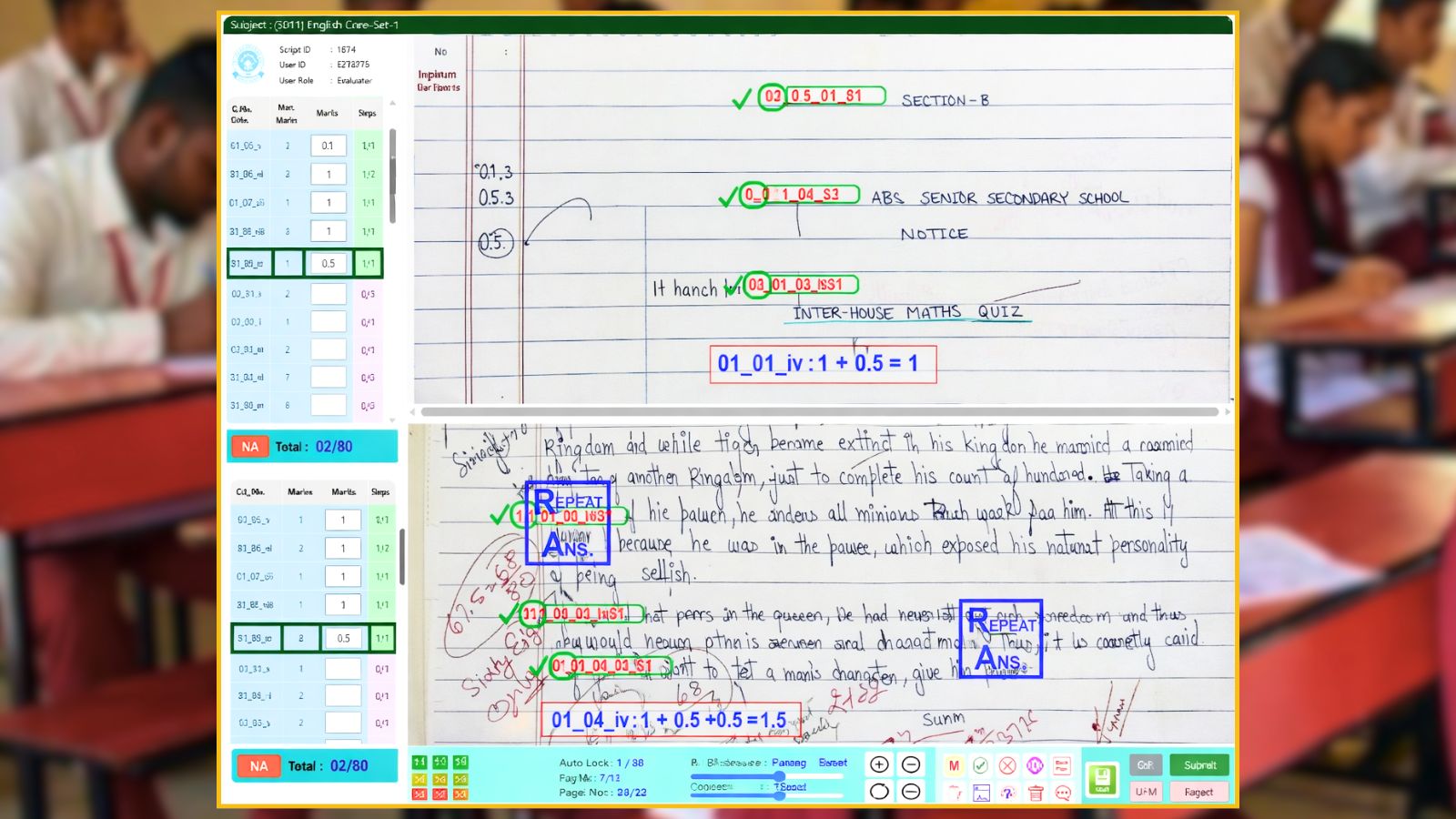
The Central Board of Secondary Education (CBSE) is set to introduce ‘On-Screen Marking’ (OSM) for Class 12 board examinations from 2026. This, according to the Board, will be a “much-needed shift” from physical evaluation of answer sheets to a fully digital assessment system. Announcing the move, Sanyam Bhardwaj, Controller of Examinations, CBSE, said during a live webcast while insisting that the initiative marks a ‘next level experience’ in evaluation and is aimed at reducing errors, speeding up the process, and increasing transparency.
According to the CBSE, for Class 12 Board Exams 2026, as many as 18,57,479 students are expected to appear across 120 subjects. The Board will handle an estimated 1,00,44,295 (10.4 crore) answer books. The scale of exams – which also includes several centres abroad, Bhardwaj said, is precisely why CBSE is moving to digital evaluation. The CBSE is set to commence the annual exams for Class 12 from next Tuesday, February 17.

What is On-Screen Marking and why is CBSE introducing it?
On-Screen marking means that evaluators will no longer check physical answer books at designated centres. Instead, answer sheets will be scanned and uploaded to a digital platform. Teachers will log into the system and evaluate responses directly on screen. Teachers who have been designated as examiners will be given login credentials for the online assessment portal at cbse.onmark.co.in/cbseevalweb.
Explaining the decision, Bhardwaj said CBSE had historically introduced reforms first at the Class 10 level, with the introduction of dual-board exams. “But this time we have decided to go ahead with Class 12,” he said, adding that the Board was confident in both the system and the teachers. He emphasised that the shift is not experimental but the result of extensive redesign, testing, feedback, and system upgrades.
According to the Board, the move is expected to eliminate tedious post-result verification process and uploading errors, reduce human intervention in coordination work, and enable closer monitoring of evaluation quality.
How will the new digital evaluation system function?
Under the new system, answer books will first be scanned at designated centres. Every page, including blank pages, will be scanned to ensure transparency. Bhardwaj said that around 400 answer books can be scanned by one scanner in eight hours. After scanning, a quality check team will verify whether all pages are correctly scanned, in sequence, and clearly visible.
Once discrepancies, if any, such as page alignment issues, faded images, and un-numbered pages are resolved, the digital copy will be made available on the evaluation platform.
Story continues below this ad
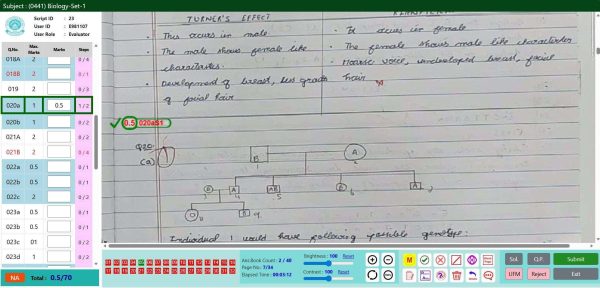 Screengrab of CBSE On-Screen Checking portal (Image via CBSE)
Evaluators will log in using a secure ID and password. Access will be restricted through IP-based controls — meaning teachers will only be able to log in from authorised locations, typically their schools. “If the IP address is not matching, the system will not permit entry,” Bhardwaj explained.
On screen, evaluators will see the scanned answer sheet on one side and a digital marking panel on the other. They will award marks question-wise using predefined step markings aligned with the official marking scheme. The system will not allow submission unless every question has been marked, including those not attempted, which must be marked as ‘NA’.
What changes for evaluators and head examiners?
CBSE has clarified that the structure of evaluation teams — evaluators, associate examiners (AE), and head examiners (HE) — will continue. However, their work will now be digital.
In the manual system, evaluators physically moved answer books between desks for cross-checking. In the digital format, answer scripts will be automatically assigned for review. The AE and HE will see both the evaluator’s awarded marks and the scanned script. If changes are required, they can modify marks within the system.
Story continues below this ad
The system also generates detailed reports, including subject-wise evaluation progress, day-wise work done, time taken per script, and mark distribution patterns. Bhardwaj said this would allow the Board to monitor quality more closely.
“Once teachers log in, their attendance and time spent on each script will be recorded,” he said. The system will also flag mistakes and track how many answer books have been reviewed.
How will digital marking reduce errors and revaluation requests from students?
One of CBSE’s stated goals is to reduce errors in evaluation. Bhardwaj repeatedly stressed that the Board wants “zero error” assessment.
Under OSM, the system will not permit submission of an answer book unless all questions have been evaluated. Marks are entered directly into the platform, removing the need for separate uploading. This is expected to eliminate discrepancies between marks awarded and marks recorded.
Story continues below this ad
He said the Board aims for a time when, after results are declared, students applying for verification or revaluation will find “no change in awarded marks.”
Because marks are entered and calculated within the system, there will be no need for separate mark posting checks that were required under manual evaluation.
How will teachers be trained and supported?
Acknowledging that teachers may have concerns about adapting to a new system, Bhardwaj said CBSE has conducted dry runs and global testing of the platform. Teachers from schools abroad also participated in testing, and the overall feedback has been positive.
The Board will conduct multiple familiarisation sessions. Teachers will be allowed to log in and practise evaluation on sample answer books before the actual assessment begins. User manuals and step-by-step videos will be provided.
Story continues below this ad
On the first day of actual evaluation, teams will hold a detailed discussion on the marking scheme. Five common answer books will be checked by all evaluators to ensure uniformity. Variations in marking will be discussed and resolved before full-scale evaluation begins.
Additionally, a dedicated call centre with over 30 trained personnel will provide technical support during the evaluation process.
What specific instructions have been issued to teachers?
CBSE issued directions to evaluators who will be part of the assessment process this year:
- Evaluation must be full-time during the assigned period. No other school work should be undertaken simultaneously. This was also instructed to school heads.
- Teachers must maintain the confidentiality of login credentials.
- If a question is ‘not attempted’, it must be marked ‘NA’; otherwise, the script cannot be submitted.
- Marks must be awarded step-wise as per the digital marking scheme. The marking scheme will also be integrated into the assessment-portal and be available for teachers at all times during the checking process.
- If an answer is repeated, the better response will be considered, as per system provisions.
- Evaluators must review scripts fully before submission, as changes can only be made before final submission.
Bhardwaj also stated that schools are required to relieve teachers for evaluation duties. If schools fail to comply, he warned, the Board may withhold the results of that school’s students.
Story continues below this ad
“If you are sending 20 students, it is your responsibility to evaluate 20 answer books,” he said during the webcast.
What is changing for students appearing in the 2026 exams?
For students, the format of writing the examination will not change. However, certain procedural instructions remain important:
- In subjects such as History and Geography, where maps are used, students are required to attach map sheets at the end of the answer book, not between written pages, to ensure smooth scanning.
- Students have also been advised to follow question-wise answering strictly. If answers are written outside the specified sections, there is a possibility they may not be evaluated.
It is worth noting that this represents a departure from previous practice, when students were not required to answer questions in the sequence presented in the question paper, and were often encouraged by their respective schools and teachers to attempt them in an order that best aligned with their competence.
CBSE has also cautioned against relying on social media rumours about question paper leaks or predictions. Bhardwaj said fake information circulates online during exam season and urged stakeholders to guide students to focus on self-study and official communication.
Story continues below this ad
How will OSM impact the evaluation timeline?
Bhardwaj said the digital system could help the Board declare results on time, and possibly even earlier.
Under the manual system, evaluation could take up to 60 days in some cases. With digital marking, CBSE expects the timeline to reduce significantly. Transportation of physical answer books to and from centres will no longer be required.
Teachers will work from their schools, reducing travel time. The system allows wider participation, including teachers from smaller schools and even overseas institutions affiliated with CBSE.
What security and transparency measures are built into the system?
The OSM platform includes multiple safeguards. Access is IP-restricted. Every login and logout time is recorded. The time spent on each script is tracked.
Story continues below this ad
Each script’s history, including marks awarded, changes made, and review comments, is stored within the system. Evaluator, AE, and H copies are digitally maintained. The Board said the system does not allow partial evaluation. Scripts cannot be submitted unless all sections are addressed.
“Data will say the truth only,” Bhardwaj said, referring to the monitoring features embedded in the system.
What happens next?
CBSE will begin the first digital evaluations with smaller subjects, such as Biotechnology, to test the system during live examinations. Feedback, if any, will be incorporated.
With 18,57,479 students and over 1 crore answer booklets to assess across 120 subjects, the 2026 Class 12 board exams will mark the largest implementation of On-Screen Marking by the Board so far.
As Bhardwaj said in his address to stakeholders during the live webcast, the shift is intended not just as a technological update but as a structural reform in how evaluation is conducted — with the stated aim of faster, error-free, and more transparent assessment for India’s senior secondary students.
