

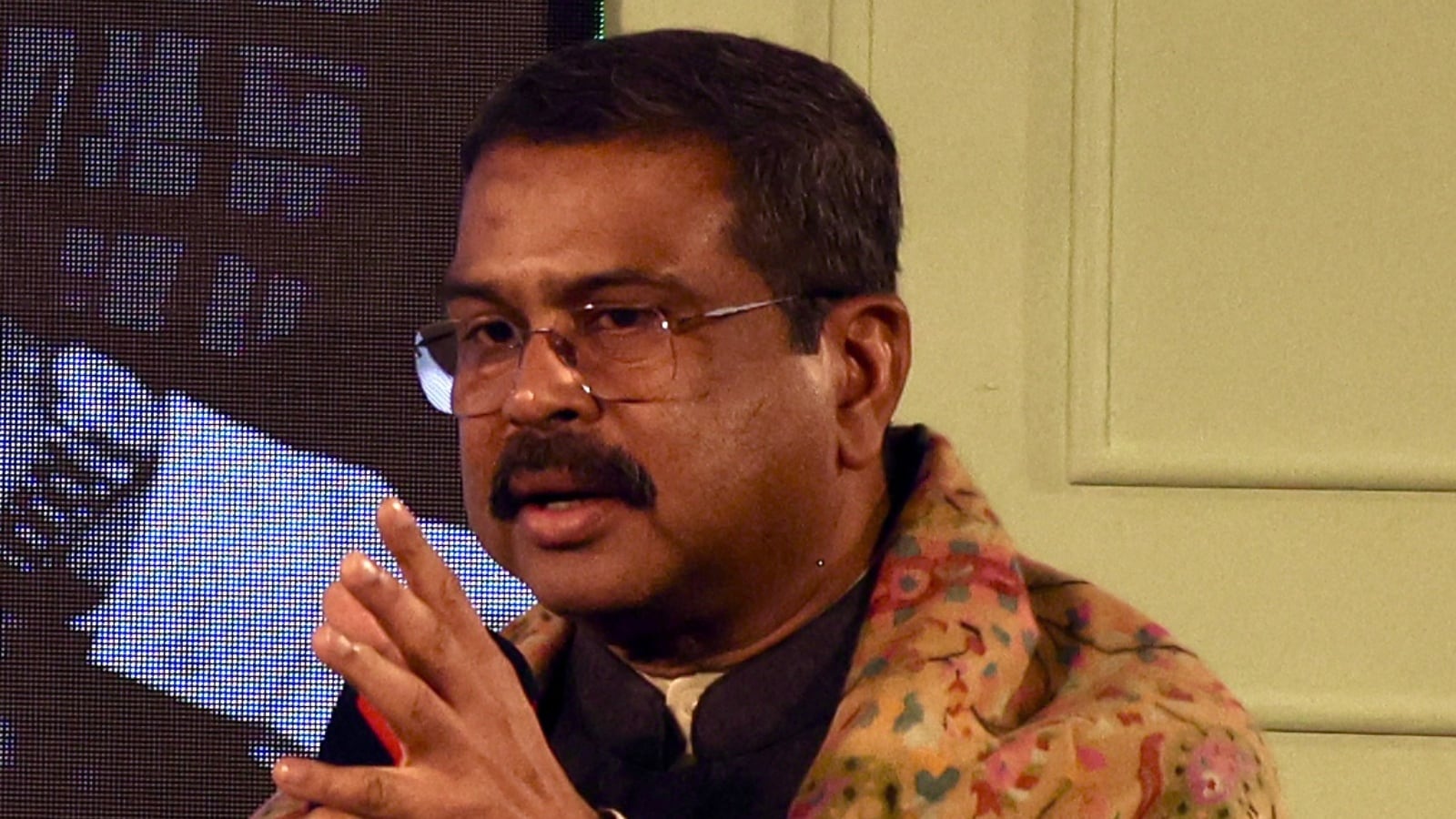
Describing Artificial Intelligence as a “good catalyst” and a “bridge”, Union Education Minister Dharmendra Pradhan said at the Express Adda Friday that the National Education Policy (NEP) 2020 focuses on using technology to “fill learning gaps” and “take education to inaccessible areas”.
Responding to a question on NEP and whether it can meet the challenges posed by AI, Pradhan said: “The policy came in 2020, but work began in 2014. The document was brought after six years of homework. The policy gives importance to making technology a means to fill learning gaps. AI and technology were there before as well. But now there is a new momentum. Using technology to take education to inaccessible areas is a focus of the policy. Policy should be futuristic. After AI, there will be quantum…then there will be more challenges. The NEP has visualised these things, which is why it has said that our education system will be rooted and futuristic, and technology will be the bridge.”

Pointing out that making education affordable and accessible is a challenge, he said: “The new education system, new textbooks, new approach that is coming with the NEP, considering global needs…in this, AI will be a good bridge, and a good catalyst. It will be in favour of the field of education in the country.”
The Express Adda was moderated by Vandita Mishra, National Opinion Editor, The Indian Express.
Responding to another question on foundational learning in the mother tongue, Pradhan said, “The Government has never said that it should only be Hindi…we are saying that in Tamil Nadu, learning should be in Tamil; in Kerala, it should be in Malayalam…Odia in Odisha, Bengali in West Bengal, Punjabi in Punjab. In Hindi regions, it should be in Hindi. This has been our belief. That’s what the NEP says.”
He said: “Up to class 5, the medium of instruction should be the mother tongue. Then critical thinking will be clear…what they learn as a second language, it is up to the choice of the student. From class 6 to 10, there will be a third language. The NEP says that the third language should be an Indian language. From a political angle, some people say they are opposed to the NEP. But there is no state in the country that disagrees with learning in the mother tongue at the primary level. In this age of technology, I don’t think there is any dilemma in this.”
Pointing to countries like Germany, Japan and China using their mother tongues, he said: “The languages of our civilisation are Indian languages. We need to give importance to Indian languages if we need to make big leaps.”
Story continues below this ad
To improve enrollment in higher education, Pradhan said there is a need to set up new institutions, “make our regulatory regime more liberal”, bring in philanthropic investment and increase state funding.
Asked about the UGC regulations on equity, which the Supreme Court has recently stayed, Pradhan said: “Our Constitution says there should not be any discrimination. It is said very clearly in Article 14 and 15. The UGC regulations are sub-judice. The Government will not allow injustice against anybody, no matter who it is. This is the Government’s responsibility.”
On textbook revisions, he said history based on the stories of our civilisation should be brought forward, and asked if only the story of a thousand years of “slavery” should be considered as the country’s history.
“What is a matter of pride for us…zero came from India…shouldn’t these topics be there? Shouldn’t our glorious economics be there? Should we only consider the story of a thousand years of slavery as our history? Should we not consider our history before that? For any civilised society, history is like a mirror. If you look in the mirror, then the path to the future will be easy,” Pradhan said.
Story continues below this ad
On the need for textbook revisions, Pradhan said topics are to be updated and new ones introduced in keeping with changes in society. Asked about ideological motivation behind such revisions, and the Babri Masjid not being named but referred to as a ‘three-domed’ structure in a revised school textbook, Pradhan said: “Should we take pride in the Babri Masjid? Should we take pride in Aurangzeb and Babur? Those who destroyed the country’s civilisation and freedom, destroyed a temple and made a mosque…”.
“The matter of Babri Masjid has been decided before the court. The Supreme Court permitted the construction of a Ram temple, and a grand temple has been made. This is the country’s ideology. Will the country’s ideology be Ram, or Babur, or Aurangzeb?…Had Aurangzeb not ordered the destruction of the Kashi Vishwanath temple? Should we be stuck on this topic when we teach (about) the glorious civilisation of our country?” he said.
“We are not saying something that has been imagined. The stories of our civilisation, local history…what is based on facts…we should be proud of it as a civilisation. That is what we believe,” Pradhan said.
Responding to questions on the stalemate in Parliament over Rahul Gandhi not being allowed to speak, Pradhan pointed to the Leader of Opposition’s “unruly behaviour” and his “inability to accept defeat”.
Story continues below this ad
“PM Narendra Modi is not here because of kindness from somebody. The people have given him the responsibility for the third time. (The office of) Prime Minister is not somebody’s jagir, it is not ancestral property. Rahul Gandhi ji thinks it belongs to his family. His intolerance, his frustration against the Prime Minister, his hatred. Listen to the way in which he talks…the world is watching Rahul Gandhi’s unruly behaviour,” Pradhan said.
Asking if Parliament will function as per will or decided procedure, he said: “The Speaker has said…matters cannot be raised without validating them. You cannot place a book that has not even been published…Rahul Gandhi wants to impose things that he is imagining. Afflicted by the remorse of his defeat…he wants to indulge in hooliganism.”
Pradhan, who was the BJP’s poll in-charge in states like Bihar and Haryana, said the party’s “basic philosophy is to serve people.” Responding to a question on the BJP’s election machinery, he said the party has clarity of thought, and ideological foundation, leadership and policy. “We are not a family party. We are not a feudal set-up. We are a democratic set-up. There is accountability,” he said.
Pradhan, who began his political involvement in student politics and the ABVP, responded to a question on the organisation’s hold over campuses and the changes in student politics.
Story continues below this ad
“ABVP is an open university. You get ideas, inspiration from there. Times have changed, generations have changed, social conditions have changed…but the fundamental spirit of ABVP…of nation first, the enthusiasm — it’s still there,” he said.
“ABVP is a movement…governance is the responsibility of people in government. There are processes…whether it is appointment of VCs…intellectual activism in campuses…it is a democracy; everybody has the right to do it. But campuses should not get into parochialism of political ideas. Kya campus mein desh ke tukde hone ka naara lagni chahiye (Should slogans of the nation being broken up be raised on campuses)?…Matters on the sovereignty of the country should not be raised. There will be objections to it, whichever organisation or group it is. In a democracy, disagreement can be registered. Everybody’s free to do that,” he said.
On a personal note, Pradhan spoke about growing up in Odisha’s Talcher, the freedom struggle in the area, and how that has shaped him as a politician. “Industrialisation, farming, the matters of workers…and the freedom struggle in my area, which is my legacy, that spirit…that inspired me to get into student politics. My sensibilities have been shaped by the challenges of my town. Those were my first learnings in social life,” he said.
