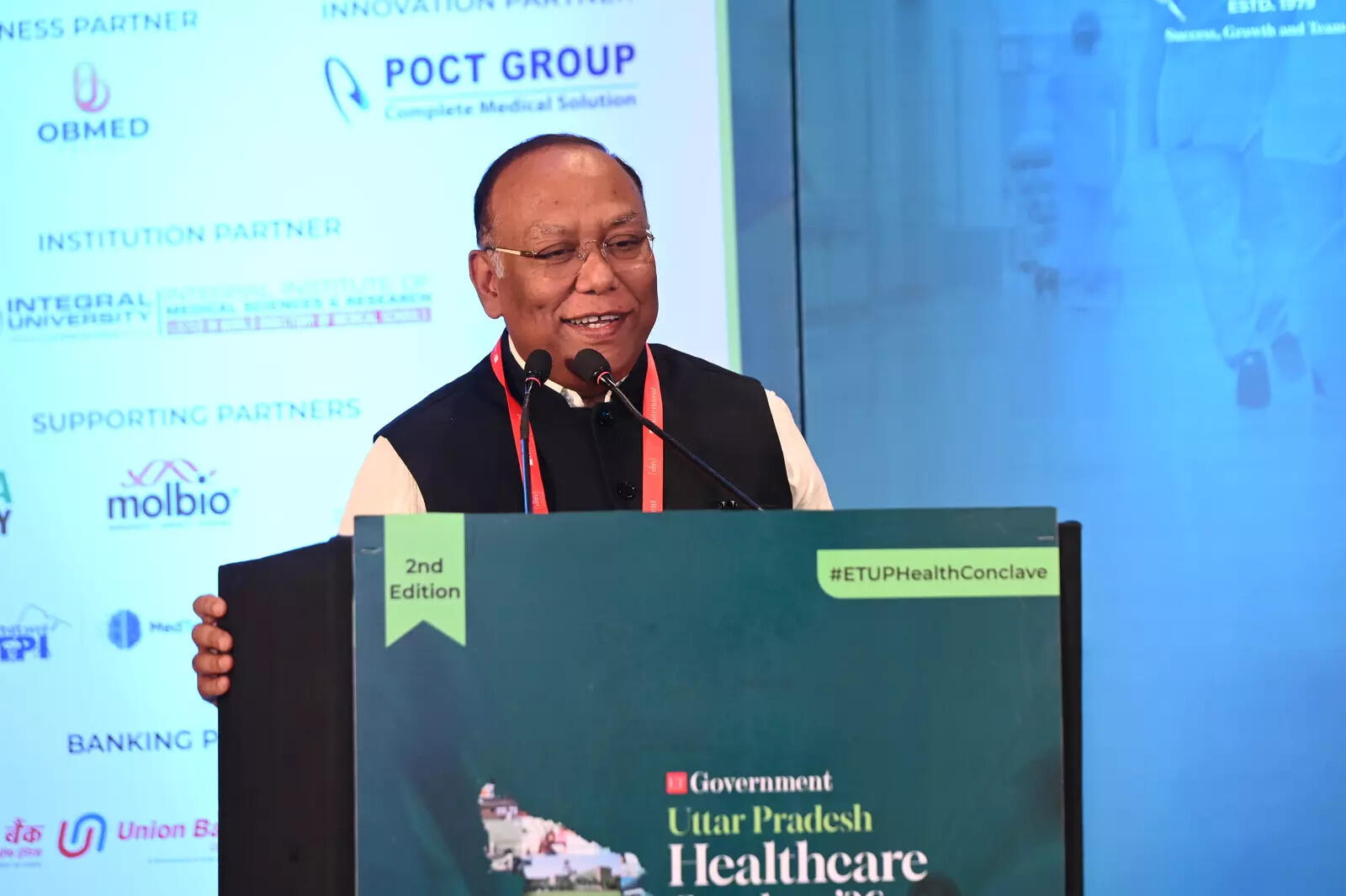
Adopting a technology-first approach is key to addressing the Uttar Pradesh’s rising healthcare demand, said Amit Kumar Ghosh, Additional Chief Secretary, Medical, Health & Family Welfare and Medical Education, Government of Uttar Pradesh, on Wednesday, emphasising that integrated deployment of digital tools, skilled manpower, and infrastructure is critical to improving outcomes.
His remarks come at a time when large states like UP are grappling with increasing lifestyle diseases and capacity constraints, making timely intervention and system efficiency key priorities.
He was speaking at the ETGovernment Uttar Pradesh Healthcare Conclave, which convened policymakers, healthcare providers, and industry stakeholders to discuss the evolving healthcare ecosystem in the state.
Framing the challenge, Ghosh pointed to the persistent and expanding demand for healthcare services, noting that even with improvements in roads, schools, and basic infrastructure, health concerns remain a primary issue for citizens. He observed that “the demand for healthcare is never ending,” underlining the structural pressure on public systems and the urgency to strengthen delivery mechanisms.
He also stressed the need for convergence across three pillars—technology, skills, and infrastructure. Citing the example of STEMI (ST-Elevation Myocardial Infarction) care, Ghosh illustrated how a hub-and-spoke model enabled early diagnosis and intervention in districts lacking cardiologists. “When technology works with numbers and skills, transformation can happen,” he said, explaining how real-time ECG analysis and remote expert guidance have significantly improved emergency cardiac care outcomes across multiple districts.
Building on this, the state is now scaling telemedicine infrastructure to expand access. Ghosh noted that Uttar Pradesh is moving towards covering nearly all community health centres and district hospitals through telemedicine networks, enabling round-the-clock specialist consultations. This push reflects a broader strategy to bridge urban-rural healthcare gaps through digital connectivity.
Artificial intelligence is emerging as the next layer of transformation. Referring to ongoing initiatives, he highlighted that “AI is the next thing that we want to focus on,” pointing to early adoption efforts within medical institutions and alignment with national-level digital health frameworks. These efforts are expected to enhance diagnostics, decision-making, and system efficiency.
At the same time, Ghosh underscored the role of private sector participation in scaling healthcare capacity. He outlined multiple public-private partnership (PPP) opportunities, including management of community health centres, development of large hospitals, and incentives for greenfield investments in underserved districts.
“The scale at which Uttar Pradesh needs healthcare expansion requires active private sector participation,” he indicated, adding that schemes like Ayushman Bharat are enabling wider access while also acting as an incentive for private providers.
He also emphasised the importance of building a seamless digital health ecosystem through electronic health records and interoperable platforms. The state, he noted, is targeting a significant expansion in digital health IDs and records, which will allow patients to move across public and private systems without disruption. This, he said, will ensure continuity of care and better utilisation of healthcare resources.