


By using the value of explicit for the consumer configuration’s share.acknowledgement.mode, the code takes on the responsibility of specifying how each message should be acknowledged. The available AcknowledgementType values are ACCEPT, RELEASE, REJECT, and RENEW. These values influence the state of each message in relation to the share group. Those states are AVAILABLE, ACQUIRED, ACKNOWLEDGED, and ARCHIVED.
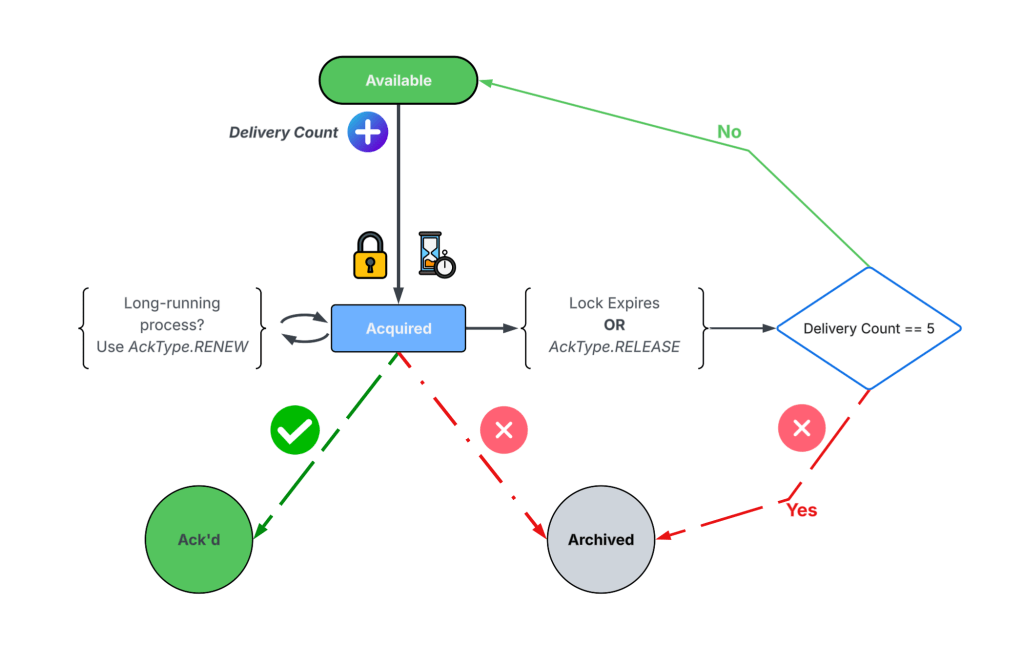
The state machine that controls the life cycle of messages based on these acknowledgement types is detailed in this diagram.
Confluent
Only messages in an AVAILABLE state can be fetched by a consumer. When fetched, a message transitions to the ACQUIRED state and a delivery count for that message is incremented. This effectively “locks” this message from fetches by other members of the share group.
Once ACQUIRED, a message is expected to be processed in a finite amount of time. If this “lock” or “lease” expires, the message is either sent back to the ACQUIRED state or moved to an ARCHIVED state, based on the delivery count of the message. The state and delivery count of each message is tracked in the share partition. This provides for a built-in retry mechanism developers can use in the event of a condition where the message process could be reattempted, as the message could be acknowledged using the RELEASE type.
