


JEE Main 2026 Normalisation Process: National Testing Agency (NTA) will announce the JEE Main 2026 Session 2 results on April 20. Alongside the results and final answer keys, students’ scores will be normalised. But how does NTA’s normalisation process work? Understanding how this process works is important for students to interpret their JEE Main session two results.
The NTA conducts examinations on multiple days, typically in two shifts per day. Each shift has a different question paper, and despite efforts to maintain uniformity, the difficulty level may vary across papers. As a result, some candidates may face relatively tougher sets of questions compared to others.
Candidates who face tougher question papers are likely to score lower than those attempting easier ones. To address this, the NTA applies a normalisation procedure based on percentile scores, ensuring that no candidate is unfairly advantaged or disadvantaged due to differences in exam difficulty.
Why is normalisation necessary for JEE Main?
To ensure fairness and identify a candidate’s true merit across multiple exam shifts, the NTA adopts a normalisation procedure based on percentile scores. This system is widely used in large‑scale selection tests in India to balance differences in question paper difficulty.
How is JEE score normalisation done by the NTA?
-Examinations are held in multiple shifts, each with a different paper.
-Raw marks are converted into percentile scores, which reflect a candidate’s relative performance within their shift.
-Percentile scores range from 0 to 100. The topper in each shift receives a percentile of 100, while other scores are scaled accordingly between the highest and lowest marks. This ensures that candidates are neither advantaged nor disadvantaged due to variations in paper difficulty, creating a level playing field across all shifts.
Story continues below this ad
For the JEE Main examination, the percentile score serves as the normalised score, replacing raw marks in the preparation of merit lists. According to the NTA, in order to ensure accuracy and fairness, percentile scores are calculated up to seven decimal places, which helps avoid bunching and reduces the chances of ties.
Calculation of percentile scores
The percentile score of a candidate reflects the percentage of examinees in the same shift who scored equal to or below that candidate’s raw marks. This statistical method ensures consistency across multiple shifts with varying difficulty levels.
 Percentile of a score
Note: The percentile of the total shall not be an aggregate or average of the percentile of the individual subject. The percentile score is not the same as the percentage of marks obtained.
Example: Suppose a test was held in 4 shifts of examinees as per the details given below:
(Allocation of days and shifts was done randomly)
(a) The distribution of candidates was as follows:
Story continues below this ad
Day-1 Shift -1, Day-1 Shift -2, Day-2 Shift -1 and Day-2 Shift -2
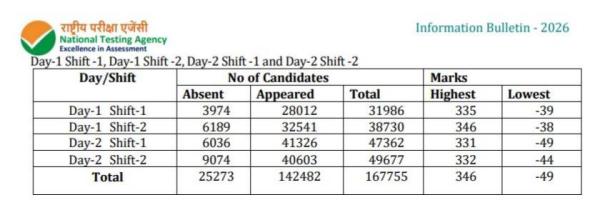 Distribution of Candidates
In this scoring method, the highest raw score in each shift automatically corresponds to the 100 percentile, meaning that 100% of candidates in that shift have scored equal to or below the topper.
Highest Raw Score = 100 Percentile
Every candidate who achieves the top raw score in their respective shift will receive a normalised percentile score of 100. All other scores in that shift are scaled proportionally between the highest and lowest marks.
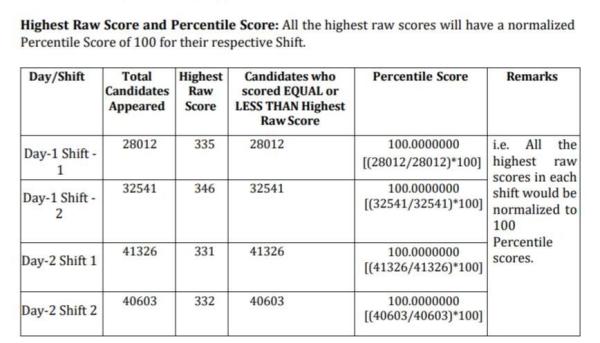 Highest Raw and Percentile Score
In this method, the lowest raw score in each shift is also converted into a percentile score, but unlike the topper’s fixed 100 percentile, it depends on the total number of candidates who appeared in that particular shift. The percentile reflects how many examinees scored equal to or below that lowest mark, ensuring that even the bottom scores are scaled consistently within the shift.
Story continues below this ad
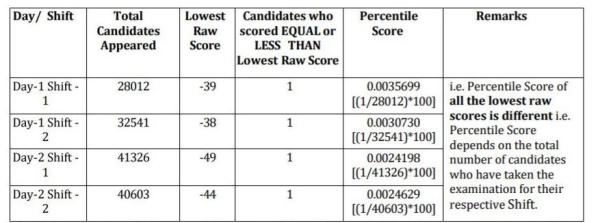 Lowest Raw and Percentile Score
Example: Shift‑3 (Day‑2, Shift‑1)
In this shift, a total of 41,326 candidates appeared for the examination. To interpret the raw scores fairly, each candidate’s marks are converted into a percentile score, which reflects their relative performance within the group.
-The highest raw score automatically corresponds to the 100th percentile, showing that all other candidates scored equal to or below the topper.
-The lowest raw score is also assigned a percentile, determined by the total number of candidates in the shift.
Story continues below this ad
-Scores in between are proportionally scaled, ensuring that every candidate’s performance is judged relative to others in the same shift.
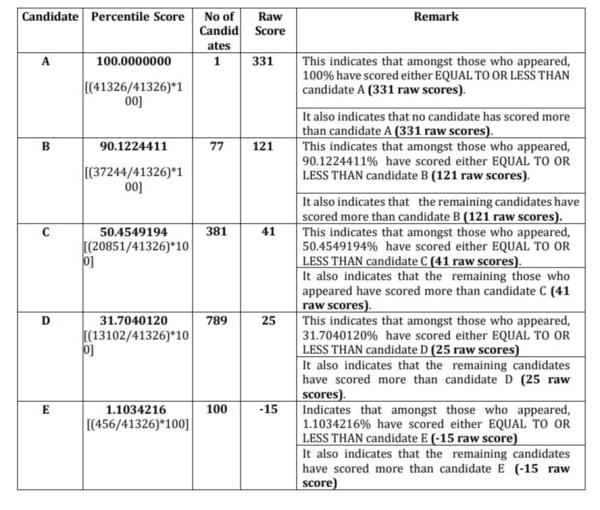 Interpretation of Raw score and percentile score
Step-by-step process for normalisation of JEE scores, and preparation of results:
To ensure fairness across exam sessions, candidates are randomly assigned to shifts so that each shift has approximately the same number of examinees.
For example, if the test is conducted over two shifts in a day, candidates are divided into Day‑1 Shift‑1 and Day‑1 Shift‑2. In case of more days or fewer shifts, the distribution is adjusted accordingly, minimising any bias in allocation. With such a large pool of candidates spread nationwide, the possibility of bias becomes negligible.
Once the examination is conducted, results for each shift are prepared separately. These results include the raw scores obtained by candidates and their corresponding percentile scores. The percentile score represents a candidate’s relative performance within the shift and is calculated for each examinee. For instance, the percentile score of a candidate’s total raw marks is denoted as TP1, which is then used in the normalisation process to ensure comparability across shifts.
Story continues below this ad
 Formula to -Calculate percentile
In the final stage, the percentile scores calculated for each shift are merged to create the NTA scores, which form the basis for compiling results and determining allocations. This ensures that candidates across different shifts are compared on a common scale. If the percentile scores corresponding to the eligibility cut‑off marks vary between shifts, the lowest percentile is adopted as the cut‑off for that category, thereby maintaining fairness.
For example, if 40% marks correspond to a percentile of 78 in Shift‑1 and 79 in Shift‑2, then all candidates scoring at or above the 78th percentile in either shift will be considered eligible under the general category. The same principle applies across all categories and remains consistent even when the examination is conducted in more than two shifts.
