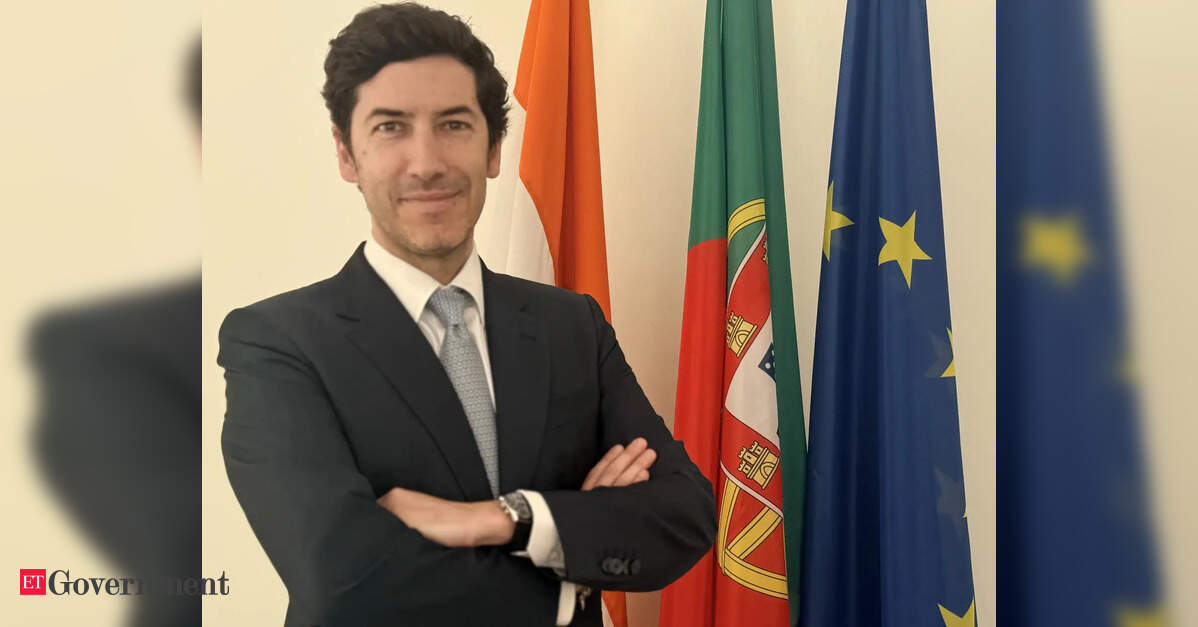
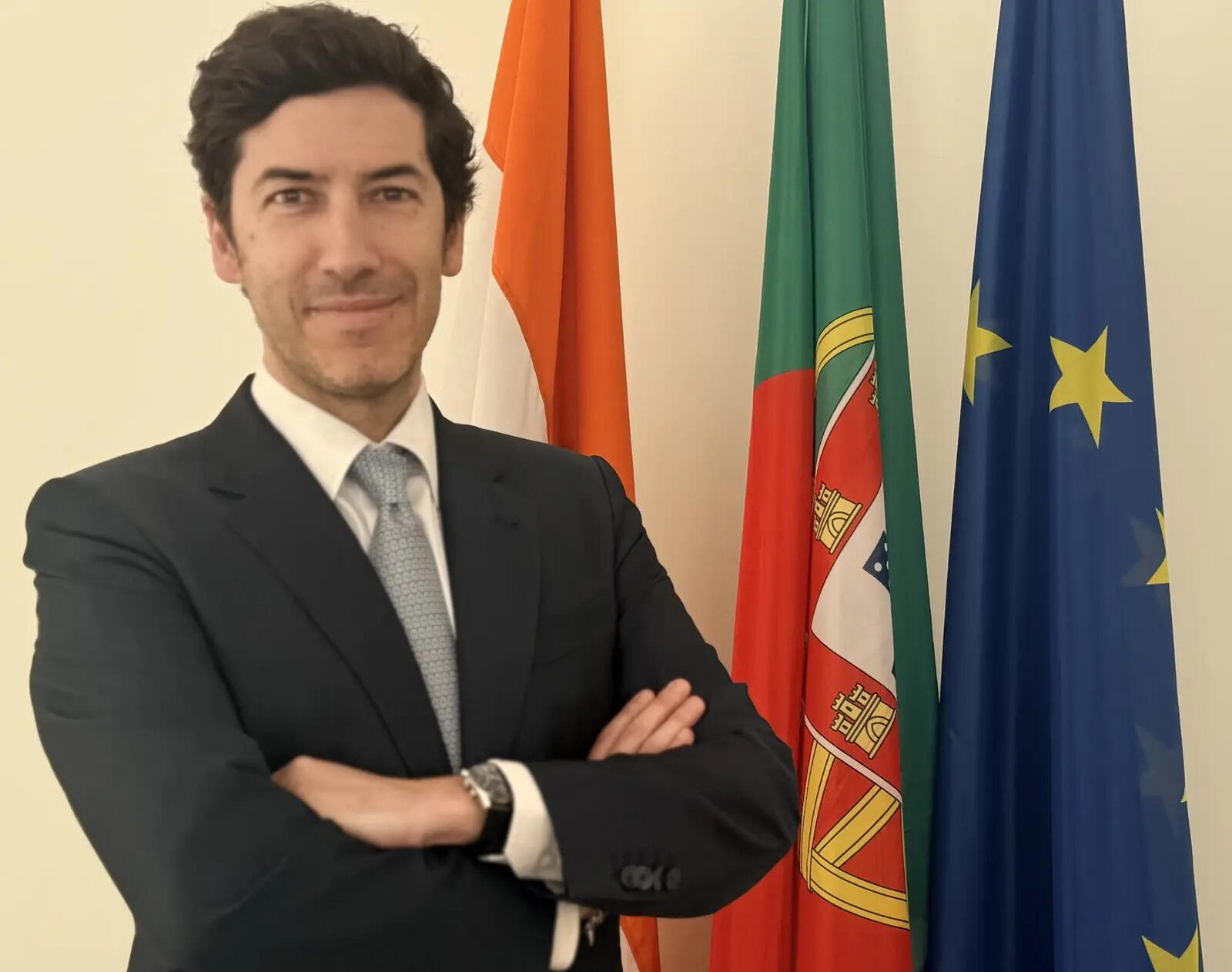
As India and the European Union move closer toward a Free Trade Agreement, João Rui Ferreira, Portugal’s Secretary of State for Economy, is in India leading a high-level delegation of Portuguese entrepreneurs from various sectors.
The visit reflects Portugal’s growing strategic focus on India as one of the world’s fastest-growing major economies and a long-term partner in trade, technology and industrial cooperation.
Against the backdrop of geopolitical uncertainty, supply chain realignments and the emergence of a more multipolar economic order, Portugal is seeking to deepen its engagement with India not merely through commerce, but through long-term investment partnerships, innovation ecosystems and collaborative manufacturing.
In this interview with Anoop Verma, João Rui Ferreira discusses the future of India–Portugal economic relations, the opportunities emerging from the proposed India–EU Free Trade Agreement, Portugal’s strengths in renewable energy and infrastructure, India’s manufacturing ambitions, startup collaboration, and the role both countries can play in shaping a more open and balanced global economy.
Edited excerpts:
How do you see the next phase of India–Portugal economic relations evolving, and what are the key strategic objectives behind your visit to India?
My agenda is very intensive because we want to transform strategic intent into concrete economic outcomes. We have three major priorities for this visit.
The first is attracting more Indian investment into Portugal. We believe this is the right moment because Portugal has demonstrated strong macroeconomic performance and is increasingly positioning itself as a European hub for strategic industries. I am already sensing strong interest from Indian businesses during my meetings here.
The second priority is to help more Portuguese companies expand into India. There are many sectors where Portugal’s industrial capabilities complement India’s ambitious development agenda for 2047. We believe our knowledge, experience and technologies can contribute meaningfully to India’s growth journey.
The third priority is building long-term strategic partnerships in sectors where our economies naturally complement each other. This includes aerospace, defence-related manufacturing, digital technologies, ICT, renewable energy, advanced industries, infrastructure and health technologies.
I am also very interested in strengthening the links between our innovation ecosystems. Both Portugal and India are very dynamic in startups, AI-driven businesses and digital innovation. The reopening of AICEP’s office in New Delhi reflects how strategically important India has become for Portugal. Our message is very clear: Portugal wants a stronger, more practical and more ambitious economic partnership with India.
India and Portugal share deep historical and cultural ties. In the current geopolitical and economic environment, how do you see the bilateral relationship evolving over the next decade?
India is undoubtedly one of the defining economies of this century. I believe the next decade should be the decade in which Portugal and India transform their historical relationship into a truly strategic economic partnership.
Of course, we want to increase trade, but the bigger opportunity lies in investment, industrial cooperation, technology partnerships and innovation. Both countries are strongly focused on innovation, and that creates natural synergies.
Portugal offers stability, European market access, connectivity to talent, and strong links with Africa and Latin America through the Portuguese-speaking world. India brings scale, industrial ambition, innovation capacity and growing global influence.
This creates complementarity rather than competition. We are countries of very different dimensions, but that is exactly why the partnership can become so valuable. The ambition of this visit is to transform a historically good relationship into a long-term business-driven strategic partnership.
Portugal is increasingly positioning itself as a gateway between Europe, Africa and Latin America. How can Indian companies leverage Portugal’s geography and business ecosystem for global expansion?
Portugal offers Indian companies direct access to the European single market, which is effectively one of the world’s largest integrated economies. Establishing operations in Portugal helps Indian businesses meet European regulatory standards while benefiting from legal certainty and strong investment protection frameworks.
Geographically, Portugal occupies a highly strategic position. The Port of Sines, for example, is not just a port. It is emerging as a strategic gateway for European logistics, energy and digital connectivity. The entire ecosystem around Sines is becoming increasingly relevant for maritime trade, clean energy and subsea digital cable connectivity.
Portugal also combines this with strong economic fundamentals. Recently, The Economist recognised Portugal as one of the best-performing economies globally. IMD has ranked Portugal among the world’s top talent economies. We have maintained macroeconomic stability, controlled public debt and growth rates above the European average.
Talent is another major strength. Portugal has strong engineering capabilities, highly qualified professionals and excellent English proficiency. Our startup ecosystem is extremely dynamic, with more than 5,000 startups and seven unicorns with Portuguese DNA. For Indian investors, Portugal is not merely a country to invest in; it is a strategic gateway to Europe and beyond.
The proposed India–EU Free Trade Agreement is being viewed as a major geopolitical and economic development. How do you see it influencing Portugal–India economic cooperation?
Portugal has supported this agreement from the very beginning. We see it as potentially transformational. This agreement is about much more than tariffs. It will deepen strategic economic ties between India and the European Union by improving investment conditions, predictability, legal certainty and investor confidence. These are crucial factors for businesses.
For Portuguese companies, especially in sectors such as manufacturing, machinery, automotive systems, pharmaceuticals and health technologies, the agreement will create new opportunities to engage with India. But I believe the real opportunity goes beyond exports. It lies in local investment, joint ventures and long-term industrial partnerships.
India is not simply a market for Portuguese companies. It is practically a continent in itself. Portuguese companies need local partnerships and a deeper understanding of regional diversity in order to succeed here. That is one of the reasons this visit is so important. We are here to learn, understand and build long-term engagement. Trade agreements create frameworks. Companies create outcomes. That is how I see the future of the FTA.
Do you foresee challenges in the implementation and ratification of the India–EU FTA?
I remain positive. Our expectation is that the agreement can come into effect on January 1, 2027. At the European level, there is strong political support. The President of the European Commission, the President of the European Council and countries like Portugal strongly support this process. Of course, Europe consists of 27 member states, each with its own democratic procedures and rules, but I believe we are now in the final phase. At a time of great uncertainty in global trade and geopolitics, this agreement sends a very positive signal to businesses on both sides.
The world is witnessing geopolitical tensions, supply chain disruptions and economic fragmentation. How is Portugal adapting its economic strategy to this changing environment?
Portugal is focusing on three major strategic pillars. The first is creating a safe and predictable environment for businesses. We are reducing bureaucracy, simplifying processes, increasing transparency and accelerating digitalisation. We want businesses to operate in a faster and more reliable ecosystem.
The second pillar is innovation. Portugal is not competing through volume; we compete through value. We are investing heavily in digital infrastructure, physical infrastructure and innovation incentives. Around 80 percent of our energy now comes from renewable sources, giving us one of Europe’s more competitive energy environments.
The third pillar is openness to the world. Portugal is actively diversifying markets and helping Portuguese companies explore new geographies and strategic partnerships, especially with countries like India.
You mentioned that around 80% of Portugal’s energy comes from renewable sources. What lessons or technologies can India learn from Portugal’s experience?
Portugal has made significant advances in solar and wind energy. In fact, on some days, solar energy prices in Portugal become almost negligible because of our production capacity.
We are also investing heavily in energy storage systems, smart grids and grid stability technologies. Portuguese startups are doing remarkable work in reducing energy losses and improving efficiency in energy systems. Portugal has developed strong expertise in renewable integration, electrification of industry and decarbonisation. We are also investing significantly in the battery value chain, including lithium refining and battery manufacturing.
I believe Portuguese companies, startups and engineering firms can contribute meaningfully to India’s renewable energy ambitions under its 2047 vision.
India is expanding its manufacturing sector through initiatives such as Make in India and the PLI schemes. Do you see Portuguese companies increasing their industrial footprint in India?
This is one of the goals of our mission. Portugal can complement India’s manufacturing ambitions through technology, engineering expertise and industrial know-how. We see strong opportunities in automotive systems, industrial equipment, engineering solutions, clean technologies and advanced manufacturing. Portugal is a country focused on value creation, and when combined with India’s scale, the result can be a very powerful long-term industrial partnership.
Europe is increasingly discussing strategic autonomy and economic resilience. How does Portugal view India’s growing role in shaping a multipolar global economic order?
India is already a global player. It is now the world’s fourth-largest economy and will likely become the third-largest in the coming years. This is the natural evolution of India’s growth story. Portugal and Europe see India as a strategic long-term partner. We want to build relationships based on trust, stability and mutual ambition. Multilateralism is deeply rooted in Portuguese political culture, and we continue to strongly support it. Our centuries-old relationship with India provides a strong foundation to build a deeper economic partnership.
India is investing massively in infrastructure, from ports and highways to smart cities and logistics. Do you see opportunities for Portuguese companies in this transformation?
Infrastructure is one of the most exciting areas for collaboration. We have brought several Portuguese companies to India that specialise in infrastructure development, including roads, railways, airports, waste management, clean energy systems, data centres and smart city solutions. These are globally experienced companies that already operate across multiple international markets.
During our visit to Maharashtra, we saw the scale of investment underway. Even one Indian state represents enormous opportunities. India’s infrastructure transformation is extraordinary. What impressed me most is that this transformation is not merely being discussed. It is already happening. And I believe Portuguese companies can play a meaningful role in supporting India’s next phase of infrastructure growth.
In a world facing economic nationalism, technological disruption and geopolitical uncertainty, what role can countries like India and Portugal play in preserving an open and rules-based global economy?
Portugal believes strongly in dialogue, openness and multilateralism. We are culturally very adaptable people, and that helps us connect easily with different societies and markets. Countries like Portugal and India can create bridges, lower tensions and demonstrate that international cooperation remains essential. Economic growth ultimately improves the lives of people, and governments must create transparent and reliable frameworks that allow businesses to thrive. That is the role we can play together — creating stability, opportunity and hope in an uncertain world.
How do you assess the current level of economic engagement between India and Portugal? Where would you like to see this relationship in the next decade?
The current level of economic engagement is still far below its true potential. There is enormous room for growth.
My ambition is to significantly increase partnerships between Portuguese and Indian companies over the next decade. Portuguese firms need to focus on specific sectors and regions within India rather than viewing India as a single market. Local partnerships and joint ventures will be crucial.
At the same time, we want Indian investors to view Portugal as a safe and strategic platform for expanding into Europe and other global markets. This visit is only the beginning of a longer journey. We want continuity, follow-up and long-term engagement.
Portugal has positioned itself as a European tech hub in recent years. How do you see the Indian talent pool fitting into your country’s specific goals for innovation and the startup ecosystem?
I would invite India’s young generation to know more about Portugal and to visit our country. Portugal has developed a very vibrant ecosystem for conferences, innovation, startups and entrepreneurship. Events like the Web Summit in Lisbon bring together more than 70,000 people from around the world to discuss technology and the future.
Portugal also offers excellent universities, strong opportunities for skilled professionals and attractive programs for international talent. Indian entrepreneurs and innovators will find Portugal to be a welcoming and strategic place to build businesses and global connections. India has an extraordinary entrepreneurial culture. Many Indian entrepreneurs have built global success stories from humble beginnings, and I believe Portugal can become a valuable platform for many more such journeys.
At the same time, Portugal also wants to come to India, create value here, adapt to Indian culture and work together in a spirit of complementarity and partnership.