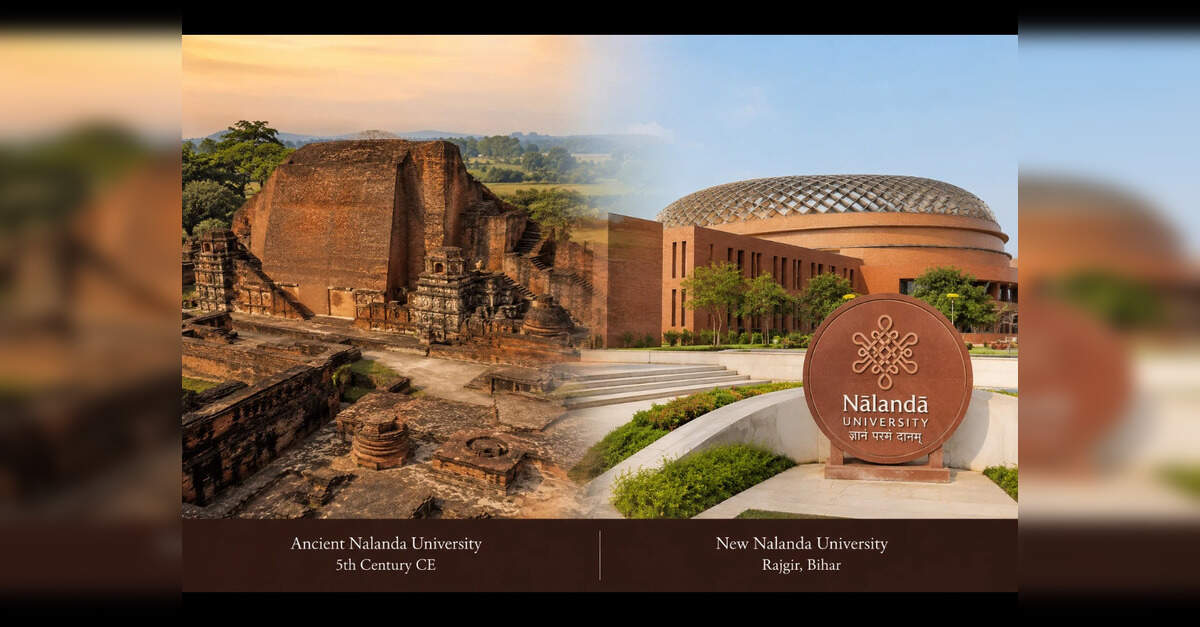
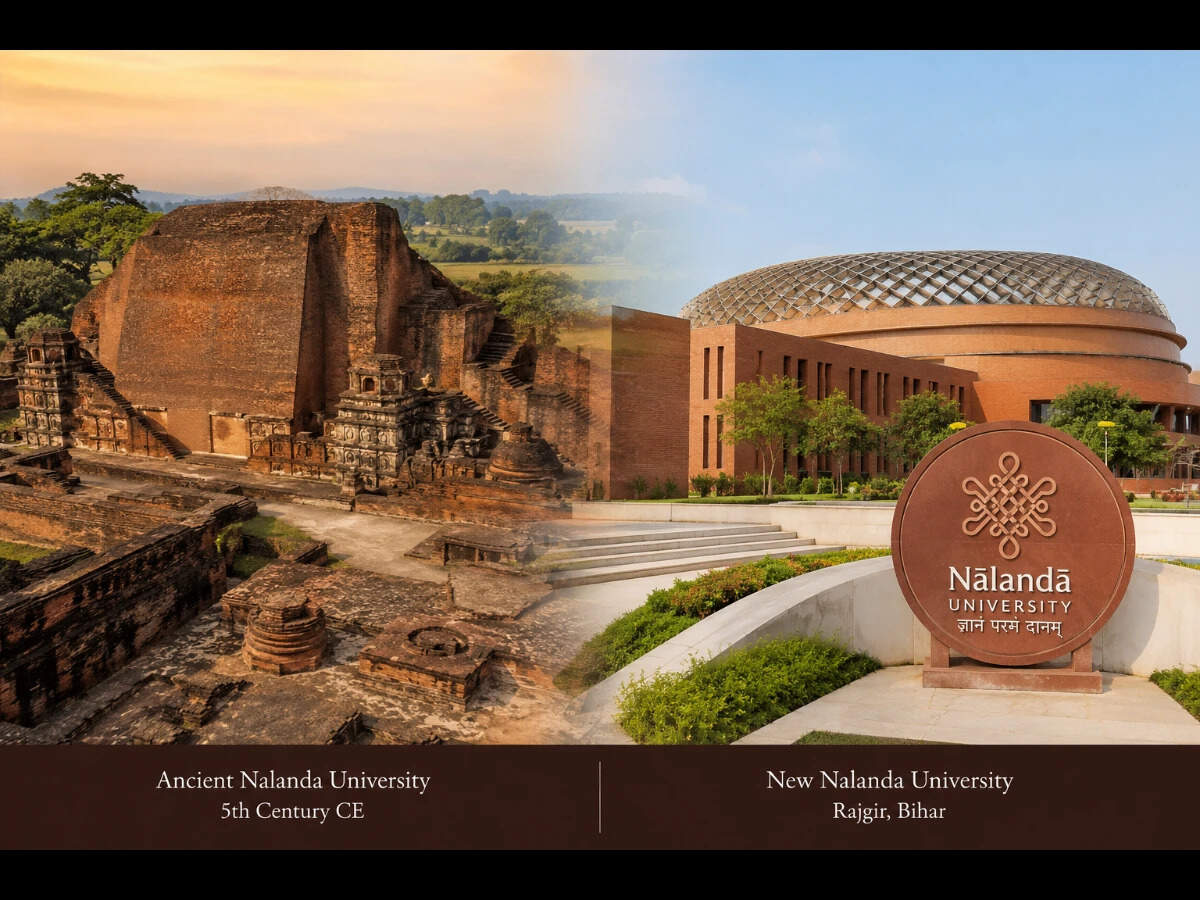
On June 19, 2024, Prime Minister Narendra Modi stood before diplomats, monks, and scholars from across Asia as the new Nalanda University campus rose behind him near the ruins of the ancient institution that once drew students from across the known world.
The symbolism was immense.
India had revived Nalanda.
The new campus in Rajgir was architecturally striking: red-brick academic blocks spread across nearly 500 acres, solar-powered infrastructure, shaded walkways, water bodies, and design elements inspired by the ancient Mahavihara that once connected India intellectually with much of Asia.
Yet behind the ceremony sat a more complicated reality.
Sixteen years after Parliament passed the Nalanda University Act in 2010, the institution had held just two convocations. Between 2016 and 2026, the university awarded degrees to a little over 600 master’s students and around 10 PhD scholars. Several influential figures associated with the revival effort, including Nobel laureate Amartya Sen, former Singapore foreign minister George Yeo, and former President APJ Abdul Kalam in an advisory role, eventually distanced themselves from the project amid disagreements, governance concerns, or institutional frustration.
What was envisioned as one of modern India’s most consequential academic projects instead became a story of political conflict, bureaucratic ambiguity, civilisational symbolism, and unresolved institutional ambition.
And yet, Nalanda is neither the triumphant revival celebrated in political speeches nor the empty failure portrayed by its harshest critics.
It is something more complex: a functioning university carrying the burden of one of history’s greatest academic legacies while still searching for a stable identity of its own.
The weight of ancient Nalanda
Founded in the 5th century CE under the Gupta Empire, ancient Nalanda was among the world’s earliest great residential centres of learning. At its peak, it reportedly housed around 10,000 students and 1,500 teachers studying subjects ranging from Buddhist philosophy and logic to medicine, mathematics, astronomy, grammar, and metaphysics.
Scholars travelled from China, Tibet, Korea, Mongolia, and Sri Lanka to study there. Chinese monk Xuanzang spent years at Nalanda in the 7th century and described a deeply rigorous intellectual culture. Centuries before Europe’s oldest universities emerged, Nalanda had already become a global knowledge centre.
Its destruction in the late 12th century during Bakhtiyar Khilji’s invasion acquired near-mythic status in Indian historical memory. Historical accounts describe the university’s library complex burning for months.
What disappeared was not merely a campus, but a transnational intellectual network connecting large parts of Asia. The ruins eventually became a UNESCO World Heritage Site. But the idea of reviving Nalanda as a modern university remained dormant until the early 2000s.
In her 2026 convocation address, President Murmu said ancient Nalanda welcomed diverse ideologies and fostered a culture of debate and dialogue, a tradition the modern institution continues to invoke symbolically.In her 2026 convocation address, President Murmu said ancient Nalanda welcomed diverse ideologies and fostered a culture of debate and dialogue, a tradition the modern institution continues to invoke symbolically.
More than a university
Modern Nalanda was never conceived as a routine central university.
It was imagined simultaneously as:
- a postgraduate research institution,
- a pan-Asian academic platform,
- a Buddhist civilisational bridge,
- a soft-power instrument for India,
- and a symbol of Bihar’s historical revival.
In many ways, it was supposed to become India’s first truly transnational university.
That ambition explains why the project drew support not just domestically but from countries across East and Southeast Asia. It also explains why Nalanda eventually came under the Ministry of External Affairs rather than the Ministry of Education, a decision that would later shape many of its institutional contradictions.
The modern revival formally began in 2006 when President APJ Abdul Kalam proposed rebuilding Nalanda as an international university while addressing the Bihar legislature.
The moment carried political significance.
Nitish Kumar had recently taken office as Bihar Chief Minister and was attempting to reposition the state after years of governance decline and economic stagnation. Nalanda fit naturally into that larger aspiration.
The Bihar government transferred hundreds of acres near Rajgir for the project. At the East Asia Summit in 2007, sixteen participating nations endorsed the initiative.
Soon after, the UPA government established the Nalanda Mentor Group under Nobel laureate Amartya Sen. Parliament passed the Nalanda University Act unanimously in 2010, and the Union government approved ₹2,727 crore for the project.
On paper, the ambition was extraordinary.
Several exits, one pattern
The university’s troubles, however, began long before the permanent campus emerged. Even during its formative years, Nalanda suffered from a deeper institutional ambiguity.
Was it:
- an academic institution,
- a diplomatic platform,
- a civilisational showcase,
- or a political prestige project?
Different stakeholders appeared to answer that question differently.
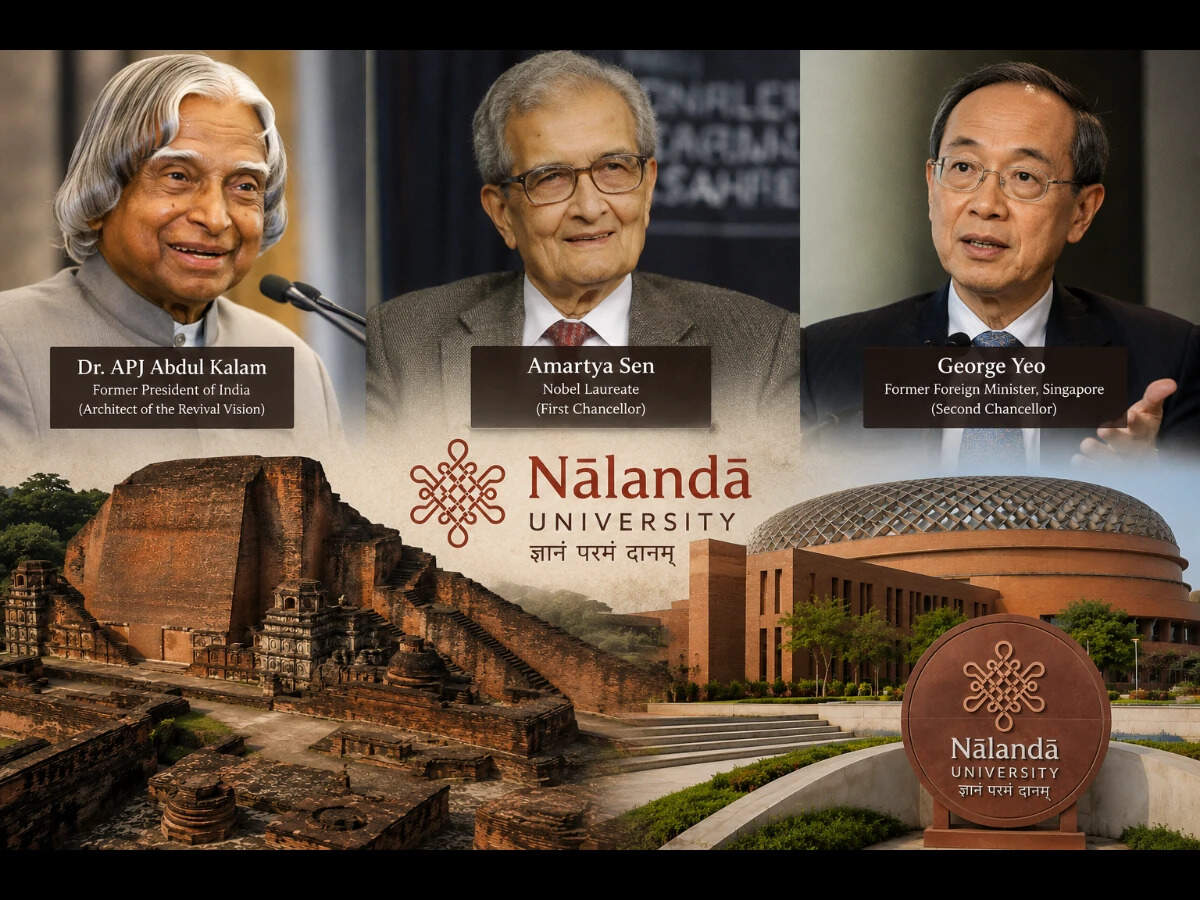
Amartya Sen became the intellectual face of the revival effort and brought enormous international credibility to the institution. But his tenure also became associated with disputes over governance, appointments, and administrative functioning.
By 2015, tensions between Sen and the Modi government had escalated publicly. Sen eventually withdrew himself from consideration for another term as Chancellor, stating that government “non-action” had created a decisional vacuum.
The episode transformed Nalanda into a national political controversy. One of the lesser-discussed but revealing episodes involved APJ Abdul Kalam himself.
In a 2011 letter later revealed through RTI disclosures, Kalam reportedly argued that the university needed leadership combining academic stature with long-term institutional commitment. Soon afterward, he quietly distanced himself from the project.
Then came George Yeo.
The former Singapore foreign minister appeared capable of restoring Nalanda’s international credibility without being embedded in Indian ideological battles.
But in 2016, the Government dissolved the university’s governing structure. Yeo resigned soon afterward, saying the autonomy he had been assured did not appear to exist in practice. The repeated exits of influential figures reflected a broader pattern of institutional instability.
The numbers behind the symbolism
For all the symbolism surrounding Nalanda, the institution’s academic scale remains modest relative to the investment and expectations attached to it. The first convocation took place in 2016, with only 12 students graduating.
The second convocation was held only in 2026, when the university awarded degrees to cumulative graduating batches, including its first doctoral scholars. Between 2016 and 2026, Nalanda awarded degrees to more than 600 master’s students and around 10 PhD scholars.
The scale gap becomes clearer in comparison.
| Institution | Approx Students | Permanent Faculty | PhD Output |
| Nalanda University | 1200+ | Limited faculty strength | Around 10 in 9 years |
| JNU | 8,000+ | 600+ | Hundreds annually |
| Ashoka University | 4,000+ | 300+ | Growing doctoral pipeline |
The issue is not that Nalanda should immediately resemble older universities. It is that the distance between vision and institutional depth remains unusually large.
A 2017 CAG report had also flagged several governance and administrative concerns during the university’s formative years, including procedural delays and questions related to approvals and institutional processes.
What Nalanda actually is today
Strip away the politics and Nalanda today is, fundamentally, a functioning postgraduate institution.
It operates schools in:
- Historical Studies,
- Ecology and Environment Studies,
- Buddhist Studies, Philosophy and Comparative Religion,
- Languages and Literature/Humanities,
- and Management Studies.
Among its more distinctive offerings are programmes related to Buddhist studies, Pali, Sanskrit, Tibetan, sustainability, and Asian civilisational traditions.
From just 15 students operating out of temporary facilities in 2014, the university has now crossed 1,200 students. At the 2026 convocation ceremony, President Droupadi Murmu noted that more than half of the graduating cohort comprised international students representing over 30 countries, reinforcing Nalanda’s continuing attempt to position itself as a global university rooted in Asian intellectual traditions.
Few public universities in India possess infrastructure of comparable architectural ambition. Yet the scale gap persists.
The campus was envisioned for several thousand students. Current enrollment remains only a fraction of that intended scale.
Faculty strength also remains a challenge. Publicly available estimates suggest the university continues to operate with a relatively small permanent faculty base across schools. That has implications for research depth, doctoral supervision, and long-term academic credibility.
Why students still come
The most overlooked part of the Nalanda story is that students continue choosing the institution despite its controversies. Very few universities in India offer the same mix of Buddhist studies, Asian civilisational research, sustainability programmes, international diversity, and fully residential academic life.
For many international students, especially from Buddhist-majority countries, Nalanda carries symbolic and intellectual value that extends beyond rankings.
“People outside think Nalanda is either a political project or an empty campus. But academically, some of the classes are genuinely intense because the batches are small,” said an international postgraduate student who did not wish to be identified.
Another student described the university as intellectually promising but institutionally unsettled.
“The campus infrastructure is world-class, but students still feel the university is searching for an identity,” the student said. “Sometimes it feels like the institution is caught between being a diplomatic project and being an academic university.”
A former faculty member offered a similar assessment. “The symbol came before the substance,” the former faculty member said on condition of anonymity. “The university wanted to position itself globally before stabilising its academic foundations.”
Why the Structure Itself Became the Challenge
One of the most unusual aspects of Nalanda is that it is governed by the Ministry of External Affairs rather than the Ministry of Education. That arrangement reflected the university’s original diplomatic purpose: reconnecting India with Buddhist Asia and projecting soft power through scholarship.
But it also created structural complications.
Diplomatic systems are not designed to run universities.
Processes routine in most academic institutions often became more complicated within a framework involving multiple layers of approval and coordination.
At the same time, Bihar, despite providing land, infrastructure support, and political backing, retained very limited operational control over the institution.
That contradiction remains central to the Nalanda story.
For Bihar, the university represented more than education. It symbolised hopes of tourism growth, global visibility, infrastructure development, and regional transformation.
Some of that visibility arrived. Roads improved. International conferences and diplomatic delegations increased attention around Rajgir.
But the broader academic and economic ecosystem expected around a major global university has not emerged meaningfully yet.
Neither failure nor fulfilment
The easiest version of the Nalanda story is to describe it either as a grand revival or as a failed experiment. Reality lies somewhere in between.
The university today possesses genuine strengths:
- a globally visible campus,
- significant international diversity,
- niche academic programmes,
- and symbolic value unmatched by most Indian institutions.
At the same time, questions surrounding governance, faculty depth, research scale, and institutional clarity remain unresolved.
Several academics familiar with Nalanda argue that the university may still evolve into a specialised global centre rather than a large conventional institution. Its smaller scale, they argue, could eventually become an advantage if accompanied by stronger research ecosystems and academic autonomy.
The physical campus is now real, and real campuses generate their own momentum. University administrators have in recent years focused heavily on expanding infrastructure, international enrollment, and academic partnerships.
During the 2026 convocation ceremony, President Droupadi Murmu described Nalanda as a “civilizational promise” and said institutions like it would play a vital role as India moves toward becoming a developed nation by 2047.
Whether Nalanda eventually becomes a globally respected intellectual institution or remains primarily a symbolic project will depend less on ceremonies and more on whether it can build durable academic legitimacy.
ETEducation reached out to Nalanda University and Vice-Chancellor via email and phone calls over the past three weeks seeking responses to questions related to the university’s academic growth, faculty strength, governance structure, international collaborations, and future plans. No response was received till the time of publication.
Ancient Nalanda survived for centuries not because rulers celebrated it, but because its scholars produced knowledge that travelled across Asia.
That remains the real challenge before modern Nalanda.