India’s digital transformation is among the defining success stories of the 21st century.
Smartphones have connected hundreds of millions, digital payments have become ubiquitous, artificial intelligence is reshaping industries, and the country is investing heavily in semiconductors, electric vehicles, renewable energy, data centres and advanced telecommunications. These developments are central to India’s ambition of becoming a developed economy.
Yet beneath this technological progress lies a growing challenge that has received far less attention than it deserves: electronic waste, or e-waste.
While plastic pollution rightly dominates environmental discussions, e-waste may emerge as an even greater long-term challenge. Unlike plastic waste, which is primarily a disposal and pollution issue, e-waste combines environmental degradation, public health risks, resource security concerns, cybersecurity vulnerabilities and economic losses into a single, rapidly expanding problem.
The question facing India is no longer whether e-waste will increase. It undoubtedly will. The real question is whether the country can transform this challenge into an opportunity and make e-waste management a pillar of sustainable growth.
India’s Growing E-Waste Mountain
The numbers are sobering. Official figures indicate that India’s e-waste generation increased from 12.54 lakh metric tonnes in FY 2023-24 to 13.98 lakh metric tonnes in FY 2024-25, representing growth of more than 11 per cent in a single year. During the same period, reported collection, dismantling and recycling rates improved from 61.94 per cent to 70.71 per cent, reflecting significant progress in formalisation and compliance.
These figures from CPCB EPR Annual Report 2024-25 suggest that India’s regulatory framework is beginning to deliver results. However, they also highlight the scale of the challenge ahead.
The problem extends far beyond discarded mobile phones and laptops. Modern e-waste increasingly includes servers from hyperscale data centres, telecommunications equipment, batteries, solar photovoltaic systems, electric vehicle components, industrial control systems, medical devices and smart appliances.
Every AI-enabled data centre being built today will eventually contribute to tomorrow’s e-waste stream. Every electric vehicle sold today will generate future battery disposal requirements. Every solar panel installed to support clean energy goals will ultimately reach the end of its operational life.
India is therefore facing not a temporary surge but the beginning of a structural and long-term challenge.
Why E-Waste Could Become Bigger Than Plastic
Plastic waste remains a serious environmental concern, but e-waste presents a far more complex challenge.
A discarded plastic bottle is largely an environmental liability. A discarded smartphone, server or EV battery is simultaneously an environmental risk, a cybersecurity concern, a repository of critical minerals and a lost economic opportunity. Electronic waste contains hazardous materials such as lead, mercury, cadmium and brominated flame retardants that can contaminate soil, water and ecosystems if improperly handled.
At the same time, these products contain valuable materials including gold, silver, copper, lithium, cobalt, nickel, palladium and rare earth elements. In essence, e-waste is both a pollution challenge and a resource challenge. Countries that recognise this distinction earliest will gain significant strategic advantages.
The Hidden Wealth in Urban Mining
India currently imports a substantial proportion of the critical minerals required for advanced manufacturing, electric mobility, energy storage and electronics production.
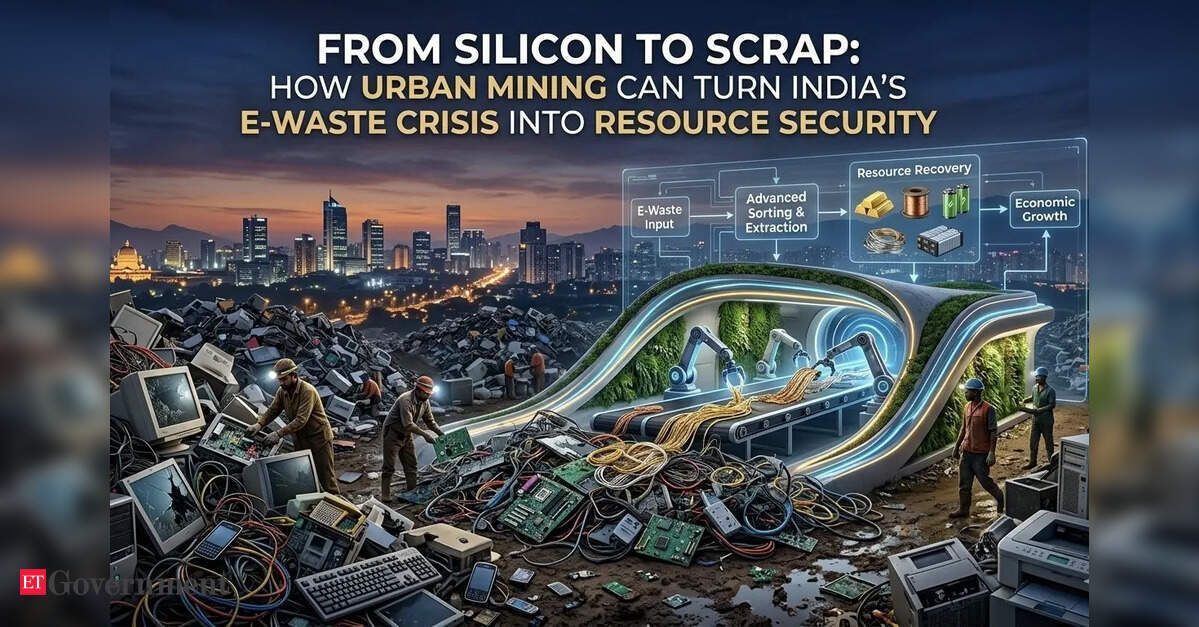
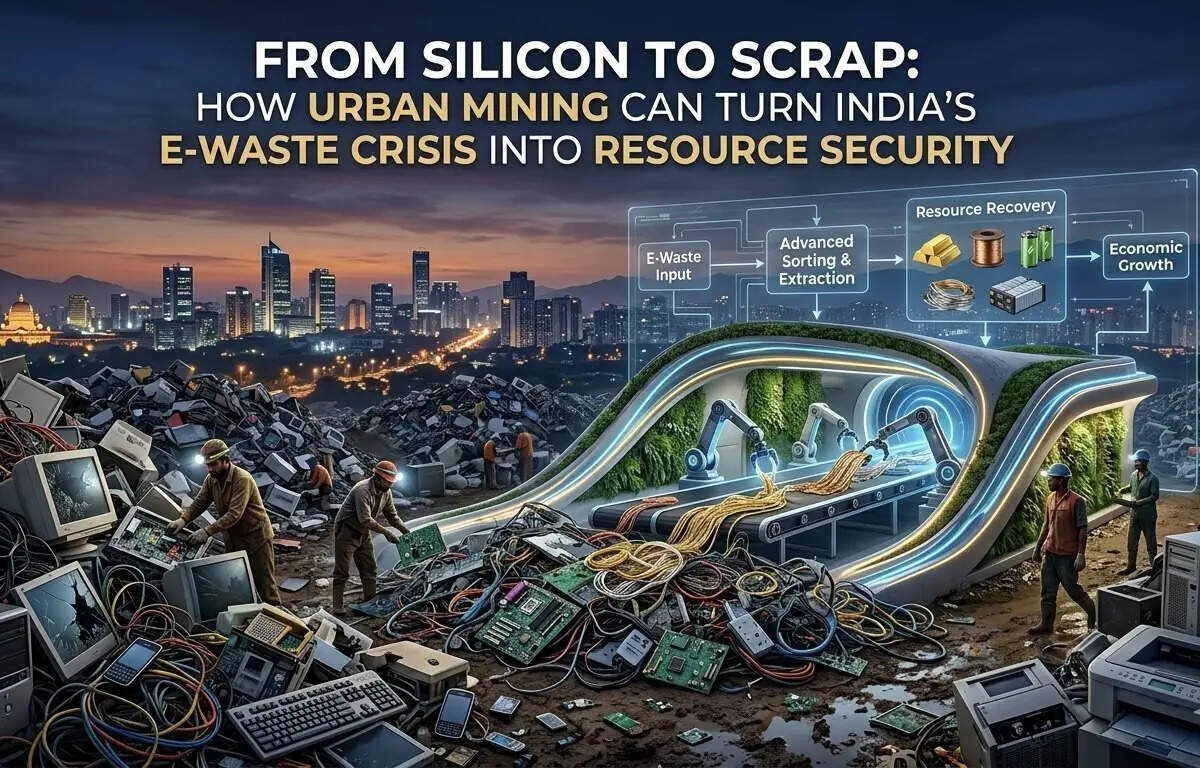
Yet large quantities of these same materials already exist within the country’s growing e-waste stream. This has given rise to the concept of urban mining, the recovery of valuable resources from discarded electronics and infrastructure. In many cases, electronic waste contains higher concentrations of valuable materials than naturally occurring ore deposits.
As India pursues ambitious goals in semiconductors, batteries, renewable energy, defence manufacturing and AI infrastructure, urban mining can become an important pillar of resource security. E-waste should no longer be viewed solely as a waste management problem. It should be viewed as a strategic resource recovery opportunity.
The Architecture Exists, But Collection Remains the Weakest Link
India deserves credit for creating one of the world’s more advanced digital governance systems for e-waste management.
The E-Waste Management Rules and the CPCB’s EPR portal have created a transparent compliance architecture involving producers, manufacturers, recyclers and refurbishing centres. India today has more than 320 registered recyclers and over 70 registered refurbishing centres, with a combined annual processing capacity exceeding 22 lakh metric tonnes.
This creates an important policy paradox.
India’s formal recycling capacity already exceeds officially reported annual e-waste generation. If recycling infrastructure exists, why does so much e-waste continue to flow through informal channels?
The answer lies not in recycling capacity but in collection efficiency, traceability and enforcement. The fact that registered recycling capacity exceeds annual e-waste generation suggests that the primary challenge is no longer one of recycling infrastructure. The bottlenecks increasingly lie in collection, aggregation, reverse logistics and ensuring that waste actually enters the formal ecosystem.
The current EPR framework has successfully created a recycling market. Producers fulfil their obligations by purchasing certificates generated by registered recyclers after processing e-waste. While this has improved compliance, it does not automatically guarantee the development of robust collection systems.
This raises perhaps the most important question in India’s e-waste journey. Has India built a recycling market or a collection market?
E-waste is generated in millions of homes, offices, hospitals, factories, telecom networks, government departments and data centres. Recovering these assets requires reverse logistics, collection centres, consumer participation and take-back mechanisms. The next phase of reform must focus as much on collection as on recycling.
The Consumer Challenge
A significant portion of India’s e-waste never enters either formal or informal recycling channels immediately after reaching the end of its useful life. Millions of obsolete mobile phones, laptops, chargers and electronic accessories remain stored in homes and offices for years. Concerns over personal data, uncertainty regarding disposal options, perceived residual value and simple lack of awareness often discourage consumers from surrendering old devices.
This phenomenon creates a hidden reservoir of electronic waste that remains outside the formal collection ecosystem. Improving collection rates will therefore require not only additional infrastructure but also greater public awareness, trusted take and buy back mechanisms and convenient consumer facing collection programmes. Unless households and organisations are encouraged to release dormant devices into the recycling chain, a substantial portion of India’s e-waste will continue to remain invisible to the formal system.
Integrating the Informal Sector
One of the most persistent challenges in India’s e-waste ecosystem is the dominance of informal collection and processing networks. Traditional scrap dealers and informal collectors possess something that formal recycling systems often struggle to replicate and that is the extensive last mile reach and collection efficiency.
Attempting to eliminate these networks through regulation alone is unlikely to succeed. The more practical approach is integration.
India should build a hybrid ecosystem that combines the environmental safeguards and traceability of formal recycling with the collection efficiency of informal networks. Training, certification, digital registration and financial incentives can help bring informal workers into the formal economy while preserving livelihoods and improving environmental outcomes.
The objective should not be to eliminate the informal sector. It should be to formalise it.
Beyond Compliance: The Enforcement Challenge
Another critical issue is enforcement. India’s e-waste governance framework operates through a dual structure. The Central Pollution Control Board establishes policy frameworks, manages the national EPR portal and oversees compliance architecture.
However, field level enforcement rests largely with State Pollution Control Boards and Pollution Control Committees. This distinction is important. The sophistication of a national digital portal does not automatically translate into uniform implementation across all states. Enforcement capability varies significantly in terms of manpower, technical expertise, monitoring capacity and recycling infrastructure.
As a result, the effectiveness of India’s e-waste policy should be measured not only through recycling percentages and certificates generated but also through inspections conducted, violations detected, illegal facilities closed, certificate audits undertaken and enforcement actions completed. A mature regulatory system requires both compliance and credible enforcement.
Producer Responsibility Must Evolve
Extended Producer Responsibility has been a significant policy innovation. However, the next phase must move beyond demonstrating compliance through certificates alone.
Global and domestic manufacturers that benefit from India’s vast consumer market must play a greater role in financing collection networks, take back systems and reverse logistics infrastructure. Producer responsibility should increasingly be measured not only by certificates purchased but also by measurable collection outcomes, consumer awareness initiatives and recovery performance.
The success of EPR will ultimately depend on whether producers become active participants in the collection ecosystem rather than passive participants in a compliance ecosystem.
A New Cybersecurity Challenge
E-waste policy is increasingly becoming a cybersecurity issue. Discarded servers, enterprise storage systems, telecom equipment, government hardware and critical infrastructure components often contain sensitive information. Improper disposal can expose organisations and even national infrastructure to data breaches and cyber risks.
As India’s digital economy expands, secure destruction and certified sanitisation of digital assets must become a mandatory component of e-waste management. This is particularly important for government departments, defence establishments, financial institutions and critical infrastructure operators.
What India Must Do Next
The next phase of India’s e-waste journey should focus on six priorities.
First, establish a nationwide producer supported collection network that reaches consumers at the district level. Outreach to consumers can be part of this initiative.
Second, integrate informal collectors through certification, skilling and digital onboarding programmes.
Third, publish enforcement metrics alongside compliance metrics to improve transparency and accountability.
Fourth, create a dedicated Urban Mining Mission linked to India’s Critical Minerals strategy to recover valuable materials from e-waste streams.
Fifth, mandate secure data destruction standards for enterprise, government and critical infrastructure assets.
Sixth, operationalise a robust Right-to-Repair framework to extend product lifecycles and reduce waste generation at source.
The Road Ahead
The same cities driving India’s technological and economic growth are generating the largest volumes of electronic waste. This reality presents both a warning and an opportunity.
If left unmanaged, e-waste could become one of India’s most significant environmental challenges over the coming decades, potentially surpassing plastic waste in complexity and long-term impact. If managed effectively, however, it can become a valuable source of critical materials, employment, innovation and sustainable economic growth.
India has built a credible digital architecture for e-waste governance. The challenge now is to ensure that compliance translates into collection, recycling translates into resource recovery, and policy ambition translates into enforcement.
World Environment Day is an appropriate moment to recognise that the future of environmental protection will not be determined solely by how we manage forests, rivers and emissions. It will also depend on how responsibly we manage the technologies that increasingly define modern life.
The opportunity is clear: transform a growing environmental liability into a strategic national asset and a cornerstone of India’s circular economy.
(Lieutenant General Madhavan Unnikrishnan Nair (Retd.) is former Signal Officer-in-Chief and former National Cyber Security Coordinator (NCSC); Views expressed are personal)