

Indian Geography is a key topic in General Awareness and General Studies for competitive exams. It covers India’s physical features, climate, rivers, states, natural resources, and population distribution. Understanding Indian Geography helps aspirants answer questions accurately and quickly, as it appears in SSC, Banking, RRB, and State PSC exams. Simple visualization and logical memory techniques can make this topic easy to master.
Geography Notes PDF
Download Geography Notes highly useful for SSC Exams by clicking on the link below :
Indian Geography Notes-At a Glance
THE HIMALAYAN MOUNTAIN
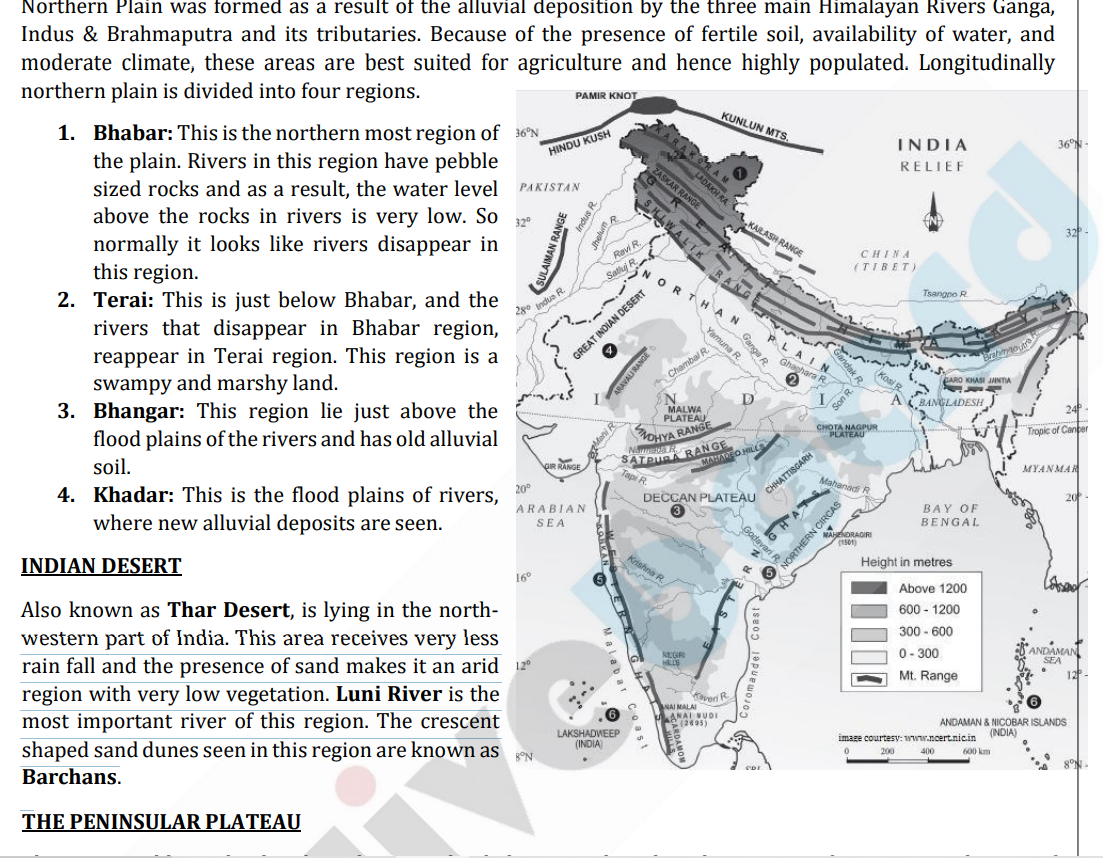
This young fold mountain ranges from north to the north-eastern borders of India. The Himalayas consist of three parallel longitudinal ranges; Greater or Inner Himalayas or the Himadri, Middle Himalayas or Lesser Himalayas or Himachal, and Outer Himalaya or Shiwalik.
- Himadri: This is the northern most range and most continuous of all the three ranges. It is also home to loftiest peaks including Mt. Everest.
- Himachal: It is composed of highly compressed and altered rocks. Pir Panjal, Dhaula Dhar, and Mahabharat are very famous ranges present here. It is also famous for many valleys including Kashmir, and Kulu valley. This region is also known for hill stations.
- Shiwalik: It is composed of unconsolidated sediments brought down by Himalayan Rivers. The longitudinal valleys lying between Himachal and Shiwalik is known as Duns. Dehra Dun, Kotli Dun and Patli Duns are some of the well-known Duns.
Indian Geography-THE PENINSULAR PLATEAU
Plateau is a tabletop land. Indian Plateau is divided into two based on the position of River Narmada. Part of the plateau lying north of Narmada is called Central Highlands and the part lying south of Narmada is known as Deccan Plateau.
- Central Highlands: In south it is bounded by Vindhyan range and north-west by Aravalis. The further westward extension gradually merges with the Thar Desert. Its eastern extension is known as the Bundelkhand and Baghelkhand.
- Deccan Plateau: This triangular land mass, in south west is bounded by Western Ghats and in South-East by Eastern Ghats. Anai Mudi is the highest peak in Western Ghats and Mahendragiri in Eastern Ghats. Western Ghat is more continuous and hence only with the help of a natural pass, anyone can cross it. On the other side, Eastern Ghat is discontinuous and can be easily crossed.

Hi, I’m Tripti, a senior content writer at Oliveboard, where I manage blog content along with community engagement across platforms like Telegram and WhatsApp. With 3+ years of experience in content and SEO optimization related to banking exams, I have led content for popular exams like SSC, banking, railway, and state exams.
