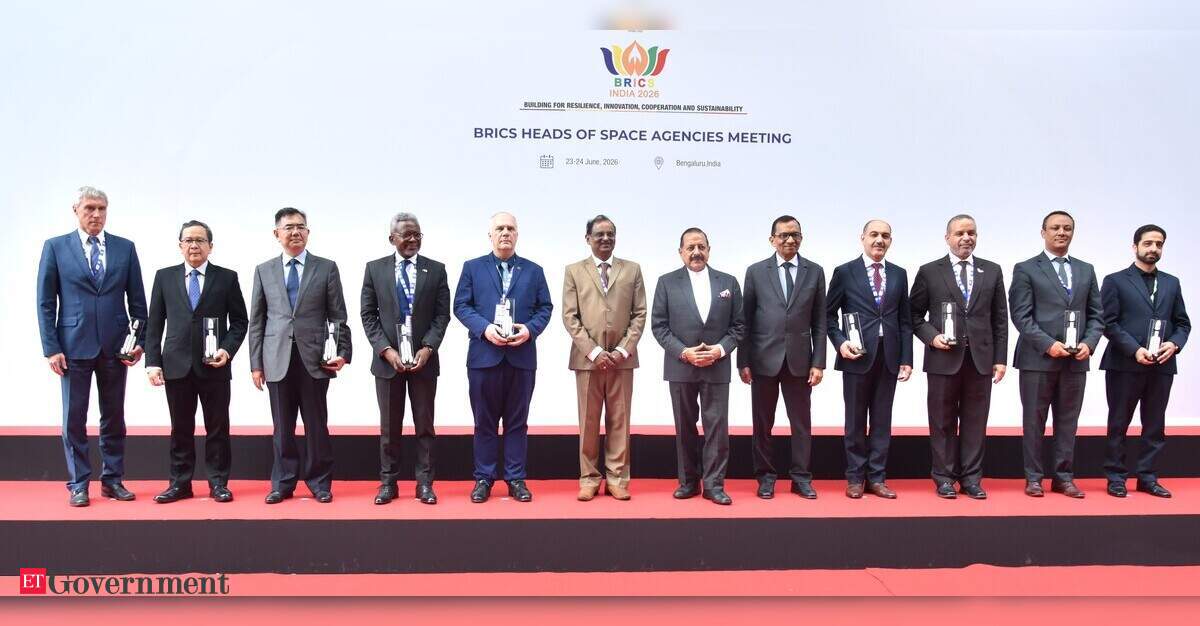

India has proposed the creation of a “BRICS Space Economy” framework, positioning space not merely as a strategic domain but as a major driver of future economic growth, technological innovation and sustainable development.
The proposal was put forward by Union Minister of State (Independent Charge) for Science & Technology, Earth Sciences, and Minister of State for the Prime Minister’s Office, Personnel, Public Grievances, Pensions, Atomic Energy and Space, Dr. Jitendra Singh, while addressing the valedictory session of the BRICS Heads of Space Agencies (HOSA) Meeting in Bengaluru.
The proposal comes at a time when the global space sector is undergoing rapid commercial expansion, with governments increasingly relying on partnerships with private industry, startups and international collaborators to develop next-generation space technologies and applications. Against this backdrop, India argued that BRICS countries collectively possess the scientific capability, industrial strength, technological expertise and market scale to emerge as one of the world’s most influential space blocs.
“The future of the space economy will not be shaped by nations working in isolation. It will be shaped by partnerships, shared innovation and collective ambition,” Dr. Jitendra Singh said, urging member nations to move towards deeper collaboration in research, technology development and commercial space activities.
Hosted by the Indian Space Research Organisation (ISRO) under India’s BRICS Chairship in 2026, the two-day meeting brought together the heads of space agencies and senior officials from Brazil, China, Egypt, Ethiopia, Indonesia, Iran, Russia, South Africa and the United Arab Emirates. The meeting was attended by ISRO Chairman and Secretary, Department of Space, Dr. V. Narayanan, IN-SPACe Chairman Dr. Pawan Goenka, senior Department of Space officials, representatives of India’s growing private space industry and NewSpace startups.
From Strategic Cooperation to Economic Collaboration
While BRICS has traditionally cooperated in satellite applications and Earth observation, India’s intervention sought to expand the scope of engagement towards a broader economic partnership.
Dr. Jitendra Singh argued that the space sector is increasingly becoming an important pillar of national economies, supporting telecommunications, navigation, agriculture, disaster management, environmental monitoring, healthcare, education and digital connectivity. According to him, BRICS nations can leverage their combined capabilities to accelerate innovation, attract investment, encourage technology transfer and strengthen industrial partnerships.
The Minister proposed that BRICS countries move beyond policy coordination towards co-development, co-innovation and co-creation of space technologies by bringing together scientists, engineers, industries, startups and young innovators from member nations.
The emphasis reflects India’s broader strategy of integrating its rapidly expanding private space ecosystem into international partnerships following reforms that opened the country’s space sector to private participation.
Space Sustainability Emerges as a Common Priority
A significant part of the discussions focused on the long-term sustainability of outer space.
Participating countries reviewed ongoing cooperation on space sustainability, debris-free missions and the expansion of the BRICS Remote Sensing Satellite Constellation (RSSC), which enables participating countries to share satellite data for applications such as disaster management, environmental monitoring and resource mapping.
The meeting also deliberated on expanding participation of newer BRICS members in existing space cooperation mechanisms and advancing discussions on establishing a proposed BRICS Space Council that could provide an institutional framework for future collaboration.
Highlighting the growing challenge posed by increasing satellite launches and orbital congestion, Dr. Jitendra Singh stressed that preserving outer space as a safe and sustainable environment would require greater international cooperation, transparency and responsible behaviour.
He welcomed discussions on debris-free missions and sustainable space operations, describing them as essential for safeguarding future space activities.
India’s Expanding Space Ecosystem
The Minister also highlighted India’s own transformation in the space sector over the past few years.
He said policy reforms initiated under Prime Minister Narendra Modi have opened the space sector to startups, academia and private industry, resulting in one of the world’s fastest-growing commercial space ecosystems. India’s recent missions, including Chandrayaan-3, Aditya-L1 and the ongoing Gaganyaan human spaceflight programme, have expanded opportunities for international scientific collaboration while demonstrating the country’s growing technological capabilities.
During the meeting, Dr. Jitendra Singh released the Indian Space Industry Brochure, interacted with representatives of Indian NewSpace startups and private companies, and showcased India’s emerging commercial space capabilities to visiting BRICS delegations.
Towards a BRICS Space Architecture
Beyond technical cooperation, the Bengaluru meeting reflected a broader attempt by BRICS countries to strengthen institutional mechanisms for space collaboration.
The proposed BRICS Space Council, expansion of the Remote Sensing Satellite Constellation, greater collaboration in disaster management, Earth observation, capacity building and knowledge sharing collectively point towards a more structured framework for long-term cooperation among member countries.
Concluding the meeting, Dr. Jitendra Singh reiterated India’s commitment to working closely with all BRICS partners to transform shared aspirations into concrete outcomes.
He said India envisions BRICS space cooperation evolving beyond consultation into co-development and innovation, enabling member countries to jointly address global challenges while contributing to a more resilient, sustainable and economically vibrant global space ecosystem.