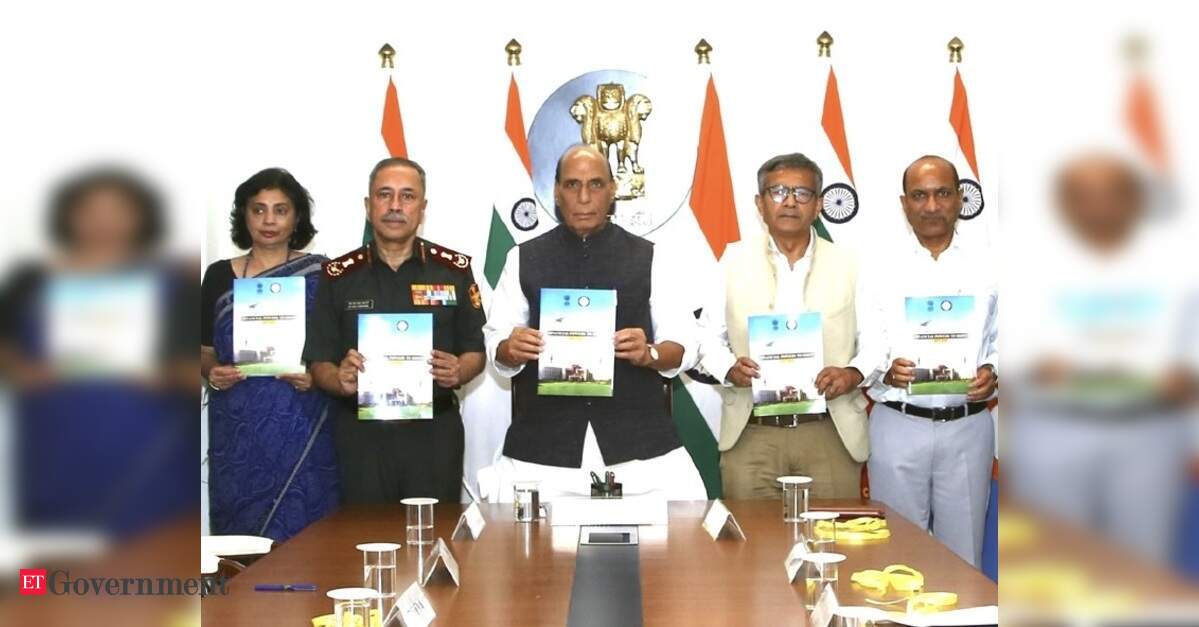

In a significant policy reform aimed at accelerating India’s defence research ecosystem, Defence Minister Rajnath Singh on Monday unveiled the Delegation of Financial Powers to DRDO (DFP-2026), granting greater financial autonomy to the Defence Research and Development Organisation (DRDO).
The move is expected to reduce procedural delays, speed up research and development programmes, and facilitate faster induction of indigenous military technologies into the Armed Forces.
The new framework marks one of the most consequential administrative reforms for DRDO in recent years. Rather than focusing solely on increasing financial limits, DFP-2026 restructures decision-making authority across different levels of the organisation, allowing projects to move ahead with fewer administrative bottlenecks while strengthening accountability.
Launching the revised framework, Rajnath Singh described it as an important step towards improving efficiency, transparency and timely execution of strategic defence projects. He said the new financial architecture would enable quicker production and induction of systems, platforms and technologies emerging from India’s defence research ecosystem.
“The revised framework will facilitate faster production and induction of systems, platforms and technologies into the Defence Forces while promoting stronger collaboration with industry and academia,” the Defence Minister said. He added that DFP-2026 would reinforce the vision of Aatmanirbhar Bharat, enhance self-reliance in critical defence technologies and strengthen India’s defence preparedness.
Addressing Long-Standing Procedural Challenges
For years, one of the major criticisms of India’s defence research ecosystem has been that promising technologies often spend years navigating multiple layers of financial and administrative approvals before progressing to trials or production.
While DRDO has demonstrated growing technological capabilities across missiles, radar systems, electronic warfare, unmanned systems and advanced materials, project execution has frequently been slowed by rigid financial procedures.
DFP-2026 seeks to address these systemic challenges by empowering various levels within the Department of Defence Research and Development with clearly defined financial authority.
One of the most notable provisions is the creation of dedicated financial allocations for trial campaigns, testing and evaluation activities. Defence experts have often pointed out that delays in conducting field trials have extended development timelines even after technologies reached maturity. By providing independent financial provisions for such activities, the new framework is expected to minimise interruptions during the critical testing phase.
Greater Flexibility for Early-Stage Innovation
The revised delegation also authorises the sanctioning of pre-project research and development initiatives, an important shift that could encourage exploratory research before full-scale project approval.
This provision recognises that breakthrough defence technologies often require initial experimentation and proof-of-concept work before evolving into formal programmes. By enabling funding at this stage, DRDO scientists may be able to pursue innovative ideas with greater flexibility and reduced administrative delays.
The framework also introduces a clearer segregation of financial powers relating to grants-in-aid for different categories of collaborative programmes. These include Extra-Mural Research Projects, Defence Innovation Accelerator-Centres of Excellence and projects supported through the Technology Development Fund.
Such clarity is expected to improve coordination between DRDO, universities, research institutions, start-ups and private industry—an increasingly important component of India’s evolving defence innovation ecosystem.
Supporting India’s Expanding Defence Industrial Base
The reform comes at a time when India’s defence industrial landscape is undergoing rapid transformation. Over the past decade, the government has steadily expanded private-sector participation, launched the Innovations for Defence Excellence (iDEX) initiative, promoted defence start-ups and encouraged technology partnerships with academic institutions.
Financial decentralisation within DRDO complements these broader reforms by reducing the time taken to convert laboratory research into deployable military capability.
As indigenous defence manufacturing grows in scale, faster project execution could also help synchronise research timelines with production schedules, ensuring that technologies developed by DRDO reach public and private manufacturing partners more quickly.
Strategic Importance in a Changing Security Environment
The timing of DFP-2026 is strategically significant. India’s armed forces are pursuing rapid modernisation amid an evolving security environment marked by emerging technologies such as artificial intelligence, autonomous systems, quantum technologies, cyber warfare, hypersonic weapons and space-based capabilities.
These domains require shorter development cycles and greater organisational agility than traditional defence procurement systems have historically offered.
By simplifying financial approvals and strengthening institutional autonomy, the Defence Ministry aims to ensure that research organisations can respond more rapidly to operational requirements while maintaining financial discipline.
The reform also aligns with the government’s broader objective of reducing dependence on imported defence technologies and strengthening indigenous capabilities across critical strategic sectors.
From Administrative Reform to Operational Capability
Although DFP-2026 is essentially an administrative and financial reform, its long-term significance lies in its potential operational impact. Faster financial decision-making can translate into quicker prototype development, earlier field trials, accelerated user feedback and faster induction of indigenous systems into military service.
The effectiveness of the framework will ultimately depend on how efficiently these delegated powers are implemented across DRDO laboratories and whether they lead to measurable reductions in project timelines.
If successfully executed, DFP-2026 could become an important enabler of India’s ambition to build a globally competitive defence innovation ecosystem while enhancing technological self-reliance and strengthening national security.
The launch ceremony in New Delhi was attended by Chief of Defence Staff General N. S. Raja Subramani, Defence Secretary and Secretary, Department of Defence R&D and Chairman, DRDO Rajesh Kumar Singh, Secretary (Defence Production) Sanjeev Kumar, Secretary (Ex-Servicemen Welfare) Sukriti Likhi, Controller General of Defence Accounts Anugraha Narayana Das, DRDO Director General (Naval Systems & Materials) R. V. Hara Prasad, Director General (Resources & Management) Dr. Ravindra Singh, Additional Financial Advisor and Joint Secretary Ajeet Kumar Srivastava, Director, Directorate of Finance & Material Management Dr. Maiya Din, along with senior officials from the Ministry of Defence.