
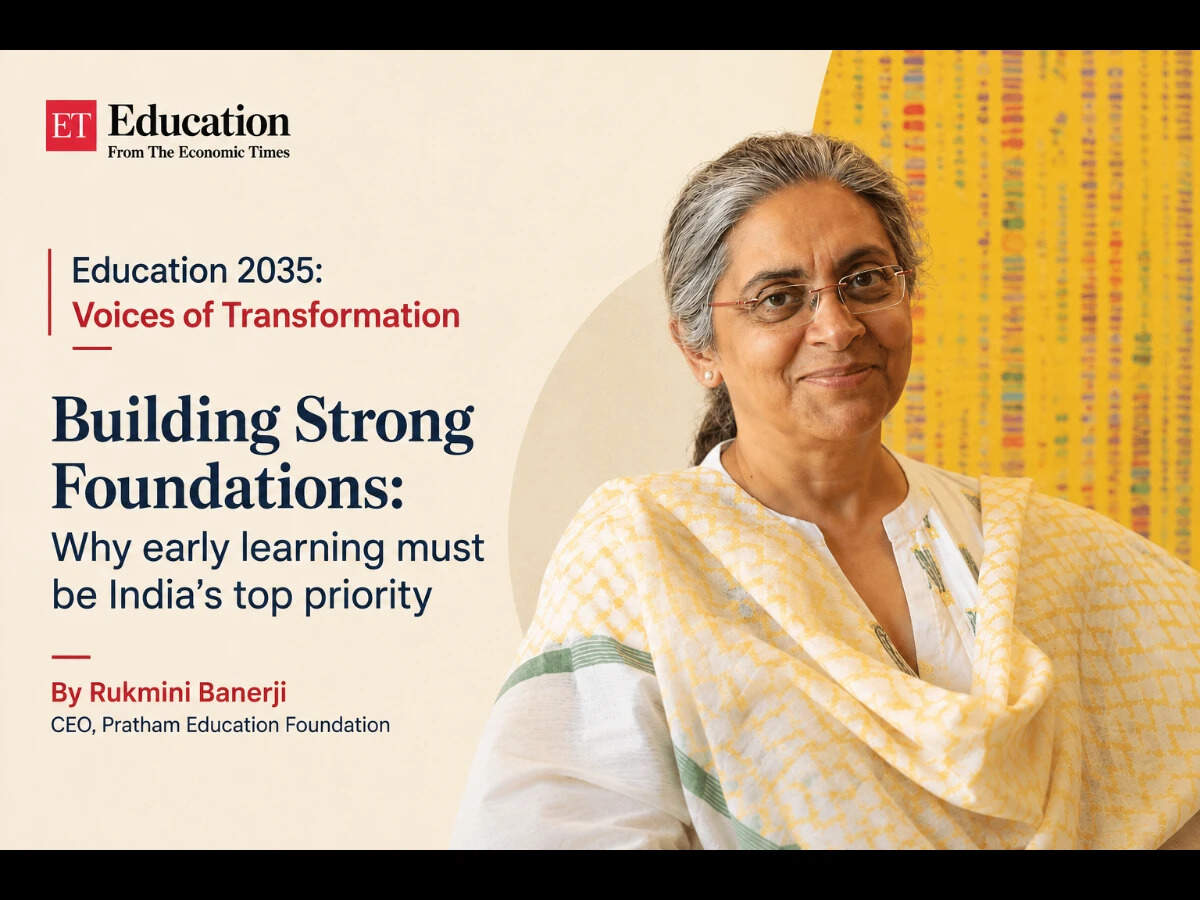
By Rukmini Banerji
India has made remarkable progress in school enrollment over the last two decades. Data from ASER and government sources show that even by 2006, more than 90% of children aged 6 to 14 were enrolled in school. States such as Bihar, Rajasthan, and Uttar Pradesh, which earlier had large numbers of out-of-school girls, saw dramatic improvements within a few years. In Bihar, for example, nearly 20% of girls aged 11–14 were out of school in 2006; by 2010, the figure had fallen to below 5%, with similar improvements for boys. Enrollment increased significantly and gender gaps largely disappeared.
While enrollment at the elementary level is now close to universal, there has also been a major shift in progression to higher grades. Around 2010, Grade VIII enrollment nationally was estimated at 11–12 million students. By 2022, the number had nearly doubled to around 22 million. Children entering Grade I after 2010 are far more likely to continue into secondary education, contributing to the intense competition now seen in board examinations and college entrance tests.
The early 2000s saw strong national and global attention on expanding schooling through initiatives such as the Right to Education Act 2009 and the Millennium Development Goals. At the same time, discussions on learning outcomes also gained importance. Government-led National Achievement Surveys began measuring grade-level competencies, while ASER, facilitated by Pratham, generated household-based data on basic reading and arithmetic through one-on-one assessments with children.
Over several years, ASER data consistently highlighted three major characteristics of India’s primary education system. First, many children in Grade III and above struggled with basic reading and arithmetic even after several years of schooling. Second, there was wide variation in learning levels within the same classroom, making instruction difficult for teachers. Third, children who failed to acquire foundational skills early in primary school showed very limited learning gains in later years.
These findings led to extensive debates and experimentation around foundational learning. Two major approaches gained prominence globally and in India. One is “structured pedagogy,” mainly used in early grades to strengthen classroom instruction. The second is “Teaching-at-the-Right-Level” (TaRL), developed by Pratham in India, which focuses on helping children in Grade III and above acquire foundational skills according to their current learning level rather than their grade. The TaRL approach has since been adapted in several countries across Africa, Southeast Asia, and Latin America.
The COVID-19 pandemic brought another major shift in India’s education landscape. School closures led to widespread experimentation with technology-enabled learning, but also shifted attention from schooling to learning within families. Parents across income groups became more involved in children’s education during this period.
There were concerns that economic hardships during the pandemic would reduce school enrollment and cause severe learning losses. ASER 2022 showed that enrollment had returned to pre-pandemic levels, but foundational learning losses were significant.
However, ASER 2024 brought encouraging news. The National Education Policy (NEP) 2020 had emphasised universal access to early childhood education and foundational learning. Data from ASER 2024 showed that more than 75% of three-year-olds were enrolled in some form of early childhood education. It also showed a sharp decline in underage enrollment in Grade I, reflecting greater adherence to age-appropriate school entry.
Most importantly, ASER 2024 recorded major improvements in foundational learning in early grades. In arithmetic, the proportion of Grade III children performing at Grade II level rose significantly between 2022 and 2024, marking one of the largest improvements seen in the history of learning assessments in India. Learning gains in government schools, especially in rural areas, were particularly notable, and similar trends were reflected in PARAKH 2024 findings.
These improvements are closely linked to the clear policy direction provided by NEP 2020 and the rapid implementation of the NIPUN Bharat mission focused on foundational literacy and numeracy. While learning levels in Grades III to V have largely recovered to pre-COVID levels, there remains a strong need for “catch-up” efforts in upper primary and middle school grades.
India’s experience shows that large-scale improvements in schooling and learning are possible when policy, implementation, and data-driven action work together. Over the next five years, the focus must remain on ensuring that every child achieves foundational reading and arithmetic skills by Grade III, while also supporting older children who still need foundational learning support. Continuous tracking, reliable data, and sustained implementation will be critical to ensuring that every child is not only in school, but also learning well.
Rukmini Banerji is Senior Advisor at Pratham Education Foundation and served as its CEO from 2015 to 2026. A renowned educationist and economist, she has led large-scale education reforms, government partnerships and learning assessments, including the Annual Status of Education Report (ASER). She has been associated with Pratham since 1996 and has played a key role in advancing foundational literacy and numeracy in India.
DISCLAIMER: The views expressed are solely of the author, and ETEDUCATION does not necessarily subscribe to it. ETEDUCATION will not be responsible for any damage caused to any person or organisation directly or indirectly.