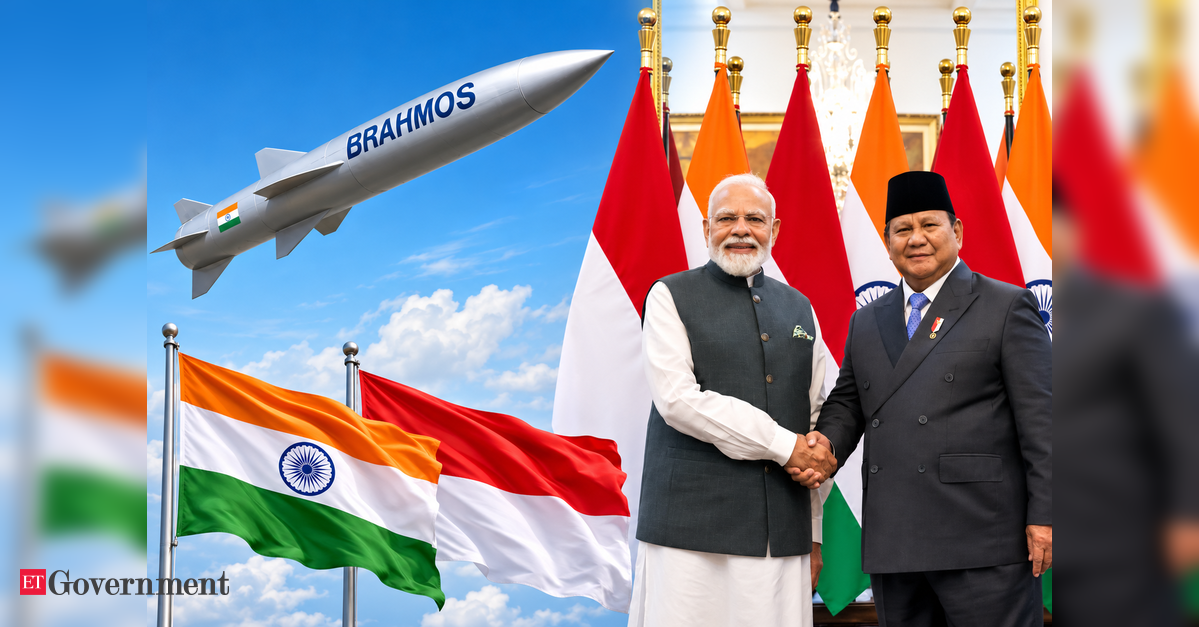
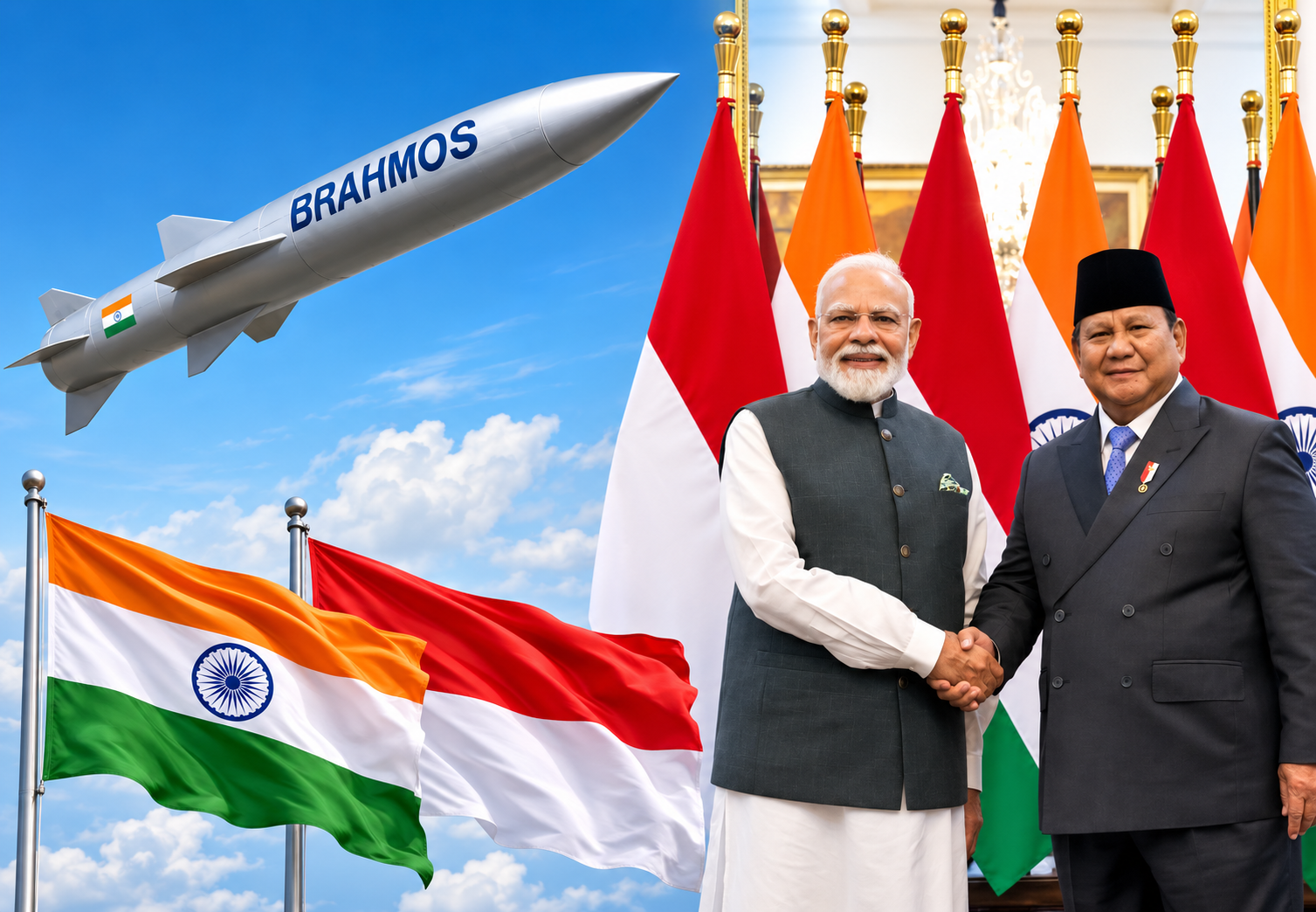
Prime Minister Narendra Modi’s state visit to Indonesia has culminated in a significant defense export agreement, marking a notable milestone in India’s defense manufacturing trajectory.
Alongside agreements on critical minerals, agriculture, maritime cooperation, digital technologies and industrial partnerships, India and Indonesia signed a landmark agreement for the supply of the BrahMos supersonic cruise missile system and the Astra air-to-air missile.
The visit elevated the India-Indonesia Comprehensive Strategic Partnership into a far more substantive security partnership at a time when geopolitical competition in the Indo-Pacific is intensifying.
The BrahMos agreement represents far more than a defence export. It signals the emergence of India as a credible supplier of advanced military technology, demonstrates the growing international confidence in Indian defence systems following their operational employment during Operation Sindoor, and strengthens New Delhi’s strategic footprint across Southeast Asia.
Coming after the BrahMos exports to the Philippines and Vietnam, Indonesia’s decision creates a chain of regional partners equipped with one of the world’s fastest operational supersonic cruise missiles, reinforcing India’s Act East policy and its broader vision of a free, open and inclusive Indo-Pacific.
Defence becomes the centrepiece of India-Indonesia ties
Although India and Indonesia have historically shared close civilisational and maritime links, defence cooperation has traditionally remained below its potential. That equation has now changed.
During the summit meeting in Jakarta, Prime Minister Narendra Modi and Indonesian President Prabowo Subianto agreed to significantly deepen defence industrial cooperation. Along with the BrahMos agreement, the two countries announced collaboration on the Astra beyond-visual-range air-to-air missile, cooperation in critical minerals, maritime security, agriculture, steel production, digital public infrastructure and supply chain resilience.
The missile agreement is particularly significant because Indonesia occupies one of the world’s most strategic maritime locations. Straddling the Malacca, Sunda and Lombok Straits, the Indonesian archipelago controls sea lanes through which a substantial proportion of global trade and energy supplies pass.
For Indonesia, acquiring BrahMos substantially enhances its coastal defence and anti-ship strike capability. For India, it places an Indian-developed strategic weapon in one of the Indo-Pacific’s most important maritime nations.
Why Indonesia wanted BrahMos
Indonesia has evaluated the BrahMos system for several years. The missile offers a combination of speed, precision and flexibility that relatively few weapon systems can match.
Developed jointly by India’s Defence Research and Development Organisation (DRDO) and Russia’s NPO Mashinostroyeniya under BrahMos Aerospace, the missile can be launched from land, ships, submarines and aircraft. Depending on the variant, it has a range extending well beyond the original export configuration and travels at nearly Mach 3, making interception extremely difficult. Its sea-skimming terminal flight profile further reduces enemy reaction time.
Unlike many long-range cruise missiles that travel at subsonic speeds, BrahMos compresses the defender’s decision-making window from several minutes to well under a minute in many operational scenarios. For a maritime nation comprising more than 17,000 islands, such a capability offers a powerful deterrent against hostile naval forces operating near its territorial waters.
Operation Sindoor transformed BrahMos into a combat-proven export
The timing of the Indonesian acquisition is unlikely to be accidental. Although BrahMos had long been regarded as one of the world’s premier cruise missiles, Operation Sindoor marked the first time it received extensive international attention following its operational employment by the Indian Armed Forces.
India’s precision strikes demonstrated the missile’s ability to engage high-value targets rapidly and accurately while maintaining stand-off distances. Defence analysts across Asia viewed the operation as a practical demonstration of India’s long-range precision strike capability rather than merely another missile exercise.
Combat performance often changes international perceptions of military equipment. History provides numerous examples—from the Patriot missile after the Gulf War to HIMARS in Ukraine—where operational success significantly boosted export prospects. Operation Sindoor appears to have had a similar effect on BrahMos.
International interest in the missile has accelerated since the operation, with several countries reportedly examining potential acquisitions. Reuters reported that growing international interest followed the weapon’s combat employment during Operation Sindoor, strengthening India’s position in ongoing export negotiations.
For prospective buyers, combat validation reduces uncertainty far more effectively than technical brochures or demonstration firings.
More than a missile sale
The Indonesia agreement also reflects the maturity of India’s defence manufacturing ecosystem. For decades India remained among the world’s largest arms importers. Today it is increasingly positioning itself as an exporter of sophisticated weapon systems developed through indigenous research, international partnerships and domestic production.
BrahMos is particularly important because it represents one of India’s highest-value defence export products. Its success also enhances confidence in India’s broader missile ecosystem, including Akash, Astra, Pinaka and future long-range precision strike systems.
Every export order generates manufacturing activity across hundreds of Indian suppliers involved in propulsion, guidance systems, electronics, launchers, command systems and logistics support. Consequently, BrahMos exports contribute not only to India’s strategic influence but also to employment, technology development and defence industrial capacity.
Strategic implications across Southeast Asia
Indonesia becomes the latest Southeast Asian nation to strengthen maritime deterrence through Indian missile technology. Earlier exports to the Philippines altered India’s role in regional security by making New Delhi a supplier of strategic defence capabilities rather than merely a diplomatic partner.
Vietnam has also moved towards acquiring BrahMos systems, reflecting growing regional confidence in Indian defence technology. Collectively, these developments create a broader network of countries operating compatible Indian-origin missile systems across the South China Sea and eastern Indian Ocean.
While India continues to emphasise that BrahMos exports are defensive in nature, the regional strategic implications are significant. Countries facing growing maritime security concerns now have access to a highly capable coastal defence weapon that raises the cost of any hostile naval operation. This contributes to deterrence rather than offensive military expansion.
The China factor
Although neither India nor Indonesia publicly framed the agreement in terms of China, regional analysts view the development within the wider Indo-Pacific strategic environment. China’s expanding naval presence, extensive maritime claims in the South China Sea and growing military activities have prompted several Southeast Asian nations to strengthen their coastal defence capabilities.
Indonesia has experienced repeated tensions around the waters near the Natuna Islands, where Chinese vessels have operated despite Jakarta’s objections. In this context, BrahMos provides Indonesia with a credible anti-access capability without fundamentally altering its long-standing non-aligned foreign policy.
Rather than joining any military bloc, Indonesia is enhancing its own deterrence. For India, supplying such capabilities aligns with its stated objective of supporting regional security while respecting the strategic autonomy of partner countries.
Strengthening India’s Act East policy
The agreement also reinforces India’s Act East policy in practical terms. For years, India’s engagement with Southeast Asia centred on trade, connectivity and diplomacy. Defence cooperation is now becoming an equally important pillar.
The BrahMos agreement demonstrates that India’s relationships with ASEAN members are increasingly driven by shared security interests, maritime cooperation and defence industrial partnerships. This evolution complements India’s growing naval presence in the eastern Indian Ocean, its cooperation with Quad partners and expanding engagement with ASEAN defence institutions.
The visit also advanced cooperation in Sabang Port, maritime connectivity, critical minerals and industrial partnerships, indicating that security cooperation is being integrated with broader economic engagement.
A signal to other prospective buyers
Indonesia’s decision is likely to influence defence procurement discussions elsewhere. Military acquisitions are often shaped by peer decisions.
When multiple countries successfully induct a sophisticated system, confidence grows among other prospective buyers regarding logistics, training, maintenance and long-term support. Several countries in Southeast Asia, West Asia, Africa and Latin America have reportedly expressed interest in BrahMos in recent years.
Indonesia’s purchase strengthens India’s credibility as a reliable supplier capable not only of producing advanced weapons but also of supporting their long-term deployment.
The emergence of India as a defence exporter
The BrahMos agreement reflects a broader transformation underway in India’s defence sector. Successive policy reforms under the Atmanirbhar Bharat initiative have expanded indigenous manufacturing, encouraged private-sector participation and increased exports of military equipment.
The country’s defence exports have grown dramatically over the past decade, with missile systems, artillery, radars, electronic warfare equipment and naval platforms becoming increasingly competitive internationally. High-end exports such as BrahMos carry strategic importance beyond their commercial value.
They generate enduring military relationships through training, maintenance, upgrades and joint exercises, creating long-term defence partnerships that often last decades.
A milestone beyond commerce
The BrahMos agreement signed during Prime Minister Narendra Modi’s visit to Indonesia will be remembered not simply as another defence contract but as a milestone in India’s strategic evolution.
It demonstrates that India is no longer viewed only as a major defence market but increasingly as a producer of advanced military technologies capable of competing internationally. For Indonesia, the acquisition strengthens maritime deterrence and enhances national security.
For India, it validates decades of investment in indigenous missile technology, reinforces the credibility gained through Operation Sindoor, expands strategic influence across the Indo-Pacific and strengthens defence diplomacy with one of ASEAN’s most influential powers.