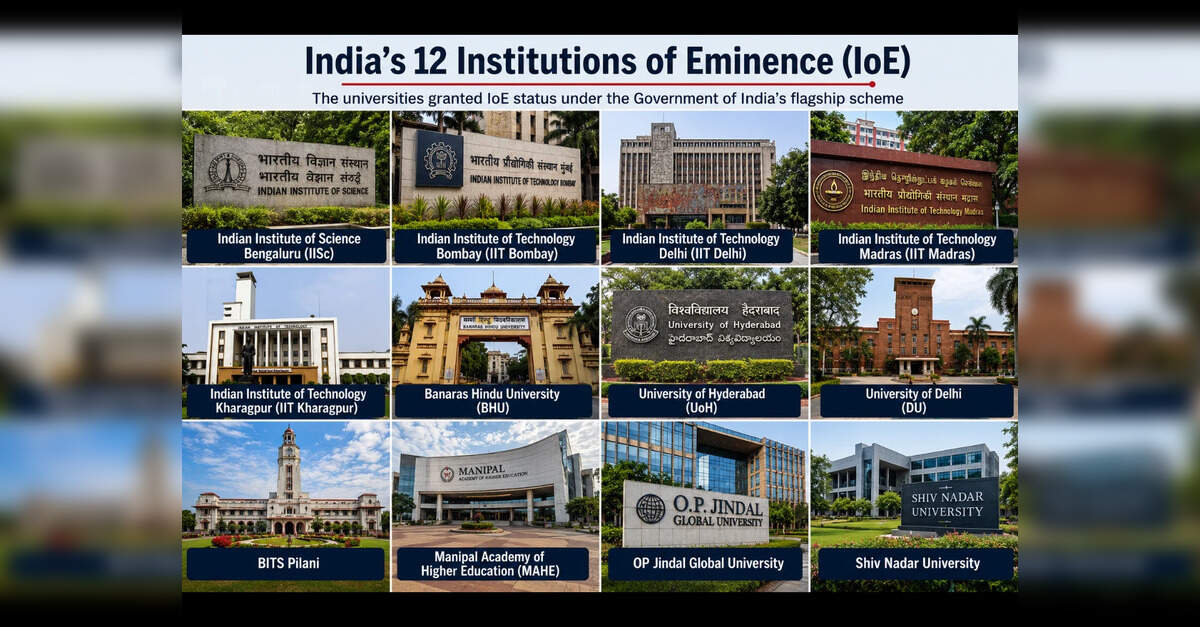
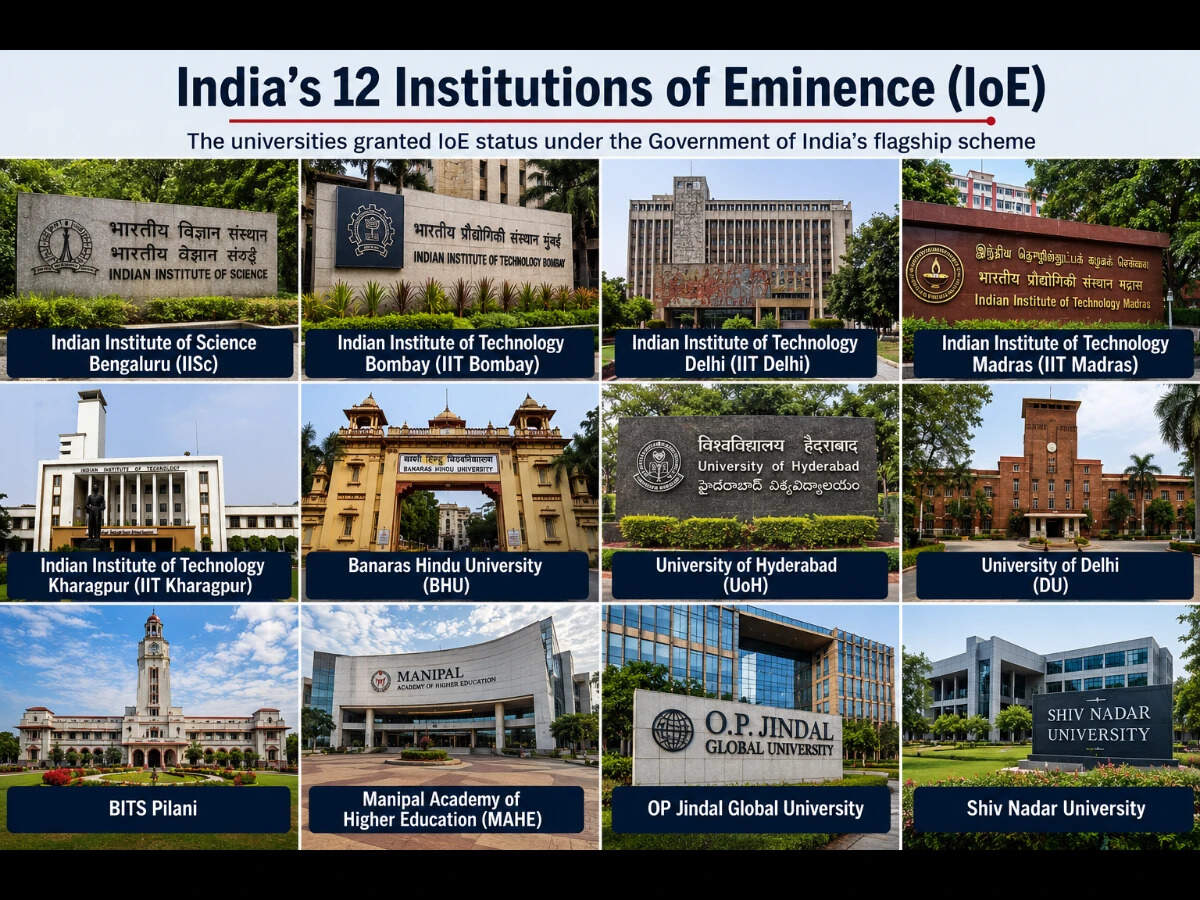
In February 2016, Finance Minister late Arun Jaitley announced in his Budget speech that India would identify and nurture institutions with the potential to become world-class, giving them money, autonomy, and a mandate to compete globally. That promise became the Institutions of Eminence (IoE) scheme: select 20 universities, 10 public and 10 private, free them from regulatory constraints, and set them targets. Top 500 globally within ten years. Top 100, eventually. Under the scheme, each public IoE was eligible for up to Rs 1,000 crore over five years. With eight public institutions eventually notified, the total funding commitment amounted to Rs 8,000 crore.Nearly a decade later, ETEducation audited that promise against reality, approaching all 12 notified IoE institutions with a structured questionnaire, tracking budget allocations year by year, and cross-referencing parliamentary records and the freshest ranking data available. What emerged is a story of genuine progress in some institutions, significant shortfalls in others, and a scheme that appears to have quietly wound down without ever being formally concluded.
The selection and its controversies
The UGC formally notified the scheme’s guidelines in September 2017. An Empowered Expert Committee (EEC) chaired by former Chief Election Commissioner N Gopalaswami received 114 applications and selected the first batch in October 2018: IISc Bengaluru, IIT Bombay, and IIT Delhi from the public sector. From private, BITS Pilani and MAHE, and a third institution that immediately defined the scheme’s early reputation.
Jio Institute, a university that did not yet exist, received a Letter of Intent under a greenfield category. The reaction from academia was swift and critical: a scheme designed to elevate India’s finest had endorsed an institution with no students, no faculty, and no campus. As the Ministry of Education confirmed to Parliament in March 2026, Jio Institute does not hold IoE status.
Subsequent batches through 2020-22 added IIT Madras, IIT Kharagpur, BHU, University of Hyderabad, University of Delhi, OP Jindal Global University, and Shiv Nadar University, bringing the total to 12 formally notified institutions. The promised 20 was never reached. In September 2019, Letters of Intent were also issued to five private institutions, Amrita Vishwa Vidyapeetham, VIT Vellore, KIIT, Jamia Hamdard, and Bharti Institute of the Satya Bharti Foundation, Mohali. None were formally notified as Institutions of Eminence. Jadavpur University’s bid collapsed after West Bengal’s funding commitment fell by nearly 80 per cent. Anna University’s proposal was withdrawn by the Tamil Nadu government. JNU was never shortlisted.
| THE IoE PIPELINE: FROM APPLICATION TO NOTIFICATION | ||
| Institution / Group | Outcome | Reason |
| IISc, IIT Bombay, IIT Delhi (Public) | Notified Batch 1, Oct 2018 | Fully notified |
| IIT Madras, IIT Kharagpur, BHU, DU, UoH (Public) | Notified Batch 2, 2020 | Fully notified |
| BITS Pilani, MAHE, OP Jindal, Shiv Nadar (Private) | Notified, 2020-22 | Fully notified |
| Jio Institute | LoI issued, lapsed | Greenfield; never formalised |
| Amrita, Bharti Institute | LoI issued Sept 2019 | Not formally notified |
| VIT Vellore, KIIT | LoI issued Sept 2019 | Not formally notified |
| Jamia Hamdard | LoI issued, rejected | EEC recommended against |
| Jadavpur University | Recommended, dropped | State funding commitment collapsed |
| Anna University | Shortlisted, withdrawn | Tamil Nadu state govt withdrew |
| JNU | Never shortlisted | Applied; not selected |
The funding gap
Based on allocations and institutional disclosures available till mid-2026, around Rs 6,199 crore has been released against the Rs 8,000 crore commitment, leaving approximately Rs 1,800 crore yet to be disbursed. Parliamentary records and institutional responses to ETEducation’s questionnaire now allow for an updated institution-wise picture.
| IoE FUNDING: PROMISE VS REALITY (as of mid-2026) | |||
| Institution | Promised | Received | % of Promise |
| IIT Madras | Rs 1,000 Cr | Rs 1,000 Cr* | 100% |
| IISc Bengaluru | Rs 1,000 Cr | Rs 842 Cr | 84.2% |
| BHU | Rs 1,000 Cr | Rs 812.15 Cr** | 81.2% |
| IIT Bombay | Rs 1,000 Cr | Rs 770.59 Cr | 77.1% |
| IIT Delhi | Rs 1,000 Cr | Rs 736.31 Cr | 73.6% |
| IIT Kharagpur | Rs 1,000 Cr | Rs 734.72 Cr** | approx 73.5% |
| University of Hyderabad | Rs 1,000 Cr | Rs 596.79 Cr | 59.7% |
| University of Delhi | Rs 1,000 Cr | Rs 445 Cr | 44.5% |
| TOTAL | Rs 8,000 Cr | approx Rs 6,199 Cr | approx 77.5% |
*IIT Madras confirmed full utilisation in response to ETEducation questionnaire, June 2026. **BHU and IIT Kharagpur figures from institutional questionnaire responses.
Disbursement has been deeply uneven. IIT Madras is the only institution to confirm full utilisation of its Rs 1,000 crore grant. The University of Delhi, one of India’s most prominent public universities, received less than half its promised allocation despite being notified in the same batch as institutions that received significantly more.
Budget allocations under the head ‘World Class Institutions’ peaked at Rs 1,710 crore in 2021-22 before falling sharply to approximately Rs 475 crore in 2025-26, a 72 per cent reduction. Union Budget 2026-27 then nearly doubled the allocation to Rs 900 crore, without any accompanying policy statement explaining the reversal.
Despite repeated reminders, neither the Ministry of Education nor the University Grants Commission responded to ETEducation’s detailed questionnaire seeking clarification on the scheme’s current status, funding disbursements, the reconstitution of the Empowered Expert Committee, and the future of institutions that were shortlisted but never formally notified. Their silence is noted throughout this report.
The watchdog that vanished
The EEC, the scheme’s central accountability mechanism, expired in February 2021 and has never been reconstituted. The body that was empowered to review institutional progress, order corrective action, and revoke the eminence tag for underperformance has been dormant for five years. Its penalty clause has never been invoked. For Batch 1 institutions, the five-year review deadline passed in 2023 with no review. For Batch 2, that deadline arrives this year. The Parliamentary Standing Committee on Education recommended reconstitution in both its 2023 and March 2026 reports. No action has followed.
Where the rankings stand
The QS World University Rankings 2027, released on June 18, 2026, is the most current measure of the scheme’s core promise. Six of 12 IoEs have met the top 500 target. Six have not.
| IoE INSTITUTIONS: QS WORLD UNIVERSITY RANKINGS 2027 | |||
| Institution | QS 2027 Rank | Top 500 Target | 10-Year Deadline |
| IIT Delhi | 118 | Met | Oct 2028 |
| IIT Bombay | 134 | Met | Oct 2028 |
| IIT Madras | 170 | Met | Feb 2030 |
| IIT Kharagpur | 205 | Met | Feb 2030 |
| IISc Bengaluru | 221 | Met | Oct 2028 |
| University of Delhi | 322 | Met | Mar 2030 |
| University of Hyderabad | 851-900 | Not met | Feb 2030 |
| BHU | 901-1000 | Not met | Feb 2030 |
| BITS Pilani | 575 | Not met | Oct 2030 |
| OP Jindal Global University | 751-760 | Not met | Oct 2030 |
| MAHE (Manipal) | 901-950 | Not met | Oct 2030 |
| Shiv Nadar University | 1001-1200 | Not met | Mar 2031 |
The six that have met the top 500 target are predominantly IITs and IISc, institutions whose research infrastructure and global reputation predate IoE by decades. University of Delhi at 322 is the most striking data point: the lowest-funded public IoE, yet the highest-ranked non-technical institution in India globally. The six that have not met the target face varying degrees of challenge. BHU needs to climb approximately 400 places by February 2030. University of Hyderabad faces a similar arithmetic. Both have shown movement since receiving IoE status; whether that trajectory can be sufficiently accelerated in the years remaining is the open question.
“With increased funding, we have already moved 100 places. If this kind of investment continues, institutions from India will be in the top 100 in the next 5-10 years. Also, the categories for ranking are skewed a little bit towards western universities,” said Prof V. Kamakoti, Director, IIT Madras, in response to ETEducation questionnaire.
What the money built
Of the three public institutions that responded to ETEducation’s questionnaire, the contrasts in how IoE money was spent offer a window into why outcomes have diverged.
IIT Madras, under Director Prof V. Kamakoti, is the scheme’s clearest success by the numbers. Full utilisation of Rs 1,000 crore, 70 per cent directed toward research activities and 30 per cent to physical infrastructure, and a climb of more than 100 places in QS rankings from 275 in 2021 to 170 today. Prof Kamakoti made a direct case for extension: ‘Continuing the scheme for one more five-year term would leave a really long-lasting impact.’
IIT Kharagpur, now led by Director Prof. Suman Chakraborty who assumed charge in June 2025, received Rs 734.72 crore under the scheme and has cleared the top 500 target, currently ranked 205 and targeting the top 200. The institution described IoE as having fundamentally shifted its frame of reference: ‘The question is no longer whether we are among India’s best, but whether we are competing with the world’s best.’ It frames its IoE funding as catalytic capital that unlocked larger investments from industry and international partners.
BHU, under Vice Chancellor Prof A.K. Chaturvedi, received Rs 812.15 crore, with approximately 80 per cent allocated to capital infrastructure and 20 per cent to recurring research activities. The university credits IoE with significant changes: the creation of a research excellence ecosystem, improved talent acquisition through competitive fellowships, and a reported tripling of international student enrolment from approximately 100 to nearly 350 annually. In QS rankings, BHU has moved from the 1001-1200 band to the 901-1000 band. The university says it is on a positive trajectory and that the full impact of its investments will continue to materialise over coming years.
Prof. Suman Chakraborty, Director IIT Kharagpur says: “IoE shifted the focus from incremental excellence to global benchmarking. The question is no longer whether we are among India’s best, but whether we are competing with the world’s best.”
The private question: Autonomy without money
For India’s four private IoEs, the scheme offered regulatory freedom but no financial support. Of the four, BITS Pilani has shown the most pronounced ranking movement, jumping 93 places in a single year to 575 in QS 2027. OP Jindal sits at 751-760, MAHE at 901-950, and Shiv Nadar at 1001-1200. None are yet in the top 500.
The Pro Vice Chancellor of MAHE (Manipal), Prof. (Dr) Madhu Veeraraghavan in a separate conversation with ETEducation in which IoE status came up, offered a candid institutional assessment. ‘Institution of Eminence is an amazing recognition of what you have done. But it comes with very strong pillars in which you have to perform,’ he said. ‘It has definitely helped because potential students who apply know MAHE is an institution of eminence, something given to us by the Government of India, which is a prestigious recognition.’ On autonomy, he was specific: ‘When universities have this IoE, it gives us the freedom to experiment. We don’t now have to take every approval from the government of India. That independence, that freedom is very important.’ He also added a note of self-awareness: ‘You can’t just live on this past glory.’
Officials at other private IoE institutions, speaking without attribution, questioned whether the autonomy provisions had delivered outcomes meaningfully different from what a well-governed private university could have negotiated through other regulatory channels. The answer appears to vary by institution and by how actively each has exercised its IoE freedoms.
The institutions that would not speak
ETEducation sent a structured questionnaire to all 12 notified IoE institutions. Three responded on the record: IIT Kharagpur, IIT Madras, and BHU. Nine did not, including IISc Bengaluru, IIT Bombay, IIT Delhi, the University of Delhi, and all four private institutions. Officials at several non-responding institutions told ETEducation privately that they were unwilling to put any assessment of the scheme on record, whether positive or negative, for fear of how it might be received. One senior academic described the calculation plainly: the scheme had provided funding and recognition, and saying anything that could be read as critical was not a risk worth taking. Institutions designated for their eminence, a decade into the scheme, remain institutionally cautious about speaking publicly about it.
Where things stand
Union Budget 2026-27 allocated Rs 900 crore to the World Class Institutions head, an 89 per cent jump over the previous year. No public explanation accompanied the increase. For Batch 1 institutions, the ten-year deadline arrives in October 2028. All three are in the global top 500; none are in the top 100. IIT Delhi at 118 is India’s highest-ranked university globally, 18 places short of the top 100 the scheme’s own language set as an aspiration.
Perhaps no single data point in this audit is more telling than the University of Delhi. India’s largest public university by enrolment received Rs 445 crore, less than half its promised allocation and the lowest among all eight public IoEs. And yet it sits at rank 322 in QS 2027, the highest-ranked non-technical institution in India globally, comfortably within the scheme’s top 500 target. If the IoE scheme’s theory held, that money enables eminence, Delhi University should be the cautionary tale. Instead it raises a harder question: what exactly did the money buy, and for whom? Neither the Ministry of Education nor Delhi University chose to answer.
IIT Madras has made the clearest institutional case for continuation. IIT Kharagpur has argued for evolution: ‘India will need a next-generation version of the IoE framework, one that combines funding, governance flexibility, internationalisation support, talent attraction mechanisms, and mission-oriented accountability.’ And then, reflecting on the journey: ‘India has already demonstrated that it can create institutions of national importance. The next challenge is to create institutions of global consequence.’
That is, in many ways, also the honest summary of where the IoE scheme stands a decade on: significant steps taken, real transformations in some institutions, meaningful shortfalls in others, a monitoring framework that lapsed without replacement, and an ambition, the global top 100, that remains precisely where it was in 2016. A horizon that India is measurably closer to, but has not yet reached.
Methodology
ETEducation sent a structured questionnaire to all 12 notified IoE institutions and to the Ministry of Education and UGC. On-the-record responses were received from IIT Kharagpur (Director Prof Suman Chakraborty), IIT Madras (Prof V Kamakoti, Director), and BHU (Prof AK Chaturvedi, Vice Chancellor). Nine institutions and both government bodies did not respond. MAHE Pro Vice Chancellor comments are from a separate ETEducation conversation in which IoE was discussed. Officials at multiple institutions spoke without attribution. Funding data: institutional questionnaire responses June- July 2026; Parliamentary panel report December 2024. Budget: Union Budget documents 2017-18 to 2026-27. Rankings: QS World University Rankings 2027, released June 18, 2026. IoE pipeline: UGC notification list; Ministry of Education written reply to Rajya Sabha, March 2025.