The India–European Union relationship is entering a more consequential phase, moving beyond conventional trade diplomacy towards an institutional partnership spanning frontier technologies, industrial supply chains, clean energy and economic security.
At the third ministerial meeting of the India–EU Trade and Technology Council in Brussels on July 15, the two sides agreed to begin formal negotiations on India’s association with Horizon Europe, establish an innovation hub for electric-vehicle charging technologies, launch a deep-tech startup partnership and expand cooperation in semiconductors, artificial intelligence, quantum technologies, high-performance computing and 6G.
The decisions give operational substance to the political and economic commitments made at the 16th India–EU Summit in New Delhi in January. They also indicate that New Delhi and Brussels now view technology, trade and security as interconnected elements of the same strategic relationship.
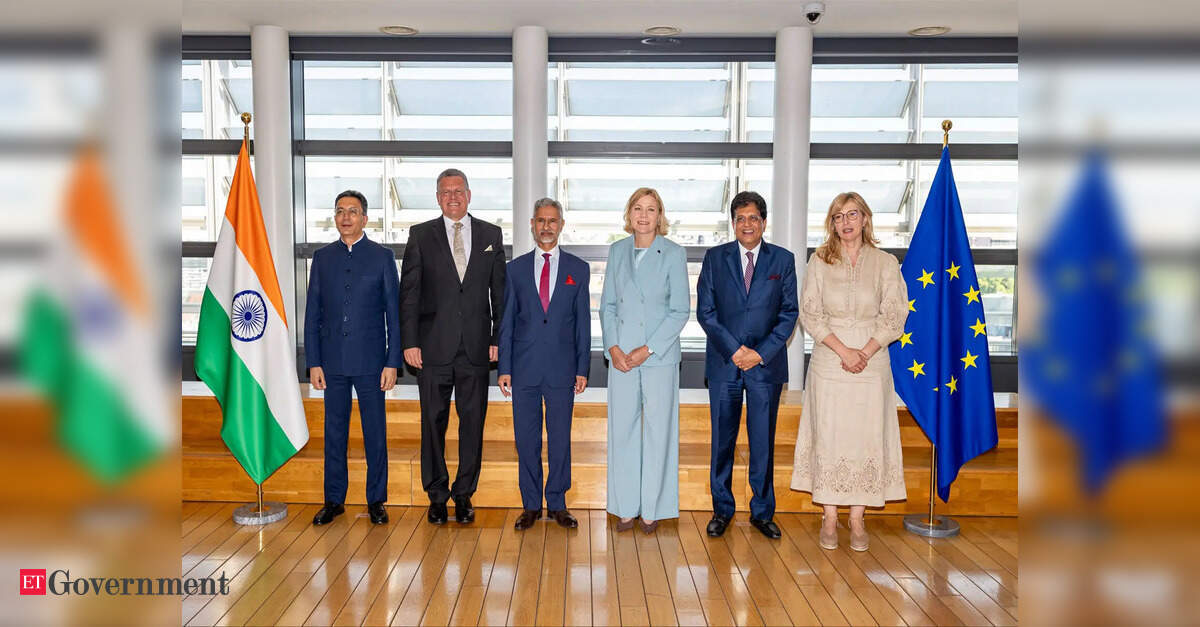
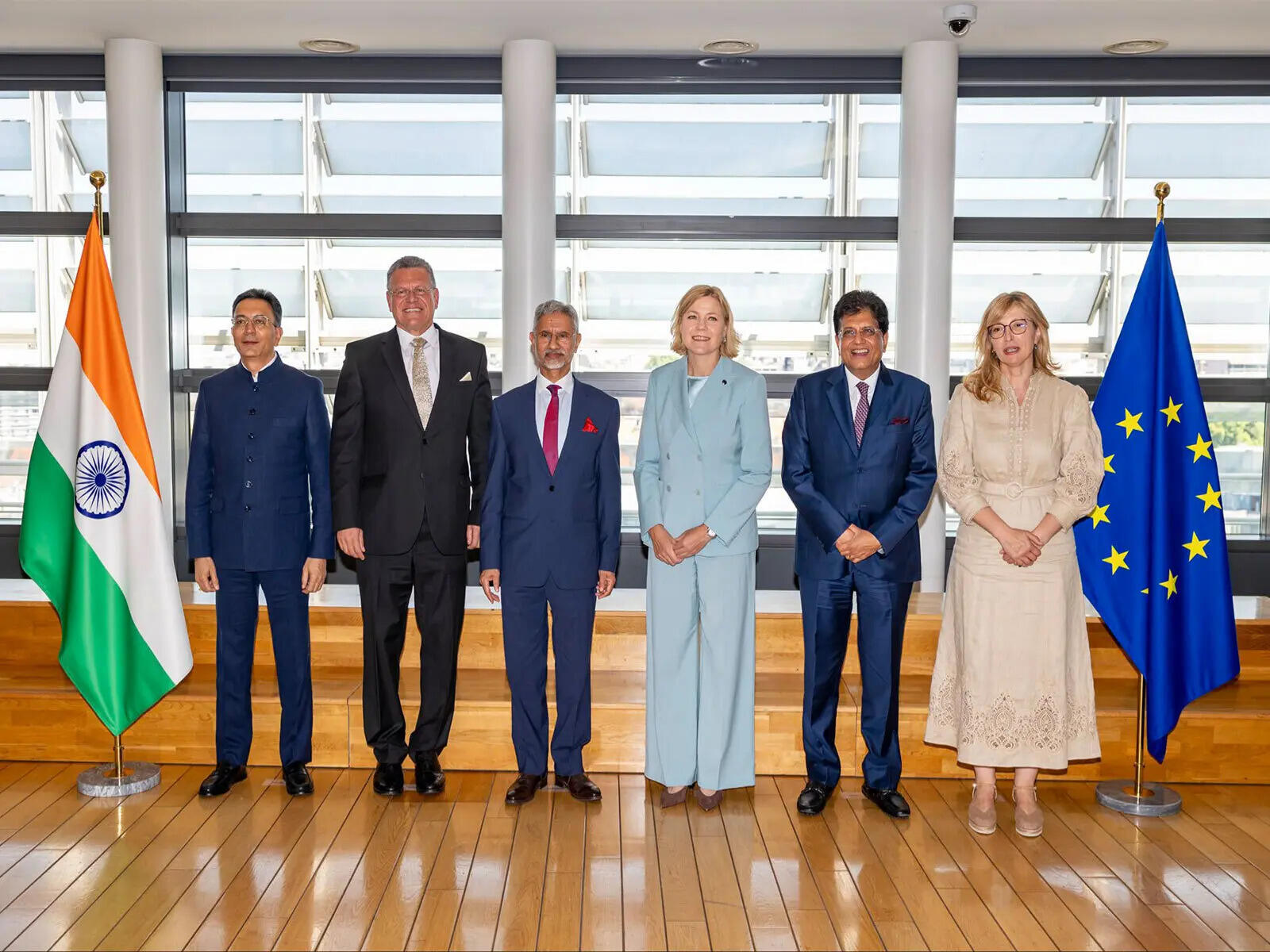
The meeting was co-chaired from the Indian side by External Affairs Minister Dr. S. Jaishankar, Commerce and Industry Minister Piyush Goyal and Minister of State for Electronics and Information Technology Jitin Prasada. Principal Scientific Adviser to the Government of India Professor Ajay K. Sood also participated.
The European delegation was led by European Commission Executive Vice-President for Tech Sovereignty, Security and Democracy Henna Virkkunen, Commissioner for Trade and Economic Security Maroš Šefčovič and Commissioner for Startups, Research and Innovation Ekaterina Zaharieva.
The joint statement issued by the Ministry of External Affairs described India and the EU as “two large and vibrant democracies with open market economies, shared values and pluralistic societies” that are “natural strategic partners in an increasingly complex geopolitical environment.”
It added: “Through collective actions, the EU and India are forging a more integrated, resilient, and sustainable economic partnership—one that delivers tangible benefits for businesses, consumers, and the global community.”
That formulation is significant. It places the Trade and Technology Council, or TTC, within a broader geopolitical project rather than treating it merely as a forum for resolving regulatory or commercial disputes.
Horizon Europe could transform research cooperation
Perhaps the most far-reaching outcome of the meeting was the decision to start formal negotiations on India’s association with Horizon Europe, the EU’s principal research and innovation programme. The two sides aim to conclude the negotiations before the end of 2026.
Association would allow eligible Indian researchers, universities, laboratories and companies to participate more directly in collaborative projects under the programme. For India, this could provide access not merely to research funding but to networks of European universities, scientific institutions, technology companies and innovation clusters.
For Europe, India offers a large scientific talent base, expanding research infrastructure, a rapidly developing startup ecosystem and the ability to test and scale technologies in a vast and diverse market.
EU Commissioner Ekaterina Zaharieva said the negotiations would open “new opportunities for our researchers and innovators,” while strengthening cooperation in areas ranging from clean technologies to industrial innovation. The initiative, she indicated, would help translate the political partnership into deeper scientific and commercial linkages.
The opportunity is substantial, but association alone will not guarantee results. Indian institutions will require stronger support for proposal development, intellectual-property negotiations and participation in multinational consortia. India will also need to ensure that research collaboration produces reciprocal benefits rather than becoming a one-way channel for talent, data or intellectual property.
The real measure of success will be whether joint research progresses into patents, products, manufacturing capacity and commercially viable enterprises.
An innovation hub focused on electric mobility
India and the EU also agreed to create their first joint innovation hub, dedicated to electric-vehicle charging technologies and testing. The choice of electric mobility reflects an area of strong complementarity.
Europe has considerable experience in automotive engineering, charging standards, power electronics, testing systems and regulatory frameworks. India offers scale, a fast-growing electric-vehicle market and distinctive technological requirements arising from its climate, road conditions, vehicle mix and price sensitivity.
A joint hub could help address issues such as charging interoperability, battery safety, testing protocols, grid integration and the development of cost-effective infrastructure for two-wheelers, three-wheelers, passenger cars and commercial fleets.
The initiative also has a strategic industrial dimension. Charging systems, battery components and power electronics form part of a broader contest over the control of clean-technology supply chains. Cooperation could help India and Europe reduce excessive dependence on concentrated sources of components and critical minerals.
The two sides nevertheless have different regulatory and industrial priorities. Europe is focused on stringent environmental standards and technological sovereignty, while India must combine decarbonisation with affordability, employment creation and domestic manufacturing. The innovation hub will therefore be valuable only if it accommodates India’s development needs instead of merely reproducing European technical standards.
Building a bridge between startups and industry
The proposed India–EU Startup Partnership will focus initially on deep-tech clean technologies. This could connect Indian startups with European research institutions, investors and industrial companies while offering European ventures access to India’s market and manufacturing ecosystem.
India has built one of the world’s largest startup ecosystems, but many deep-tech companies struggle to move from laboratory prototypes to commercial production. They often face long development cycles, high capital requirements and limited access to testing infrastructure and patient investment.
Europe has advanced research institutions and industrial expertise but frequently faces its own difficulty in scaling innovation. A structured partnership could therefore help bridge complementary gaps: Indian engineering talent and market scale on one side, and European research, industrial networks and specialised capital on the other.
To produce durable outcomes, however, the partnership will need mechanisms for co-development, joint financing, technology validation, regulatory sandboxes and market access. Conventional networking events and startup exchanges will not be enough.
Semiconductors, AI, quantum and 6G enter the strategic core
The Brussels meeting expanded the technological agenda to semiconductors, artificial intelligence, high-performance computing, quantum technologies and 6G. These are no longer purely commercial sectors. They determine economic competitiveness, military capability, cybersecurity and political influence.
India and the EU both seek greater technological autonomy, although their starting points differ. India is attempting to establish domestic semiconductor manufacturing, build sovereign AI capabilities and strengthen its electronics supply chain. The EU is investing in advanced chips, digital infrastructure and regulatory frameworks intended to reduce strategic vulnerabilities.
European Commission Executive Vice-President Henna Virkkunen linked the partnership to technological sovereignty and trusted digital ecosystems. Cooperation between the two sides, she said, has the potential to strengthen competitiveness while ensuring that new technologies remain secure and human-centred.
There is considerable scope for joint work in semiconductor design, advanced packaging, trusted supply chains, talent development and research. India’s capabilities in software, chip design and engineering services can complement European strengths in industrial equipment, automotive semiconductors, research and specialised manufacturing.
Artificial intelligence cooperation will be more complicated. India favours innovation-led development and broad deployment, including through digital public infrastructure, while the EU has developed a more prescriptive regulatory architecture. Dialogue can help prevent these systems from becoming incompatible, but it will require both sides to recognise their different economic and institutional conditions.
The same applies to cross-border data governance. Trusted data flows will be essential to digital trade and AI research, but disagreements over privacy, localisation, cybersecurity and regulatory jurisdiction could constrain the relationship.
Supply-chain resilience becomes economic strategy
The TTC agreed to strengthen resilient value chains in agri-food products, active pharmaceutical ingredients and clean-energy technologies. These sectors reveal how the partnership is being shaped by the experience of pandemics, wars, export restrictions and geopolitical competition.
India is a major producer of generic medicines but remains dependent on imported inputs for several pharmaceutical products. Europe is seeking to diversify supply chains while maintaining high regulatory standards. Cooperation on active pharmaceutical ingredients could improve security of supply for both sides, but it must go beyond buyer-seller relationships and encourage joint manufacturing, research and quality assurance.
Clean-energy technologies present a similar opportunity. India’s renewable-energy expansion requires solar equipment, storage systems, electrolysers, power electronics and critical minerals. Europe wants reliable partners for clean manufacturing and a reduced dependence on dominant suppliers. Joint investment could support production networks stretching from European research laboratories to Indian manufacturing facilities.
The joint focus on agri-food chains may prove more politically sensitive because food standards, agricultural subsidies and market access have traditionally generated disagreements. The TTC can help manage technical barriers, but neither side is likely to compromise quickly on issues affecting farmers, food safety or domestic regulation.
The FTA supplies the economic foundation
The technology agenda is advancing as India and the EU prepare to formally sign their landmark free trade agreement. Negotiations were successfully concluded at the January summit after nearly two decades of intermittent discussions.
European Commission President Ursula von der Leyen called it the “mother of all trade deals,” arguing that it would create “a market of two billion people” and account for nearly a quarter of global GDP.
“Since we have concluded the mother of all trade deals, we have been moving fast to deliver on our commitments. We will sign the Free Trade Agreement by the end of the year,” von der Leyen said in June following her meeting with Prime Minister Narendra Modi at the G7 Summit in France.
The agreement is expected to eliminate or reduce duties covering 96.6 per cent of traded goods by value and save European companies approximately €4 billion annually in customs duties. The EU expects its exports to India to double by 2032.
Commerce and Industry Minister Piyush Goyal said in July that the legal review of the agreement was approaching completion. “India–EU free trade agreement legal scrub should be over in another week or two,” he said, adding that EU members were aligned behind the partnership.
The FTA and TTC perform different but complementary functions. The trade agreement reduces tariffs and improves market access; the TTC addresses the technologies, regulations and supply chains that will shape future commerce. Together, they offer the architecture for a much deeper economic partnership.
Technology as an instrument of strategic autonomy
The larger significance of the Brussels meeting lies in its geopolitical context. India and the EU are trying to preserve strategic room for manoeuvre amid intensifying competition between the United States and China, recurring supply-chain disruptions and a weakening of established multilateral trade arrangements.
Neither side wants a closed technological bloc. Both, however, are increasingly cautious about dependencies that could be weaponised during a crisis. Their response is to build partnerships with countries that possess scale, institutional reliability and complementary capabilities.
European Council President António Costa captured this logic at the January summit when he said: “At a time when the global order is being fundamentally reshaped, the European Union and India stand together as strategic and reliable partners.”
He also described trade as “a crucial geopolitical stabiliser” and “a fundamental source of economic growth,” arguing that trade agreements strengthen the rules-based economic order and promote shared prosperity. The European Council’s summit report recorded these remarks while placing the FTA alongside the new India–EU Security and Defence Partnership.
This convergence should not be mistaken for complete strategic alignment. India and Europe continue to differ on Russia, sanctions, climate-linked trade measures, data regulation and some aspects of global governance. India will also resist arrangements that constrain its strategic autonomy or limit its access to technologies.
Yet the value of the TTC lies precisely in its ability to manage differences while pursuing practical cooperation.
The third meeting has generated an ambitious set of commitments. The challenge now is implementation. Horizon Europe negotiations must be concluded, the innovation hub must move from announcement to operation, startup cooperation must attract capital and industry, and strategic-technology dialogues must produce tangible projects.
If these commitments are executed effectively, the TTC can become the operational engine of the India–EU partnership. The relationship would then rest not only on growing trade, but on the joint creation of technologies, standards and supply chains that will shape the global economy for decades.