Myanmar’s vast deposits of heavy rare earth elements could become an important component of India’s critical-mineral strategy, but converting geological proximity into a secure supply chain will require far more than a bilateral agreement.
Political instability, armed conflict, Chinese control over processing and the absence of reliable transport corridors make Myanmar a potentially valuable—but exceptionally difficult—partner.
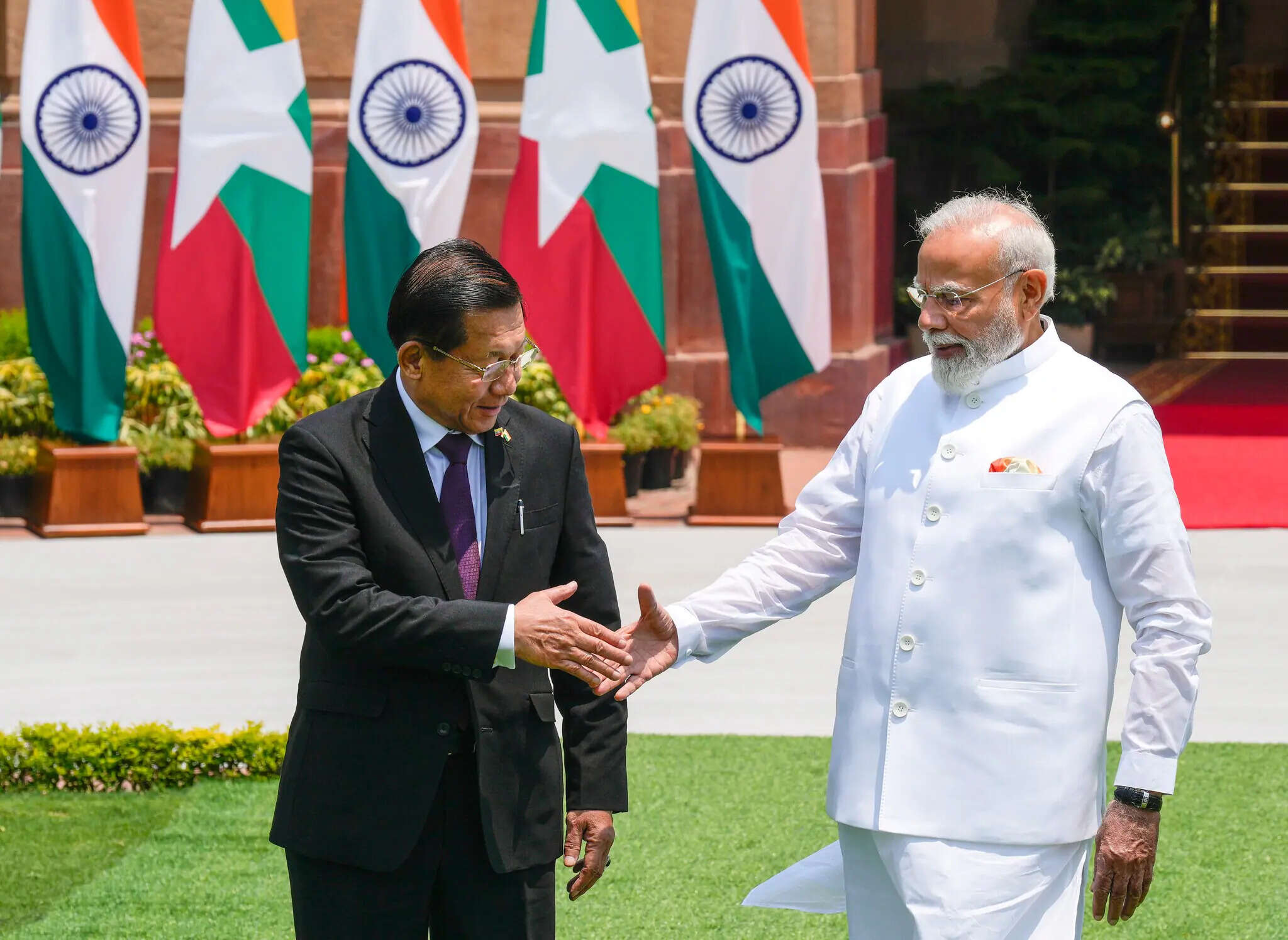
The strategic possibility gained official attention during Myanmar President U Min Aung Hlaing’s visit to India from May 30 to June 3, 2026. His discussions with Prime Minister Narendra Modi covered trade, connectivity, border management and cooperation in critical minerals and rare earths.
Foreign Secretary Vikram Misri, addressing questions after the talks, said critical minerals were “an important area” that had figured in the discussions. “This is an issue which is under bilateral consideration, and the two sides will stay in touch, remain in touch on these issues and see how we can take cooperation forward,” he said.
The measured language was significant. It established rare earths as a subject of bilateral engagement without suggesting that an agreement, commercial contract or mining arrangement was imminent. This distinction is essential because Myanmar’s mineral wealth is strategically attractive but operationally difficult to access.
Why Myanmar matters to India
Myanmar has become one of the world’s largest sources of rare earth elements. Its production was estimated at approximately 31,000 tonnes in 2024, placing it behind only China and the United States. More importantly, its deposits contain dysprosium and terbium—heavy rare earth elements that are considerably scarcer than the lighter rare earths found more widely around the world.
Dysprosium and terbium improve the heat resistance and performance of permanent magnets. These magnets are critical for electric-vehicle motors, wind turbines, industrial automation, consumer electronics, aerospace systems and advanced defence equipment. Their strategic importance is therefore disproportionate to the relatively small quantities in which they are used.
Most of Myanmar’s heavy rare earth extraction is concentrated in Kachin State, particularly around Chipwi and Pangwa near the Chinese border. Production has expanded rapidly, although reliable figures on reserves, ownership and individual mining sites remain difficult to establish. Myanmar also possesses tin, tungsten, antimony and other minerals relevant to electronics, specialised alloys and defence manufacturing.
This resource base complements rather than duplicates India’s domestic endowment. India holds an estimated 6.9 million tonnes of rare earth reserves, among the largest in the world, but much of this is associated with monazite-bearing coastal sands and consists predominantly of light rare earths. India’s production, estimated at around 2,900 tonnes in 2024, remains below one per cent of global output.
The challenge is even more pronounced downstream. Mining rare earth-bearing material is only the beginning of an intricate industrial process involving separation, purification, conversion into metals and alloys, and the manufacture of high-performance magnets. India has capabilities at parts of this chain but does not yet possess an integrated ecosystem at the scale required by its automotive, renewable-energy, electronics and defence sectors.
Myanmar’s heavy rare earth deposits could, in principle, fill a specific gap in India’s resource profile. They cannot, however, eliminate India’s processing deficit.
China’s entrenched advantage
China’s dominance extends well beyond its domestic mineral reserves. It controls the overwhelming share of global rare earth separation and refining and holds a similarly commanding position in permanent-magnet manufacturing. Its accumulated expertise, industrial infrastructure and supplier networks cannot easily be replicated.
Beijing reinforced this technological advantage in December 2023 by restricting the export of technology used to extract and separate rare earths and to produce rare earth metals and magnet materials. Subsequent controls on selected rare earth products further demonstrated how supply-chain dominance could become an instrument of economic leverage.
Myanmar is deeply embedded in this Chinese-led system. Material extracted in Kachin State is generally moved across the border into Yunnan, where established facilities process it. Chinese traders, intermediaries and companies have spent years building local networks and transport arrangements. These commercial structures have survived changes in territorial control, border disruptions and Myanmar’s continuing political crisis.
India cannot redirect this trade merely by offering to buy the ore. It would have to create a commercially competitive chain covering procurement, testing, transport, financing, environmental compliance, separation and magnet production. Without such an ecosystem, Myanmar-origin material would still be dependent on Chinese processing.
This is the central strategic lesson for New Delhi: supply diversification cannot be achieved by replacing one source of ore with another while leaving the most valuable stages of the chain concentrated elsewhere.
The problem of territorial control
The most immediate complication is that many of Myanmar’s important rare earth mining areas are not firmly controlled by the central authorities. The Kachin Independence Army and its political wing, the Kachin Independence Organisation, expanded their influence over parts of the mining belt during the conflict that intensified after the February 2021 military takeover.
Territorial control in northern Myanmar remains fluid, and authority over mines, roads, border posts and trading routes can be fragmented among armed organisations, militias and administrative bodies. A government-to-government understanding with Naypyidaw may therefore be necessary for diplomatic and regulatory purposes, but it may not by itself provide physical access to mining sites or guarantee the movement of material.
Direct or indirect engagement with a non-state armed organisation would carry significant political, legal and security risks. It could complicate India’s relations with Myanmar’s authorities and expose Indian companies to uncertain contracts, contested claims and reputational concerns. There has been speculation about attempts to obtain samples or explore procurement options from Kachin-controlled areas, but no formal Indian supply contract has been publicly confirmed.
For India, the prudent course is to maintain official discussions while avoiding premature commitments. Geological assessment, laboratory testing, mineral traceability and commercial due diligence should precede any large investment or offtake arrangement.
Connectivity remains a structural constraint
Myanmar shares a 1,643-kilometre land border with India, giving it an apparent geographical advantage over distant suppliers. Yet proximity on a map does not automatically translate into economical transport.
Kachin’s mining areas are mountainous, landlocked and oriented towards the Chinese border. Moving large quantities west or south would require secure roads through regions affected by conflict. The Kaladan Multi-Modal Transit Transport Project and the India–Myanmar–Thailand Trilateral Highway could eventually strengthen India’s access to Myanmar and Southeast Asia, but persistent delays and insecurity have limited their commercial utility.
The mineral opportunity therefore reinforces the case for completing connectivity projects, but rare earths cannot be made dependent on timelines that remain vulnerable to armed conflict. During the initial phase, India may have to examine limited-volume shipments for testing and specialised applications rather than envisioning a large, continuous flow of raw material.
Building India’s domestic chain
India has begun addressing these vulnerabilities through the National Critical Mineral Mission, approved in January 2025. The mission has a proposed expenditure of ₹16,300 crore and anticipates another ₹18,000 crore in investment by public-sector enterprises and other stakeholders. It covers exploration, mining, beneficiation, processing, overseas asset acquisition, recycling and research.
The government has also approved a ₹7,280-crore programme to establish 6,000 tonnes per annum of integrated rare earth permanent-magnet manufacturing capacity. The scheme is intended to cover the chain from rare earth oxides to finished magnets, reducing dependence in sectors such as electric mobility, renewable energy, electronics, aerospace and defence. Official government documents indicate that domestic rare earth magnet demand is expected to rise sharply as these industries expand.
Institutions such as the Geological Survey of India, IREL (India) Limited and Khanij Bidesh India Limited can support technical engagement with Myanmar. Cooperation could begin with geological mapping, mineral characterisation, sample testing, training and environmental assessment rather than immediately pursuing large-scale mining.
India will also need international partnerships. Japan possesses experience in high-performance materials and supply-chain diversification, while Australia has mining expertise and significant rare earth resources. Cooperation with these and other partners could help India acquire separation technology, develop modular processing facilities and distribute investment risk.
Environmental and governance concerns
Rare earth extraction in parts of Kachin has relied on chemical leaching methods that can contaminate soil and water. Reports from the region describe damaged forests, polluted streams and abandoned extraction pits. Weak regulation and conflict-driven mining make it difficult to enforce safeguards or determine whether revenues sustain local communities, armed organisations or illicit commercial networks.
India should not build strategic security on an environmentally destructive and opaque supply chain. Any involvement must incorporate traceability, independent environmental audits, rehabilitation obligations and protections for local communities. These conditions may increase costs, but ignoring them would create legal and reputational risks and reproduce the vulnerabilities that supply-chain diversification is meant to reduce.
Myanmar should consequently be viewed as one element of a broader portfolio rather than India’s principal answer to rare earth dependence. Domestic exploration, overseas acquisitions, recycling, alternative magnet technologies and partnerships with stable producers must proceed simultaneously.
The opportunity is nevertheless real. Myanmar could provide India with access to heavy rare earth elements that are scarce in its domestic deposits, while India could eventually offer Myanmar an alternative market, processing partnership and development pathway. But the transition from diplomatic discussion to commercial supply will be slow.
India’s objective should not be a hurried mineral deal. It should be the gradual creation of a secure, transparent and technologically capable value chain that can function despite political uncertainty. Until processing capacity, connectivity and governance improve, Myanmar’s rare earths will remain a strategic option for India—not yet a dependable industrial resource.