Twenty-seven years after Indian soldiers recaptured the icy heights of Kargil, the country’s leadership used Kargil Vijay Diwas on Sunday to honour their sacrifice and underline a wider strategic message: vigilance along the borders cannot be seasonal, terrorism and its sponsors cannot be treated separately, and military strength must rest increasingly on indigenous technology.
Prime Minister Narendra Modi led the tributes, describing July 26 as a date that fills India with pride and recalls the extraordinary courage of its soldiers. “On Kargil Vijay Diwas, our nation expresses gratitude to the brave soldiers for their extraordinary courage and commitment towards securing India,” he said. Their valour in the most formidable conditions, he added, would remain a source of national pride, while their patriotism and devotion to duty would inspire generations.
In his Mann Ki Baat address, Modi said some days “do not require a calendar to be remembered,” and July 26 was one such date. Remembering the soldiers who climbed steep mountains and fought despite adverse weather and difficult circumstances, he said the country must never forget that national security is sustained by courage, preparedness and sacrifice.
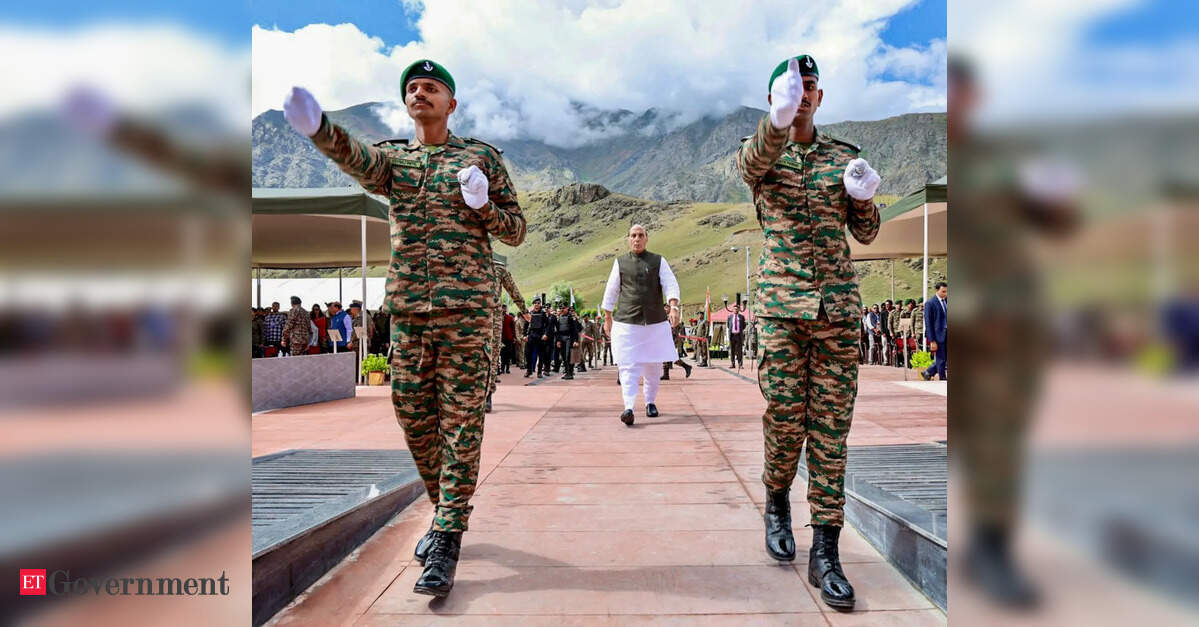
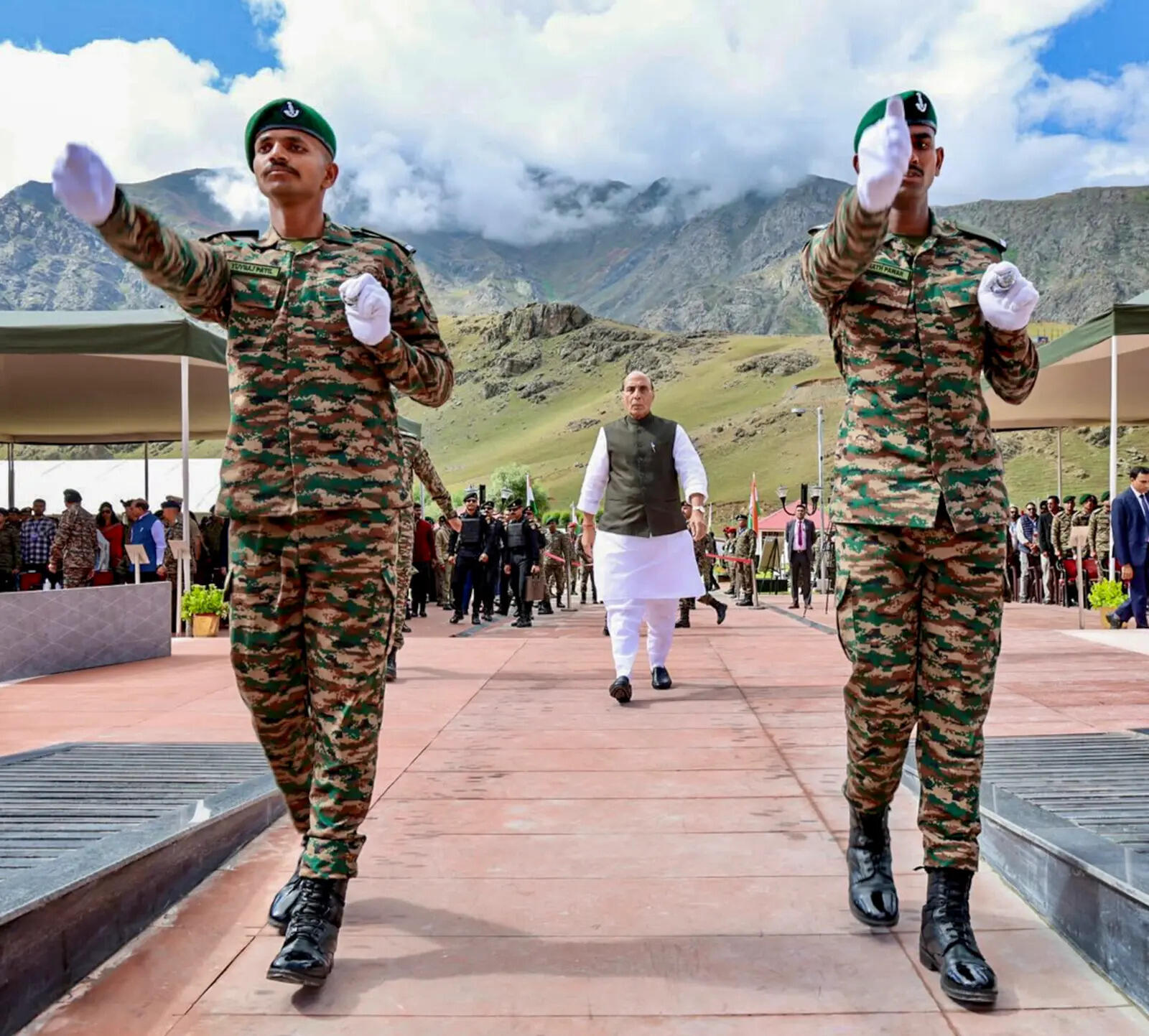
The principal commemorative ceremony was held at the Kargil War Memorial in Dras, where Defence Minister Rajnath Singh laid a wreath at the cenotaph. Army Chief General Dhiraj Seth, senior commanders, veterans, gallantry awardees, Veer Naris and families of the fallen joined the ceremony. In New Delhi, Minister of State for Defence Sanjay Seth, Chief of Defence Staff General N. S. Raja Subramani and other senior military and civilian leaders paid homage at the National War Memorial.
Rajnath Singh’s address moved beyond remembrance to connect the lessons of Kargil with India’s contemporary security posture. “The Kargil War has taught us that we must remain ever-vigilant at our borders in every season and under all circumstances,” he said. He argued that stronger border infrastructure and continuous military modernisation were essential to maintaining operational readiness.
Referring to Operation Sindoor, the Defence Minister said its success demonstrated India’s capacity to answer “Pakistan’s every misadventure with a severity far beyond its imagination.” He also asserted that India no longer viewed terrorists and governments that nurture them as separate entities. The statement placed counter-terrorism, conventional preparedness and political resolve within a single deterrence framework.
Singh contrasted India’s focus on innovation, startups, semiconductors and space missions with Pakistan’s alleged support for infiltration, radicalisation and proxy violence. His rhetoric was politically forceful, but the underlying security proposition was clear: India’s economic and technological rise requires a protective shield capable of defeating both overt aggression and deniable, below-threshold attacks.
Army Chief General Dhiraj Seth said the anniversary produced a renewed sense of energy and pride, and paid respects to the martyrs and their families. His presence at Dras also linked the memory of Operation Vijay with the Army’s continuing transformation into a technologically enabled and future-ready force.
President Droupadi Murmu paid “humble tributes” to the warriors who sacrificed their lives in the Kargil War, calling their courage and dedication an inspiration for every Indian. Union Minister Jitendra Singh described the day as both remembrance and resolve, and a reminder of the nation’s unwavering commitment to protect India’s unity and sovereignty, and honour its fallen defenders.
Kargil Vijay Diwas marks the culmination of Operation Vijay on July 26, 1999. Pakistani regulars and armed infiltrators had crossed the Line of Control and occupied a series of commanding heights in the Kargil, Dras, Batalik and Mushkoh sectors. From these positions, they threatened Indian deployments and the strategically vital Srinagar–Leh highway.
Indian troops were required to assault well-prepared positions at altitudes often exceeding 15,000 feet, climbing exposed slopes under artillery and small-arms fire. The Army, supported by the Indian Air Force through Operation Safed Sagar, progressively regained Tololing, Tiger Hill and other critical features. India chose not to cross the Line of Control, helping it retain international diplomatic support while imposing military and political costs on Pakistan. More than 500 Indian service personnel were killed in the conflict.
The war exposed serious shortcomings. The intrusions had remained undetected long enough for hostile forces to establish fortified positions, revealing gaps in intelligence assessment, surveillance, inter-agency coordination and winter deployment practices. The subsequent Kargil Review Committee and Group of Ministers process recommended extensive reforms covering intelligence, border management, higher defence organisation, surveillance and jointness.
Some lessons were implemented through new institutions, technical capabilities and operational procedures; others required a longer transformation. India has since expanded satellite and aerial surveillance, unmanned systems, electronic intelligence, precision weapons, secure communications, high-altitude logistics and all-weather border infrastructure. The creation of the Chief of Defence Staff and the Department of Military Affairs has advanced joint planning, although integration and theatre-level coordination remain continuing projects.
Kargil’s first implication for border security is that terrain cannot substitute for surveillance. Mountains, winter and difficult access may constrain an adversary, but they also conceal movement and complicate verification. Persistent multi-domain awareness—combining satellites, drones, ground sensors, patrols, human intelligence and data fusion—is therefore indispensable across both the Line of Control and the Line of Actual Control.
The second implication is the necessity of rapid mobilisation and resilient logistics. Roads, bridges, tunnels, forward airfields, ammunition stocks and protected communications determine how quickly forces can respond to a local intrusion before it becomes an entrenched military problem. Infrastructure must support soldiers while avoiding predictable patterns or new vulnerabilities to precision strikes.
Third, the boundary between conventional conflict and proxy warfare has blurred further. Terrorist attacks, drones, cyber operations, disinformation, electronic warfare and long-range precision weapons can now interact within a compressed escalation cycle. India consequently needs calibrated options that deter aggression without allowing tactical incidents to trigger uncontrolled escalation between nuclear-armed neighbours.
Fourth, self-reliance is operational, not merely industrial. Singh invoked Captain Vikram Batra’s “Yeh Dil Maange More” while calling for faster indigenous production of aircraft, submarines, missiles, drones and counter-drone systems. Domestic manufacturing can improve wartime availability, maintenance and adaptation, but indigenisation must be judged by reliability, scale, timely delivery and combat performance rather than headline percentages alone.
Finally, Kargil underlines the human dimension of security. Technology can detect intrusions and precision weapons can strike fortified positions, but high-altitude warfare still depends on trained, acclimatised and well-led troops. Better equipment, realistic joint exercises, medical support, family welfare and institutional care for veterans and the next of kin are integral to readiness.
The leaders’ messages on the 27th Kargil Vijay Diwas therefore carried significance beyond ceremonial homage. Modi emphasised gratitude and intergenerational inspiration; Rajnath Singh stressed vigilance, decisive retaliation and self-reliance; military leaders embodied continuity between remembered sacrifice and present preparedness. Together, their remarks presented Kargil as both a national memory and a living strategic warning.
That responsibility extends across governments, military institutions, industry, scientific organisations and the wider civil society across the nation.
The most durable tribute to the fallen is not rhetoric but sustained readiness: borders watched continuously, intelligence assessed without complacency, forces equipped and coordinated for emerging forms of warfare, and political objectives matched with credible military capabilities. Kargil demonstrated that tactical surprise can be reversed through extraordinary courage, but at a grave price. India’s border-security task is to ensure that such courage is supported by systems capable of preventing surprise—and, when prevention fails, defeating it swiftly.