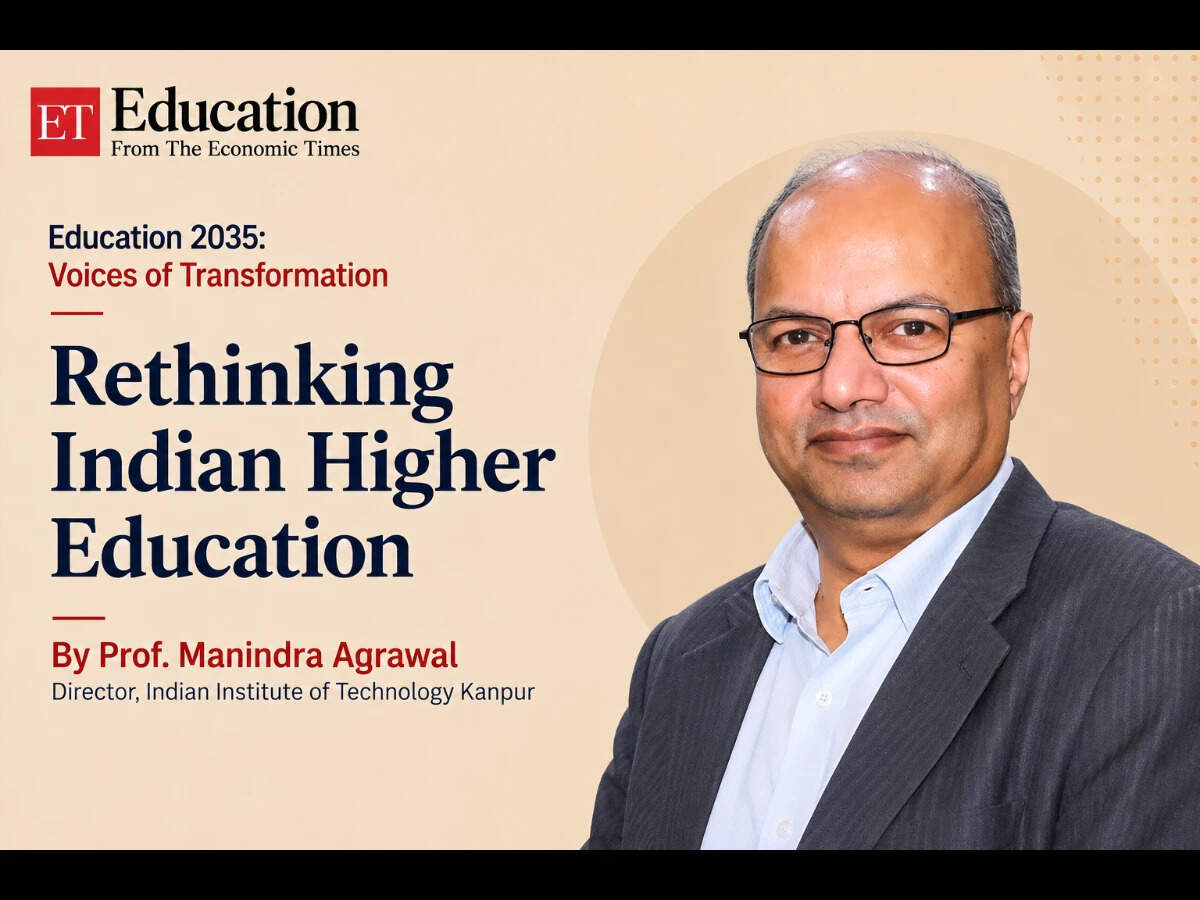
Prof Manindra Agrawal
Education is meant to promote critical thinking, creativity, personal growth, informed citizenship, and economic progress. However, education systems must continuously evolve with changing times. Today, the world is being reshaped by rapid technological disruptions, geopolitical shifts, and changing definitions of knowledge and skills. This presents a major opportunity for India to rethink and redefine its higher education system.
Post-Independence, India established several premier institutions, including the IITs, to create a technically skilled workforce for national development. These institutions relied on rigorous academic standards and strong curricula to produce engineers and professionals needed for a growing economy. While some institutions have sustained excellence, many parts of the broader higher education ecosystem have struggled with declining quality.
Over time, the focus in higher education has shifted from expansion to research and development. Institutions such as the IITs now contribute significantly to innovation and societal problem-solving. However, research output is often measured more by publication volume than by the creation of transformative technologies and practical solutions. Rapid technological change and evolving geopolitical realities now demand a rethinking of higher education to strengthen India’s technological capabilities and support the vision of Viksit Bharat 2047.
School education remains the foundation for critical thinking and specialized learning. Meaningful reforms in higher education cannot happen without addressing shortcomings at the school level. One important area is the need to move beyond the traditional one-size-fits-all classroom model toward more personalized learning systems.
Advances in Artificial Intelligence (AI) and Machine Learning (ML) offer opportunities to improve education through intelligent tutoring systems and AI-based learning support. Such systems can provide individualized guidance, identify strengths and weaknesses, and recommend tailored learning pathways. They can also assist teachers by identifying learning gaps and improving classroom effectiveness.
At the same time, curriculum reforms are essential. Education must integrate emerging technologies while promoting experiential learning, active participation, and independent thinking. Although AI has the potential to transform pedagogy, excessive dependence on technology should be avoided to ensure students continue to develop analytical and creative abilities.
Another major concern is the current structure of high-stakes examinations such as JEE. These assessments have increasingly become dependent on a coaching ecosystem that often rewards pattern recognition rather than originality, creativity, and reasoning. There is a need to move toward adaptive assessment systems that better evaluate critical thinking, resilience, and problem-solving abilities. Selection systems should focus not merely on eliminating candidates, but on identifying genuine talent and potential.
India must also strengthen its technological sovereignty. For decades, the country has depended heavily on technologies developed elsewhere. Recent global developments have shown that for a country of India’s scale, self-reliance in critical technologies is essential. While complete technological independence may not be realistic in every domain, India must build strong capabilities in strategic sectors such as cybersecurity, unmanned systems, quantum technology, AI, semiconductors, biotechnology, agriculture technology, and space technology.
Achieving this requires deeper collaboration between academia, industry, and government. Critical technologies demand sustained investment, long-term planning, and strong research ecosystems. The government has already initiated several major programmes, including the National Mission on Interdisciplinary Cyber-Physical Systems, IndiaAI Mission, National Quantum Mission, India Semiconductor Mission, and the Research, Development and Innovation Fund under the Anusandhan National Research Foundation (ANRF).
Higher education institutions, especially technical institutions, must evolve from centres of knowledge delivery into hubs of innovation, research, and entrepreneurship. Deep-tech startups emerging from institutions such as the IITs are playing an important role in translating research into practical applications. Institutions provide infrastructure and knowledge, while startups contribute agility, experimentation, and rapid innovation. This ecosystem needs to expand beyond a few leading institutions to create a broader and more distributed innovation network across the country.
Ultimately, the goal of higher education should shift from producing job seekers to nurturing job creators. This transition will take time, but universities and technical institutions are well-positioned to lead it. Achieving this vision will require stronger partnerships among academia, industry, and government.
As India redefines its global role in the coming decades, education will remain central to shaping the country’s capabilities, innovation capacity, and national character.
This article is written by Prof Manindra Agrawal, Director, Indian Institute of Technology Kanpur
DISCLAIMER: The views expressed are solely of the author and ETEducation does not necessarily subscribe to it. ETEducation will not be responsible for any damage caused to any person or organisation directly or indirectly.