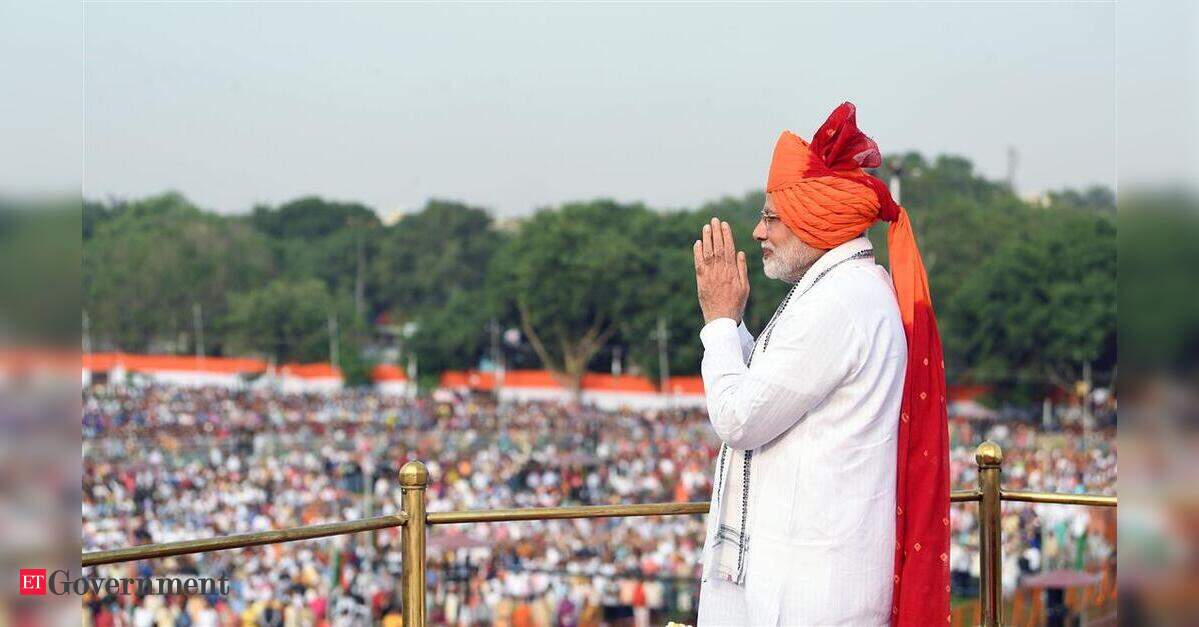
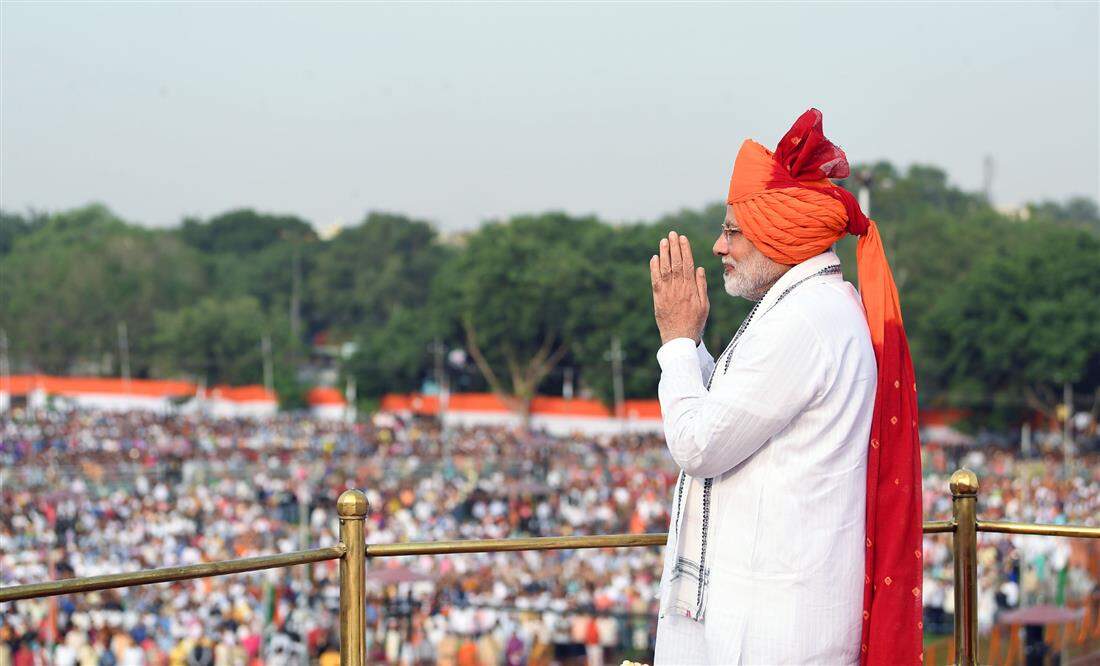
Prime Minister Narendra Modi on August 15 placed the collective strength of 140 crore Indians at the centre of India’s 80th Independence Day celebrations, invoking the sacrifices of the freedom movement while calling for greater momentum in the country’s journey towards Viksit Bharat.
Addressing the nation from the ramparts of the historic Red Fort in New Delhi, Modi said India is “powered by 140 crore Indians” and is “scaling new heights of progress”, framing Independence Day not simply as a commemoration of freedom won in 1947, but as an occasion to renew the national resolve to build a developed India by 2047.
Delivering his 13th consecutive Independence Day address from the Red Fort, Modi’s message combined remembrance, national confidence, self-reliance and the ambition to transform India’s growing economic and technological capabilities into comprehensive national power.
The 80th Independence Day celebrations themselves have been structured around India’s broader journey towards Viksit Bharat, giving the traditional ceremony at the Red Fort a distinctly forward-looking character. Modi’s 13th consecutive address is also a significant political milestone, extending an unbroken series of Independence Day speeches that began with his first appearance at the Red Fort as Prime Minister in August 2014.
Over those years, the annual address has increasingly become a platform for articulating long-term national priorities—from sanitation, financial inclusion and infrastructure to manufacturing, technological self-reliance and the Viksit Bharat goal. This year, the ceremonial programme includes the hoisting of the National Flag, a Guard of Honour drawn from the Army, Navy, Air Force and Delhi Police, and a 21-gun salute using indigenous 105 mm Light Field Guns.
The use of domestically manufactured artillery carries symbolism of its own: self-reliance is no longer being projected merely as an economic objective but as an essential component of India’s strategic autonomy.
Modi’s invocation of the power of 140 crore Indians also carries a larger developmental message. India has a demographic scale that few countries can match, but population becomes a source of national strength only when accompanied by education, skills, healthcare, productive employment, entrepreneurship and technological capability. The country’s central challenge over the next two decades will therefore be to transform demographic scale into human capital and human capital into sustained economic power.
The Viksit Bharat ambition cannot be reduced to reaching a particular GDP figure. It will require globally competitive manufacturing, stronger research and development, world-class infrastructure, resilient cities, productive agriculture, greater participation of women in the economy and the ability to generate high-quality jobs for a young and increasingly aspirational population. It will also require leadership in technologies that are rapidly becoming determinants of national power—artificial intelligence, semiconductors, telecommunications, space, defence systems, clean energy and critical minerals.
This forward-looking message from the Red Fort builds upon the themes articulated by President Droupadi Murmu in her address to the nation on the eve of the 80th Independence Day. The President described Independence Day as a national festival and paid homage to the generations of freedom fighters who challenged colonial rule and made the establishment of a sovereign Republic possible. Her address linked the memory of the freedom struggle with the contemporary national ambition of Viksit Bharat by 2047.
In doing so, she effectively connected two defining dates in India’s modern history: 1947, when political freedom was achieved, and 2047, when India aspired to complete that political achievement with economic prosperity, technological capability and wider social development.
Prime Minister Modi strongly endorsed the President’s message. Describing her address as “motivating and thoughtful”, he said, “Her thoughts reflect the strength of our nation and the aspirations of every Indian.” He further said that the President’s words “inspire us to work with renewed determination towards building a Viksit Bharat.”
The convergence between the President’s address and the Prime Minister’s Independence Day message points to the larger framework within which the government increasingly presents India’s development agenda: the next two decades are being viewed as a decisive period in which the country must convert its demographic, economic and technological advantages into lasting national capabilities.
National security was another important element of President Murmu’s address. She referred to Operation Sindoor and India’s response to terrorism, while also highlighting progress against Left-Wing Extremism. Her message on terrorism was unequivocal: “Terrorists will face consequences.” The President also referred to the suspension of the Indus Waters Treaty with a country harbouring terrorism as a decisive measure.
The significance of these observations extends beyond security policy. India’s development ambitions are unfolding in an international environment marked by wars, geopolitical rivalries, disruptions in trade and supply chains, and increasingly intense competition for advanced technologies and strategic resources. Economic resilience and national security have consequently become deeply interconnected. A country aspiring to become a leading economic and technological power must possess not only capital and markets but also the military, industrial, energy and technological capacity to protect its strategic interests.
That is also why Atmanirbharta has acquired a broader meaning in India’s policy discourse. Self-reliance cannot mean disengagement from global trade or investment; India’s economic ambitions require precisely the opposite—deeper integration with global markets, supply chains, technology networks and investment flows. But integration without domestic capability can create strategic vulnerabilities.
India’s experience of recent global crises has demonstrated the risks of excessive dependence on external suppliers for critical technologies, energy, defence equipment and industrial inputs. Building competitive domestic capacity in strategically important sectors therefore strengthens rather than diminishes India’s ability to engage globally. The indigenous guns participating in the Red Fort salute are a ceremonial illustration of this larger transformation in thinking.
The celebration of freedom also carries a solemn reminder of the price paid to defend it. On the eve of Independence Day, President Murmu approved 78 Gallantry Awards, including 13 posthumous awards, for personnel of the Defence Forces and Central Armed Police Forces. The honours comprise nine Kirti Chakras, including seven posthumous; one Bar to Shaurya Chakra; 19 Shaurya Chakras, including one posthumous; five Bars to Sena Medals (Gallantry); 36 Sena Medals (Gallantry), including five posthumous; three Nao Sena Medals (Gallantry); and five Vayu Sena Medals (Gallantry).
The President also approved 89 Mention-in-Despatches. Behind these numbers are individual stories of extraordinary courage, and the 13 posthumous awards are particularly poignant reminders that the sovereignty secured through sacrifice during the freedom movement continues to demand courage and sacrifice from those entrusted with defending the Republic.
The idea of service to the nation, however, extends well beyond the Armed Forces. India’s transformation ultimately depends on millions of farmers, workers, entrepreneurs, scientists, teachers, engineers, doctors, administrators and innovators. This is where Modi’s emphasis on 140 crore Indians acquires its deeper significance. India’s rise cannot ultimately be delivered by the government alone.
Public investment and policy can create infrastructure, institutions and incentives, but the transition to a developed economy requires an enormous mobilisation of private enterprise, innovation, skills and individual initiative. The ambition must therefore be not only to make India larger economically, but more productive, technologically sophisticated and competitive.
India begins this phase from a position that would have appeared almost unimaginable at Independence. In 1947, the country faced widespread poverty, low literacy, food insecurity, weak industrial capacity and the enormous political challenge of integrating a vast and diverse nation. Eight decades later, India is among the world’s largest economies, possesses nuclear and space capabilities, has created digital public infrastructure on an unprecedented scale and has emerged as a major global centre for technology and services.
It is simultaneously seeking a larger role in advanced manufacturing, defence production, electronics, renewable energy, semiconductors and emerging technologies.
The achievements are substantial, but so is the unfinished agenda. Employment creation must keep pace with the aspirations of India’s young population. Manufacturing needs to become deeper and more globally competitive. Research and development requires greater investment. Agricultural productivity and rural incomes remain critical challenges. India’s rapidly expanding cities need better planning, transport and municipal governance.
Above all, technological and economic progress must translate into tangible improvements in the lives of ordinary citizens. The real test of Viksit Bharat will not simply be India’s aggregate economic size in 2047, but whether prosperity creates opportunity, dignity and a higher quality of life across regions and social groups.
That is why India’s 80th Independence Day represents more than another anniversary. It is a useful point from which to view two very different national journeys. The generation that fought for freedom confronted the challenge of ending colonial rule. The generations that followed had to preserve national unity, build democratic institutions, overcome food shortages, industrialise and create the foundations of a modern economy. The generation of 2026 faces another historic task: transforming those foundations into comprehensive economic, technological and strategic capability.
As Prime Minister Narendra Modi delivers his 13th consecutive Independence Day address from the Red Fort on August 15, the symbolism of the occasion stretches from the sacrifices of the freedom struggle to the ambitions of 2047. The President’s call for unity, development and security, the gallantry awards honouring those who defend the Republic, and the Prime Minister’s invocation of the strength of 140 crore citizens converge around a common proposition: India’s next transformation will depend upon converting national confidence into national capability.
The generation of 1947 won India’s political freedom. The defining responsibility of the generation of 2026 is to use that freedom to build a country that is prosperous, technologically advanced, socially inclusive and strategically secure. As the Tricolour flies over the Red Fort on India’s 80th Independence Day, the most meaningful tribute to those who fought for freedom will be the India that today’s citizens built for 2047.