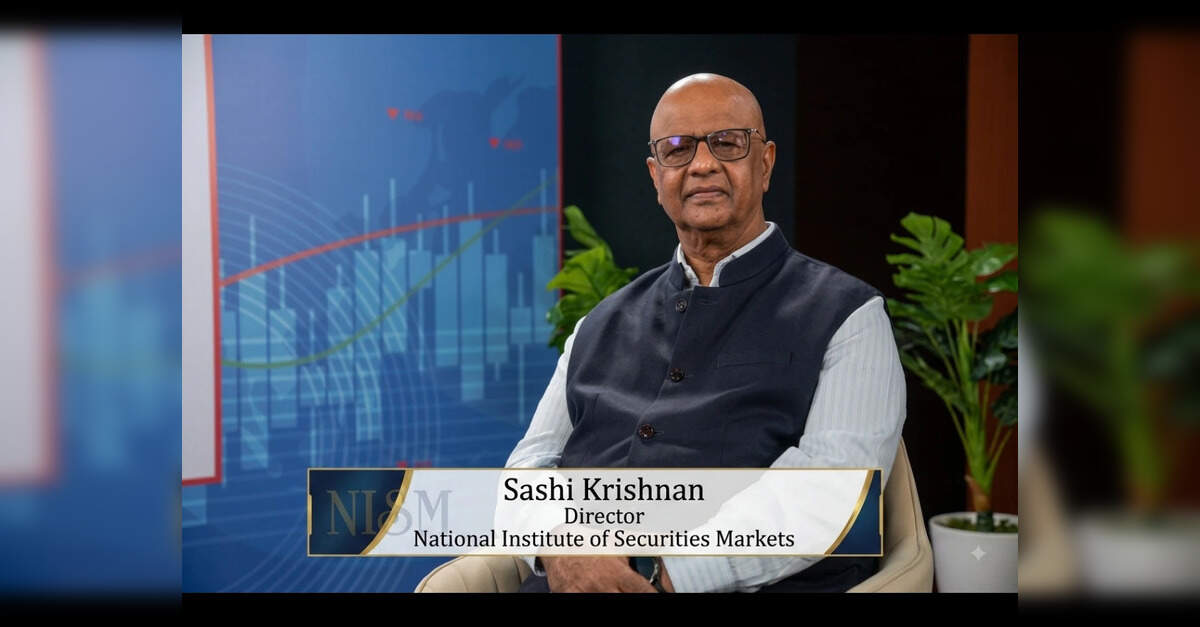
India’s management education system continues to face a gap between classroom learning and workplace requirements. NISM is trying to bridge that gap through experiential learning, industry exposure and partnerships with higher education institutions. In an interview with ETEducation, NISM Director Sashi Krishnan discusses how students can be exposed to real-world financial markets, why financial education should become a life skill and what universities can do differently to prepare graduates for the workplace.
Edited excerpts:
Q. You are saying that you have 100% placement and you are from industry and you train people accordingly. But what we see as professionals is that despite the growing number of commerce and management graduates, employers often say graduates are not industry-ready. So, where do you see the biggest skill gap in the traditional MBA and PGDM courses being offered?
Sashi Krishnan: This is what I keep telling people. What does traditional pedagogy attempt to do in your undergraduate and graduate courses? It wants you to go to a class, learn a set of skills and then take those skills and apply them to real life.
We have turned that around. We have said we will put you in a real-life situation. We will give you real-life cases to analyse and study. You will learn what happens in the real world and take this learning to your job.
So that’s the way we approach people who need to be trained for the securities market. We operate this entire learning ecosystem differently. The traditional MBA should also be taught with some industry integration. Some of the leading MBA institutes already use this kind of pedagogy. But a large majority of the MBAs, except for the top schools, may not be using this kind of pedagogy.
Q. So, the PGDM course and the LLM course that you offer, the full-time programmes, how has been the trend from the industry for these professionals who come out with these specialised skills from your institution?
Sashi Krishnan: These are very specialised. They are meant to provide resources to the securities-market industry, the banking industry and the financial sector as a whole. The entire curriculum is an immersive kind of curriculum. It is a curriculum that is basically practically oriented.
So, they are very, very useful resources for the industry. And let me tell you that we have 100% placements literally through all these courses, our PGDM, our LLM and our PGPISM courses. And the way we approach it, our pedagogy is based on experiential learning.
We have a large number of labs. We have what is called a simulation lab. In our simulation lab, students can actually go and immerse themselves in a real market situation.
They can trade in the market. They can learn how to make money or lose money because you don’t make money all the time. They can learn how to use derivatives. Similarly, we have a digital lab. Our digital lab teaches people how to use the latest digital tools, including AI and algo trading, for analysis and applying it to real-world situations.
Then we have a RegTech lab, which we have set up to help people who are involved in the regulatory space. They have real-life platforms where they can work on PMLA, prevention of money laundering and anti-money-laundering cases. And then we have a Bloomberg lab. They can go to the Bloomberg lab and figure out how actual professionals use Bloomberg information, data and terminals to analyse markets. They can complete Bloomberg certification. So, it is a very experiential learning process.
Q. Even the entire course structure, the various structures like case-based study, labs, all that is very true. But more than that, how important is direct interaction with industry professionals?
Sashi Krishnan: More than that, we have literally all the senior professionals from the market come to our classrooms and have conversations with the students. That is the most important thing.
People from exchanges, people from broking, people from the investment community, people from mutual funds, they come into our campuses. They spend a couple of classroom sessions with all our students and tell them about their experiences. And even beyond students, for the general community also, we are doing this.
As part of our investment education efforts, we do a large number of programmes. For example, we have a masterclass series where we sit down with the leaders of the industry and have conversations with them to understand from their experiences what is important, what is not important, how do you manage different kinds of things, how things are changing fast and how do you apply new technologies.
Similarly, we have online sessions where we bring in experts from outside and do these kinds of sessions. So, we approach it in a more engaging way.
Q. Do you have plans to expand courses in states with state governments, so that students get to learn these skills?
Sashi Krishnan: We are a not-for-profit trust set up by the Securities and Exchange Board of India (SEBI), with the primary objective of capacity building for the securities-market ecosystem. As part of our capacity-building initiative, there are a couple of activities that we undertake. The first is academics.
We have a 70-acre campus in Patalganga, where we have over 350 students pursuing full-time courses. One is a postgraduate diploma in management in securities markets. The second is an LLM in securities and investment law. The third is a certificate course in securities markets. We also have a large number of other offerings, including in FinTech and financial planning.
So, there is an entire academic initiative that NISM has. The courses are recognised by the relevant regulatory bodies.
The second big initiative is management development programmes, or MDPs, which we conduct for securities-market intermediaries and market infrastructure institutions. These are basically related to specific topics in the securities market.
The third big initiative is certification. We have around 30 NISM certifications. To operate in different parts of the securities market, whether as a mutual fund distributor, portfolio management services professional, investment adviser, fund manager or in other roles, you need the relevant NISM certification. After obtaining that NISM certification, you can then approach the regulator or the association for the certification required to operate in the market.
Q. So, there you have a lot of tie-ups with state-level entities?
Sashi Krishnan: Yes. This is an employment-generating opportunity for the country. For example, we have tied up with different state governments to help equip their younger generation to qualify for these certifications. We have done initiatives with governments such as the J&K government and the Uttarakhand government. A lot of governments do these kinds of initiatives.
Q. For students also?
Sashi Krishnan: Yes. All the content for the certification is available online for free. Once you have self-studied this content, you can come and take the examinations at our end. That’s how the process works.
The second part of how we do this is that we also have a large number of tie-ups with higher education institutions. We directly tie up with a large number of higher education institutions and conduct programmes in these institutions, including programmes relating to careers in the securities market.
We try to tell students what careers are available if they want to make a career as, say, an investment adviser, research analyst or mutual fund distributor. There are a set of examinations that you need to pass for these roles. These are the certifications, and we familiarise them with this kind of content.
Q. Do you see industry-recognised certification becoming an integral part of undergraduate education under the National Education Policy 2020? And is NISM also working with UGC or other regulatory bodies in this regard?
Sashi Krishnan: Yes, we are. In fact, let me tell you that we offer on-campus courses and digital courses. We also have our NISM certifications, which are for industry professionals. Beyond that, we have almost 70 e-learning and skill-development courses. These e-learning courses and skill-development courses are available to the entire ecosystem, especially the college ecosystem. Many of them are free. We have a 21-hour course called Financial Literacy for Bharat.
This Financial Literacy for Bharat is a very comprehensive course that covers the entire financial ecosystem. And many universities across India have now made it a compulsory credit course for their students, for their undergraduate and graduate students.
As part of the new education policy, you can do these courses. Similarly, a large part of many of our courses, which are free, are on the SWAYAM portal. People can access these courses through the SWAYAM portal and use them for their own credit. We do believe that, as I told you, these are must-have skills.
Q. Do you think financial education should be part of the school curriculum?
Sashi Krishnan: Financial education has never been part of the school curriculum and college curriculum. I think we are to blame for that because we have not made it part of the curriculum. Whereas we think that people should have basic mathematics skills and basic language skills, we don’t think that financial skills are a life skill that people need.
And that is something that we at NISM and SEBI are trying to change. We are trying to say that financial literacy is a life skill that people need. We acknowledge the fact that students have not got the opportunity to develop this skill. We, as an education system, haven’t given them that opportunity.
It’s mostly around engineering, medicine and all. It’s about maths skills. We have been doing that. What do you do in school? Maths skills. You want them to understand complex equations.
You don’t want to make them understand compounding, which is more important for them in life. Compounding is more important because that’s how you create wealth for yourself.
So, I think such immersive experiences actually help them see the importance of financial literacy as part of their life skill and then get them interested in learning for themselves.
Q. So, what would be your suggestion if this is to be included at the school level? From which class should it be included: Class 9, 10 or 11, 12?
Sashi Krishnan: Earlier than this. People should get the idea of what money is, what savings are. They need to create money. You need to create wealth.
There should be training. That should be the next step in the ninth grade, like you are saying. But the first initial steps, when you are in a younger, impressionable age, anywhere from Class 5 onwards to Class 8, you should be able to understand what money is, what money can do for you, what savings are, how do you save and what is the importance of saving.
Once you have that basic idea, then, as you rightly said, from Classes 9 and 10, you should be given further skills like what is compounding, why is compounding important, how regular savings help you compound your money and what the different instruments available are.
And then, I keep telling people, it’s a journey. First, you have to start with financial education, which has to continue through school and undergraduate level. From there, you move to financial literacy.
Financial literacy is about how to use the education that we have received. Education dene se kya hota hai? Beyond that, you should know how to use it.
And that’s where, at the graduate and undergraduate level, you should give them these skills. Now that you know the power of compounding, how do you understand which mutual fund to choose, what are the kinds of mutual funds and how do you access a mutual fund?
So that by the time they have graduated, they get included in the financial system. You move from financial education to financial literacy to financial inclusion. So that is a seamless journey for anybody through there. And that’s very important.
Q. Another thing which you are doing is that many colleges and management schools across the country now do an immersion programme on your campus. How does that work?
Sashi Krishnan: There are four-week to seven-week immersion programmes which are part of their core course curriculum. A batch of 150 MBA students comes to my campus. They spend seven weeks.
We take them through a whole set of curated courses. They have an assessment at the end of the day, and that forms part of the credits which they can get.
Q. In the first year only?
Sashi Krishnan: Many do it in their first year. Some do it in their second year. So, we give it to the universities, whichever way they want. We also offer that to students.
Q. Artificial Intelligence and FinTech are rapidly transforming the financial-services industry. How should universities rethink their curricula to prepare students for the next generation of BFSI jobs? And is NISM also developing some new programmes around this?
Sashi Krishnan: If you are talking specifically about that, we have a specific programme around FinTech. It’s called the Postgraduate Certificate Course in FinTech, which we offer and which broadly concentrates on the FinTech space.
But over and above that, as I told you, our entire experience is digital. We have a digital lab where we expose people to everything related to this, including AI and algo trading. So, a lot of the technology is already incorporated into how students learn today.