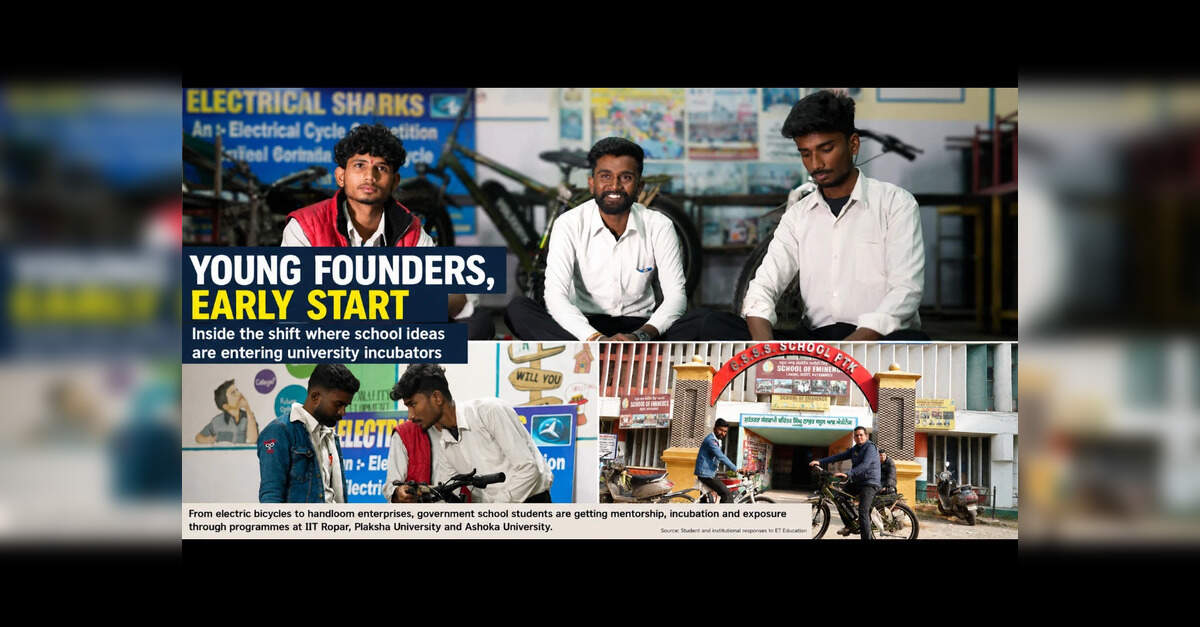
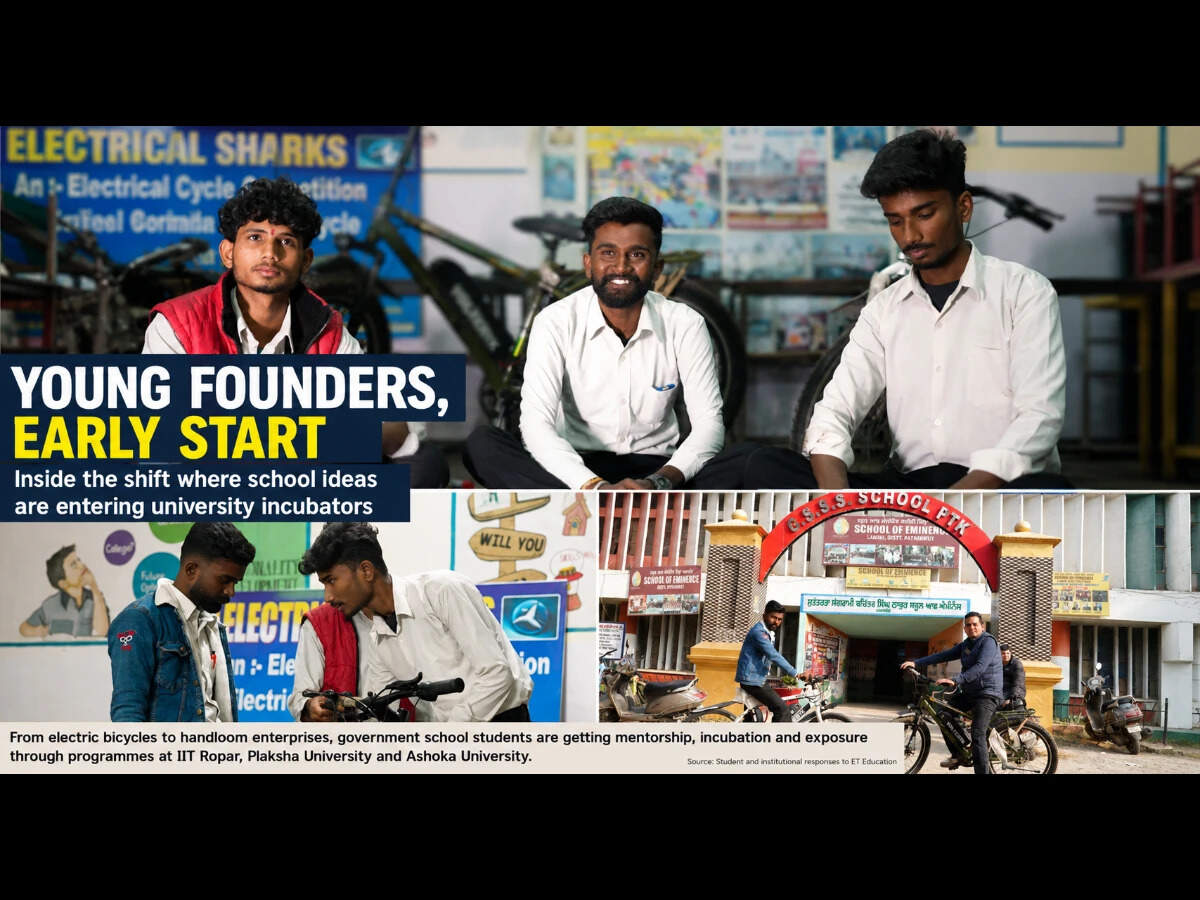
For Arjun Chaudhary, the journey into entrepreneurship began in Class 11, when he and his team started working on a rechargeable electric bicycle in a government school in Punjab.
The idea was developed through the state’s Business Blasters programme, with the students trying to address affordable mobility. The team was recognised among the top performers at the Business Blasters Punjab State Summit and secured ₹4 lakh in funding before being selected for a year-long incubation programme at IIT Ropar.
What followed was different from the usual trajectory of a school competition project. At IIT Ropar, the team received technical and business mentorship, worked on improving the battery system, reduced the cost of the cycle and received guidance on understanding customers, marketing and presenting the product.
The venture has since been registered as AC Rockers LLP, after the team found that the original name, Electrical Sharks, was unavailable for registration, and has received close to 60 orders.
“We learnt how to improve our battery system, reduce the cost of the cycle, and make our product more practical for everyday use. We also received guidance on marketing, understanding customers, and presenting our idea better,” Chaudhary said.
Chaudhary’s journey is part of a wider shift in the way school-level entrepreneurship is beginning to connect with higher education and innovation ecosystems. For some government school students, the journey from identifying a problem in the classroom to accessing university mentors, incubators and technology is now beginning before they even enter college.
Punjab’s Business Blasters, Uttarakhand’s Kaushalam, Haryana’s Kushal Business Challenge and Madhya Pradesh’s Tejasvi are among state-led programmes encouraging government school students to identify real-world problems, develop solutions and pitch business ideas while they are still in school.
The programmes themselves are not new. What is changing is what happens after students develop their ideas.
Udhyam Learning Foundation, which has worked across 15 states since 2017 as an implementation partner for such programmes, says its initiatives have reached more than 4.7 million students and 50,000 teachers.
A small proportion of students are now moving beyond school-level competitions into formal incubation or other university-led programmes. IIT Ropar is providing incubation support to school-originated ventures, while Plaksha University and Ashoka University are engaging school students through technology, mentorship, leadership and liberal arts programmes before they enter higher education.
“The biggest shift we are seeing is that school entrepreneurship is moving from being an extracurricular activity to becoming a more structured part of how students learn and engage with the real world,” said Mekin Maheshwari, CEO and Founder of Udhyam Learning Foundation.
“The journey is increasingly extending beyond the classroom, with promising student ideas getting access to mentors, institutions, competitions, incubation and funding opportunities. That creates a stronger pathway from a problem identified in a school classroom to an idea that can be developed further outside it,” he said.
When a school idea enters an incubator
At IIT Ropar, the connection is taking a more direct form. The institute’s Technology Business Incubator Foundation (TBIF) has incubated 19 student-led ventures originating from school entrepreneurship programmes, according to Dr Shray Pathak, Faculty In Charge and Director, IIT Ropar-TBIF.
Pathak said the institute saw an opportunity to take ideas emerging from school-level innovation programmes further by providing students with access to technical expertise, infrastructure, mentorship and incubation support.
“While these initiatives encourage students to identify problems and develop innovative ideas, we felt there was an opportunity to take promising ideas a step further by providing access to advanced mentorship, technical expertise, infrastructure and incubation support,” Pathak said.
This is particularly significant for government school students, he said, as access to such ecosystems can be more limited.
“We want to ensure that talent and opportunity are not determined by a student’s background or the school they attend,” Pathak said.
Arjun’s electric bicycle is one example. Another is Kalindi, a handloom enterprise founded by Dhruv while he was still in school in Uttarakhand.
Dhruv’s venture began with a single hand-painted saree. Through the state’s Kaushalam programme and subsequent incubation support, the idea developed into a larger enterprise working with local artisans. Kalindi has since fulfilled an order for more than 100 hand-painted sarees for Fabindia.
“The incubation support gave me exposure, connected me with experienced people, and encouraged me to dream bigger,” Dhruv said.
“That journey showed me that when someone believes in your idea and guides you in the right direction, you begin to believe in yourself too,” he added.
For IIT Ropar, the engagement could eventually become more than a set of individual interventions. Pathak said the institute sees potential in building a continuous pathway from school-level innovation to venture creation.
“We therefore believe this has strong potential to become a long-term model for IIT Ropar TBIF,” he said. “The vision is to create a continuous pathway from school-level innovation, prototyping, mentorship, incubation, investment and market access, to venture creation.”
Getting students into the innovation ecosystem before college
The connection with higher education does not always begin with an existing venture.
At Plaksha University, the Young Technology Scholars programme, YTS+, gives high school students immersive, project-based exposure to areas including artificial intelligence, robotics, biotechnology and computer science, along with faculty mentorship.
Pawan Kumar, Director of High School Programs at Plaksha, said the university deliberately engages with students before college because important career choices often begin taking shape much earlier.
“We believe the most important career decisions are often made far earlier than college admissions, which is why we choose to engage with students while they are still in school,” Kumar said.
He said the experiential nature of the programme can reveal interests and capabilities that conventional schooling may not always bring out.
“This experiential format often brings out a natural curiosity and talent that conventional schooling does not always reveal. For many students, it is the first time they engage with a subject purely out of interest rather than academic pressure, and that shift matters,” Kumar said.
Ashoka University is also engaging with school students through programmes including the Lodha Genius Programme and the Ashoka Young Scholars Programme, a certified summer residential programme for students in Grades 9 to 12 focused on liberal arts and sciences.
For Ashoka, the objective of engaging students early extends beyond preparing them for university or a particular career.
“Ashoka believes that the capacity to think independently, ask meaningful questions and create solutions to real-world societal challenges begins developing well before a student enters university,” the university said.
“Its engagement with young people at the school level is therefore not simply about preparing them for higher education, but about giving students the confidence, exposure and mentorship to imagine possibilities beyond what they may have encountered in their immediate environment,” it said.
Together, these approaches point to a broader change in the relationship between school education and higher education. A student does not necessarily have to wait until admission to college to encounter advanced technology, university faculty, mentors or an incubation ecosystem.
Not every venture survives
For every student whose venture moves into incubation or receives commercial traction, there are others whose businesses do not continue. But the experience can still shape what they do next.
Krishna Rathore started a home décor venture in Class 11 through Delhi’s Business Blasters programme with ₹14,000 in seed funding. His venture, YUDECOR, developed a candle brand around a repurpose-planter concept, allowing customers to reuse the candle container as a plant pot.
The brand expanded to more than 50 designs and over 70 fragrances and generated an estimated ₹10–15 lakh in sales over several years. The business eventually became difficult to sustain when Rathore began a BBA at Dr B R Ambedkar University Delhi and found himself running every part of the venture alone.
“I lacked something equally important: a committed team,” Rathore said.
“Rather than seeing the venture as a failure, I see it as my greatest classroom. Every setback taught me lessons that no textbook ever could,” he said.
Rathore has since launched a second venture, a personal care brand called Seamless by Krish, applying lessons from his first business around branding, customer psychology and long-term planning.
Gagandeep, who developed a healthier confectionery brand called BB Choco Dreams and was selected for incubation with IIT Ropar after the Business Blasters Expo, faced a different set of challenges.
His team split up after the competition, the product’s short shelf life restricted distribution, formal business registration added costs, and balancing a company with a B.Com course became difficult.
The business eventually closed, but Gagandeep said the experience changed the way he understood what he was learning in college.
“Despite closing the business, the experience was incredibly valuable,” he said. “Business concepts like cost accounting, market demand, cash flow, and licensing are no longer just abstract theories in a textbook. I have lived them firsthand.”
A new pathway, but still a narrow funnel
The scale of school entrepreneurship programmes remains far larger than the number of ventures that ultimately enter a university incubator.
Punjab’s Business Blasters, for instance, currently runs across government senior secondary schools in the state from Class 9 onward and produced 18,492 student business ideas, with more than 7,000 funded teams, in the 2025 cycle, according to state government figures.
The comparison also shows how much narrower the funnel becomes when school-level ideas move towards formal university incubation.
But the significance of these programmes may not lie only in how many startups eventually emerge.
For some students, the value lies in gaining access to technical expertise and mentors. For others, it is exposure to subjects and university-level learning before college. And for students whose ventures eventually close, the experience can still influence how they approach education, careers and future entrepreneurial efforts.
Maheshwari sees this as the beginning of a more connected ecosystem.
“Universities have traditionally entered the entrepreneurship journey after a student reaches higher education,” he said. “What we are beginning to see is a more connected ecosystem, where universities, incubators and other innovation institutions are engaging with promising ideas much earlier.”
If that model develops further, government school students could have a more continuous pathway from identifying a problem in school to building, testing and potentially scaling a solution, with fewer traditional boundaries between school education and higher education.
For students such as Arjun, the journey from a school classroom to a university innovation ecosystem is already underway.