Prime Minister Narendra Modi’s fourth visit to Uzbekistan has produced something more consequential than another round of bilateral diplomacy.
By elevating India–Uzbekistan relations to a Comprehensive Strategic Partnership, setting a $5-billion trade target and pushing cooperation in uranium, critical minerals, defence, digital infrastructure and connectivity, New Delhi and Tashkent are attempting to give economic and strategic substance to a relationship rooted in centuries of civilisational contact.
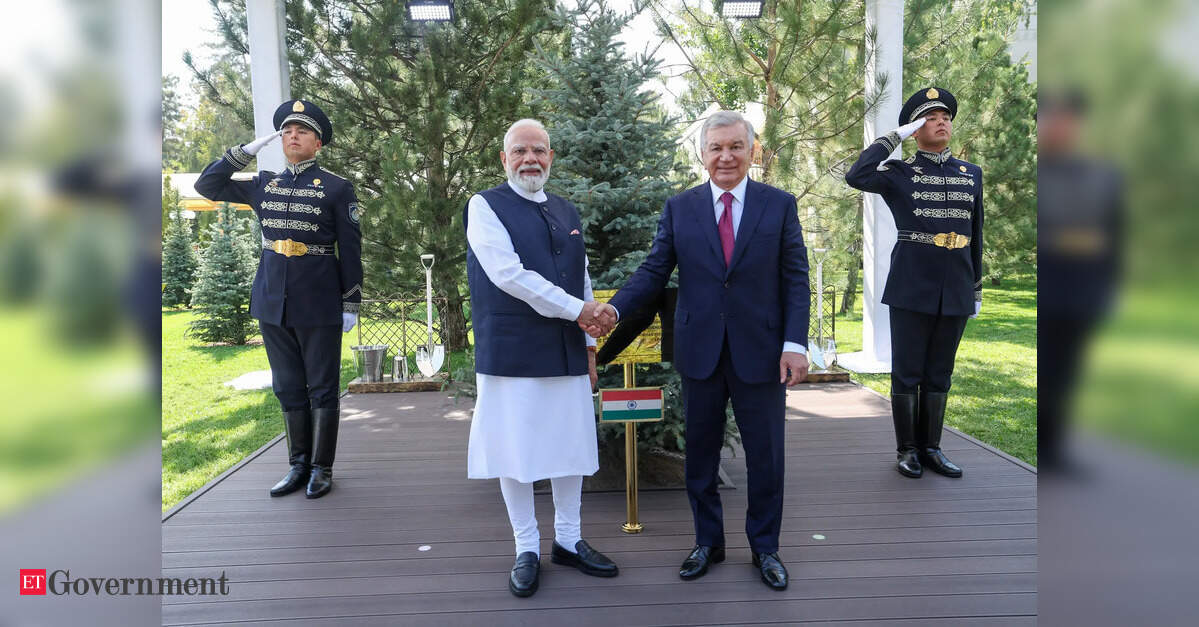
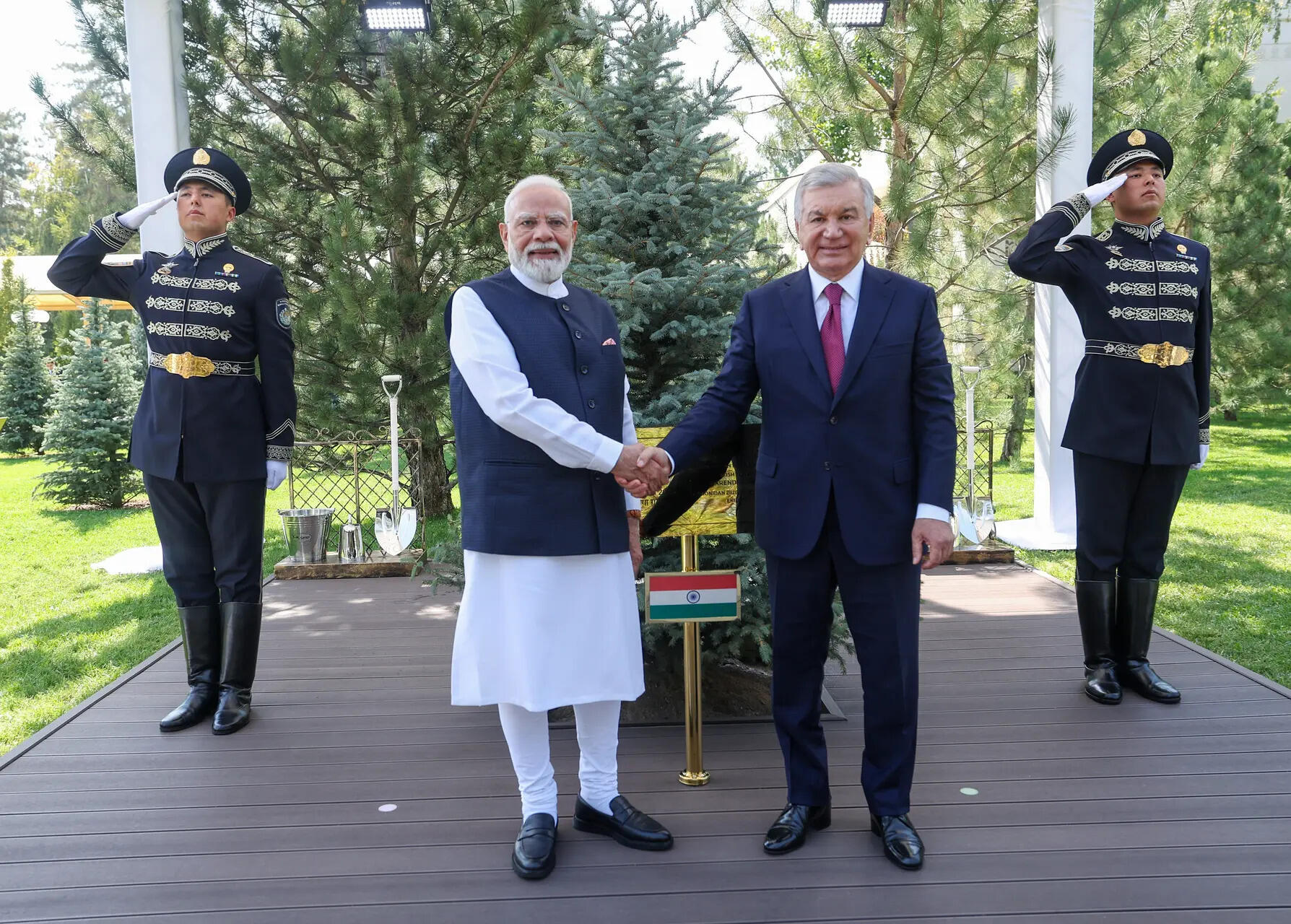
Modi arrived in Tashkent on August 29 for a two-day State Visit at the invitation of Uzbek President Shavkat Mirziyoyev, before travelling to Bishkek for the 26th Shanghai Cooperation Organisation Summit. Mirziyoyev personally received Modi at the airport, signalling the importance Tashkent attaches to the relationship. This is Modi’s fourth visit to Uzbekistan after visits in 2015, 2016 and 2022.
“Uzbekistan is at the heart of Central Asia, and at the heart of India’s engagement with the region,” Modi said after his talks with Mirziyoyev on Sunday. Announcing the elevation of ties, he said the two countries had prepared an “ambitious agenda” to advance the relationship with greater speed and concrete outcomes.
The description is significant. Uzbekistan is Central Asia’s most populous country, occupies a pivotal geographical position and has emerged as one of the region’s most active proponents of economic modernisation and regional connectivity. For India, therefore, stronger relations with Tashkent can become an important pillar of a wider Central Asian strategy.
From strategic partnership to comprehensive partnership
India was among the early countries to recognise Uzbekistan following the dissolution of the Soviet Union, and diplomatic relations were established in March 1992. The two countries declared a Strategic Partnership in 2011. Modi subsequently gave Central Asia greater political visibility when he visited all five Central Asian republics in 2015. The first India-Central Asia Summit, held virtually in January 2022, sought to institutionalise this engagement.
The latest visit coincides with the 15th anniversary of the Strategic Partnership and has now raised it to a Comprehensive Strategic Partnership.
President Mirziyoyev’s office described the decision as opening “a new chapter” in bilateral relations. The two sides have agreed to create a foreign-minister-level coordination mechanism and upgrade their Inter-Governmental Commission to ministerial level. Dedicated roadmaps, with implementing agencies and deadlines, are expected for priority sectors.
This institutional architecture matters because India’s Central Asia policy has often had greater political ambition than commercial depth. The challenge now is converting regular summit-level engagement into projects, investment flows and physical and digital connectivity.
$5 billion trade target
Economics is therefore central to the new partnership. Bilateral trade crossed $1 billion last year, according to the Uzbek presidency, and the two leaders have now set a target of $5 billion by 2030. They also called for a bilateral business summit and identified infrastructure, energy, electrical engineering, metallurgy, healthcare, pharmaceuticals, agriculture, jewellery and critical minerals as areas for greater investment.
Indian commercial presence has already expanded. An MEA bilateral brief recorded approximately $350 million of Indian investment and hundreds of enterprises with Indian capital participation. Indian universities have also established a notable presence: Amity University, Sharda University, Sambhram University and Acharya University operate campuses in Uzbekistan.
Modi said the two governments would work systematically on “market access, connectivity, banking and payment” issues to reach the trade target. The inclusion of Digital Public Infrastructure and UPI adds another dimension: India is increasingly positioning its digital governance stack as an instrument of economic diplomacy.
Uranium and critical minerals enter the strategic core
Perhaps the most consequential economic-security dimension is energy and minerals.
The two leaders reviewed progress towards a long-term arrangement for the supply of uranium from Uzbekistan to India while also agreeing to deepen cooperation in critical minerals. For India, which is expanding nuclear power as part of its long-term clean-energy strategy, diversification of uranium supplies has obvious strategic value.
Critical minerals are equally important. India’s accelerating investments in semiconductors, batteries, renewable energy, electric mobility and advanced manufacturing are increasing demand for secure mineral supply chains. Central Asia’s mineral resources consequently give the region importance beyond traditional geopolitical calculations.
Cooperation now extends into AI, clean energy, space and nuclear energy. As Modi put it, collaboration in these sectors is intended to make the partnership “future-ready.”
The connectivity problem
Yet India’s Central Asian ambitions continue to confront a stubborn geographical reality: India has no direct overland access to the region.
Pakistan blocks the most straightforward terrestrial route, while Afghanistan—despite its historic role as the bridge between India and Central Asia—continues to present political and security uncertainties.
That makes alternative corridors strategically indispensable. India’s investment in Iran’s Chabahar port and its support for the International North-South Transport Corridor are therefore not peripheral infrastructure initiatives; they are fundamental to India’s ability to build sustained economic relationships with landlocked Central Asia.
Unless transport costs and logistical bottlenecks are reduced, ambitious trade targets with Uzbekistan and the wider region will remain difficult to realise. Connectivity is thus the crucial link between diplomatic ambition and commercial execution.
Defence and counterterrorism
Security provides the other major pillar. India and Uzbekistan already have institutionalised defence cooperation through a Joint Working Group and conduct the DUSTLIK joint military exercise.
Their engagement includes military training, education and defence-industrial interaction. Uzbekistan’s Defence Industry Agency has also participated in Aero India, pointing towards a gradual expansion from military-to-military engagement into defence manufacturing.
Modi indicated that this could now accelerate. “In the coming period, we will promote direct linkages, co-production and co-development between the defence industries of the two countries,” he said.
Counterterrorism remains equally important. India and Uzbekistan share concerns over terrorism, extremism, separatism, narcotics trafficking and instability emanating from Afghanistan. The ninth India-Uzbekistan Joint Working Group on Counter Terrorism was held in Tashkent in September 2025.
“Terrorism, extremism and separatism are serious challenges for the entire region,” Modi said, stressing that zero tolerance towards them remains a shared commitment. His remarks acquire additional significance as he moves from Tashkent to the SCO Summit, where terrorism and regional security will again figure prominently.
Civilisational diplomacy alongside strategic interests
The visit has also retained a strong cultural dimension. Agreements cover culture, higher education, archives, tourism, Ayurveda and research, while India will cooperate in restoring the ancient Buddhist sites of Fayaz Tepa and Kara Tepa in Termez. Modi also announced Hindi scholarships for Uzbek students and a $1-million contribution towards environmental rehabilitation in the Aral Sea region.
The emphasis is consistent with a relationship whose cultural connections predate modern nation states. Lok Sabha Speaker Om Birla, meeting Uzbek Foreign Minister Bakhtiyor Saidov earlier this month, described the two countries as bound by “centuries-old historical, cultural, and civilizational ties” and argued that political trust, trade and people-to-people exchanges could further strengthen the partnership.
The number of direct flights has risen to 14 a week, while India’s diplomatic assessment earlier this year put the Indian community in Uzbekistan at around 21,000, including more than 16,000 students.
For New Delhi, however, the larger expectation from Modi’s visit goes beyond bilateral relations. India is seeking a stronger strategic presence in a region where Russia remains deeply embedded, China has rapidly expanded its economic footprint and other powers—including Türkiye, Iran and the European Union—are increasing their engagement.
India cannot compete in Central Asia merely through geography or financial scale. Its comparative strengths lie elsewhere: political trust, pharmaceuticals, healthcare, education, digital public infrastructure, IT, capacity building, defence cooperation and a civilisational relationship largely free of historical geopolitical baggage.
The test after Tashkent will therefore be implementation. The $5-billion trade target, uranium arrangements, critical-mineral partnerships, defence co-development and improved connectivity will require sustained work by ministries, businesses and financial institutions.
Modi summed up the strategic proposition succinctly: “A stronger India-Uzbekistan partnership will be a powerful force for peace, progress and prosperity in Central Asia.”