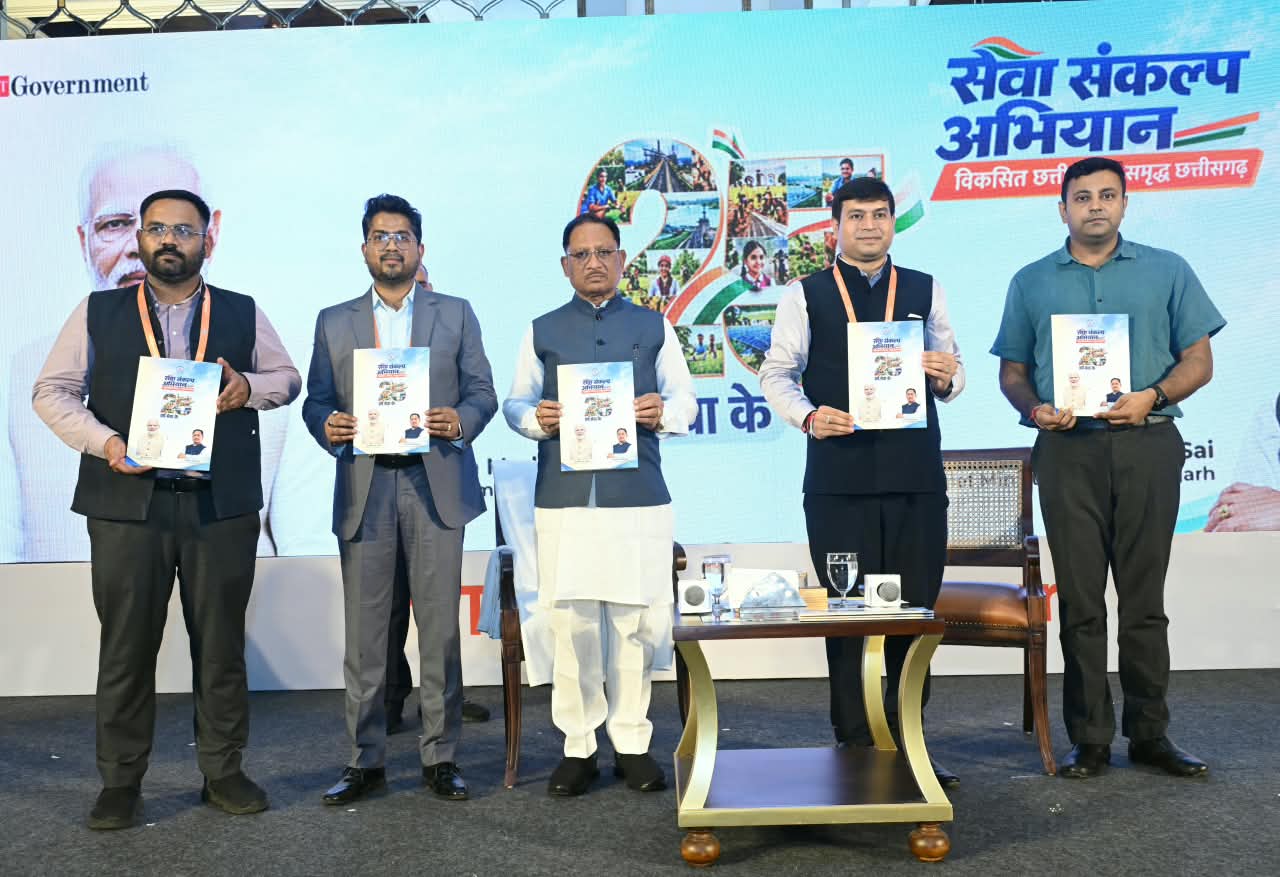
Chief Minister Vishnu Deo Sai participated in the ‘Viksit Chhattisgarh Conclave – 2026’ programme organised by ETGovernment in Nava Raipur, on September 18.
On this occasion, while discussing the topic “Seva Sankalp: Roadmap for Viksit Chhattisgarh 2047”, the Chief Minister said that the continuous 25-year journey of Prime Minister Shri Narendra Modi ji’s public life has been centred on the sacred spirit of ‘service’ and ‘good governance’. He said that as Chief Minister, he has drawn from this very experience the lesson that the first responsibility of the government is to reach the last person, and that the benefits of schemes should be visible on the ground.
Release of the booklet ‘Seva Sankalp Abhiyan – 25 Years of Service’
During the programme, Chief Minister Shri Vishnu Deo Sai released the booklet ‘Seva Sankalp Abhiyan – 25 Years of Service’. The brochure presents the efforts being made in the direction of service, good governance and development, along with key information related to the campaign.
Digital governance strengthening good governance
Chief Minister Shri Sai said that digital governance and technology are being used extensively in the state to strengthen good governance. Under this, the e-Office system has been implemented in the state, the use of IT tools is being promoted in various departments, and the GeM portal has been adopted to ensure transparency in government procurement.
He said that the ‘Atal Monitoring Portal’ has also been launched for effective monitoring of schemes, through which the progress of schemes is being continuously tracked.
Being built on unique circumstances and immense potential: the Chhattisgarh Model
The Chief Minister said that just as the entire country learned from the development work carried out by Prime Minister Shri Narendra Modi ji while he was the Chief Minister of Gujarat, in the same way Chhattisgarh is also preparing its own ‘Chhattisgarh Model’ on the basis of its unique circumstances, resources and immense potential.
He said that the greatest strength of the state is its forests and minor forest produce. A large share of the minor forest produce collected in the country comes from Chhattisgarh. Through their processing, packaging and value addition, employment opportunities can be created at the local level. Along with world-class natural tourist destinations like Chitrakote, the immense potential of eco-tourism, cultural tourism and rural tourism from Bastar to Surguja is being developed.
Peace, empowerment and an emerging economy: A new direction of development in Chhattisgarh
Sharing information on three important achievements of his tenure, he said that the decisive success achieved against Naxalism has created new opportunities for peace and development in Bastar. He said that the second major focus of the government is on strengthening the economic security of women and farmers and the confidence of the youth. The Chief Minister said that giving a new direction to the economy of the state is the third important change.
From security to prosperity: Bastar moving forward on the path of reconstruction
The Chief Minister said that after the decisive success against Naxalism, this is now the most important time for the reconstruction of Bastar. Bastar is now being viewed not only from the perspective of security, but from the perspective of development, employment, education, health, tourism and economic opportunities.
Through the ‘Bastar Munne’ campaign, the advanced 2.0 phase of ‘Niyad Nellanar’, government schemes and community facilities are being taken to the last person.
Concrete initiatives towards implementing women’s empowerment on the ground
The Chief Minister said that the Prime Minister’s idea of women’s empowerment is being implemented on the ground in Chhattisgarh. Under the Mahtari Vandan Yojana, around 68 lakh women are receiving financial assistance of Rs 1,000 every month, while 13 lakh 85 thousand women have become Lakhpati Didis in the state. The goal is for women to move beyond self-help groups and become entrepreneurs, producers and providers of employment.
Positive results of the new industrial policy becoming visible
The Chief Minister said that the new Industrial Policy 2024-30 of the state has been prepared keeping future needs in mind. Since its implementation, investor interest in new sectors has increased and the state has received investment proposals worth more than Rs 8 lakh crore.
Along with traditional sectors such as steel and cement, this policy also provides incentives to emerging sectors such as pharma, textiles, food processing, electronics, IT and data centres. Provision has also been made for additional incentives for women entrepreneurs, Scheduled Caste and Scheduled Tribe entrepreneurs, and special categories.
To convert investment proposals into actual investment, the One Click Single Window System has been strengthened, and through the Ease of Doing Business Act 2026, reforms have been made towards a risk-based system, self-certification and the reduction of unnecessary inspections.
Viksit Chhattisgarh Vision 2047
Sharing the development vision of Chhattisgarh for the year 2047, the Chief Minister said that the identity of the state should be that of a prosperous, inclusive Chhattisgarh full of opportunities, where strong agriculture, modern industry and new technology drive the economy, and where the benefits of development reach the last person in society from Bastar to Surguja.
He said that every person should get ample opportunities to realise their dreams, and the equal participation of all sections of society in the development process should be ensured.
Chhattisgarh moving towards development, free from the stain of Naxalism: Arun Sao
Speaking during the conclave, Deputy Chief Minister and Public Works Minister Arun Sao said that Chhattisgarh is now free from the image of a ‘Naxal-affected state’. This change is visible on the ground. Work on roads, bridges, culverts and other infrastructure is progressing rapidly even in the remote areas of Bastar.
By encouraging investment through the new industrial policy, the mineral, forest, water, agricultural and human resources of the state are being better utilised. In the last two and a half years, administrative approval of Rs 12,666 crore has been given under the Public Works Department for the construction of roads, bridges, culverts and buildings. A comprehensive roadmap for Viksit Chhattisgarh has been prepared through the ‘Anjor Vision’.
A new wave of change in Bastar after Naxalism: Vijay Sharma
Speaking on the changes taking place in Bastar after the end of Naxalism, Deputy Chief Minister Vijay Sharma said that after being freed from the influence of Naxalism, a new wave of change is visible in Bastar.
Liveliness is returning to the fairs and Madai, and an atmosphere of trust is taking the place of fear. Villagers are now inviting guests without hesitation, visiting other villages and living a normal social life. He said that the credit for this change should be given to the people of Bastar and the security forces.
Development will follow the tune and rhythm of Bastar
Sharma said that the development of Bastar will be carried out in keeping with its local culture, traditions and social identity. The development process is being taken forward keeping in mind the distinct social and cultural identity of Bastar, and especially of Abujhmarh.
He said that development is not limited to infrastructure; the expansion of security, dignity, opportunity and trust in people’s lives is also an important part of development.