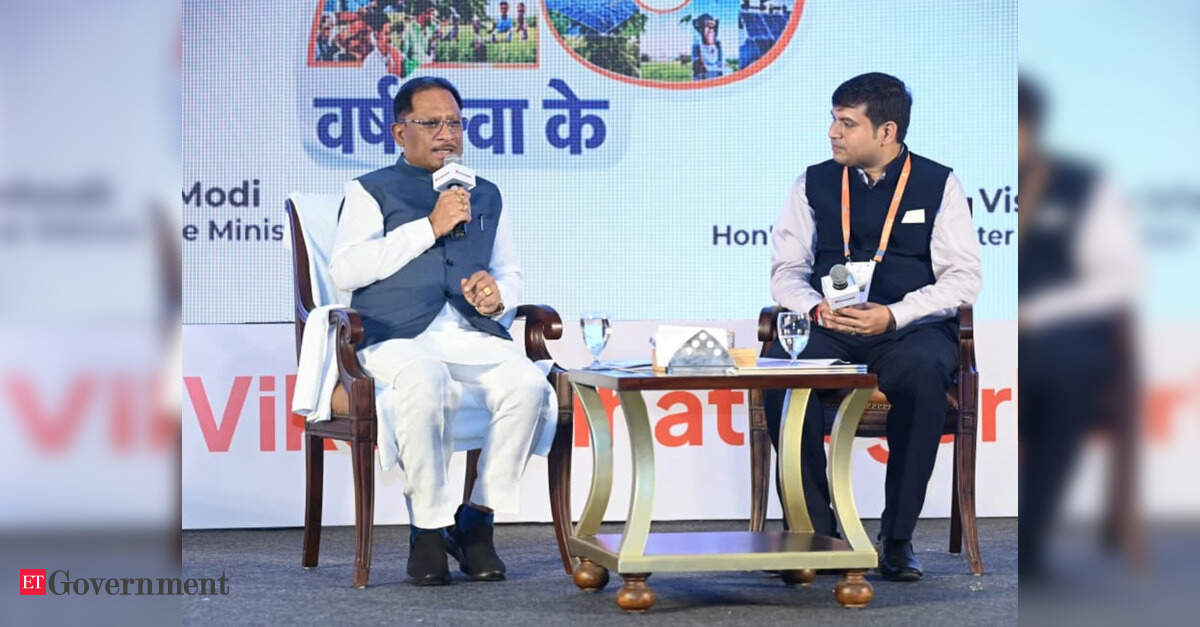
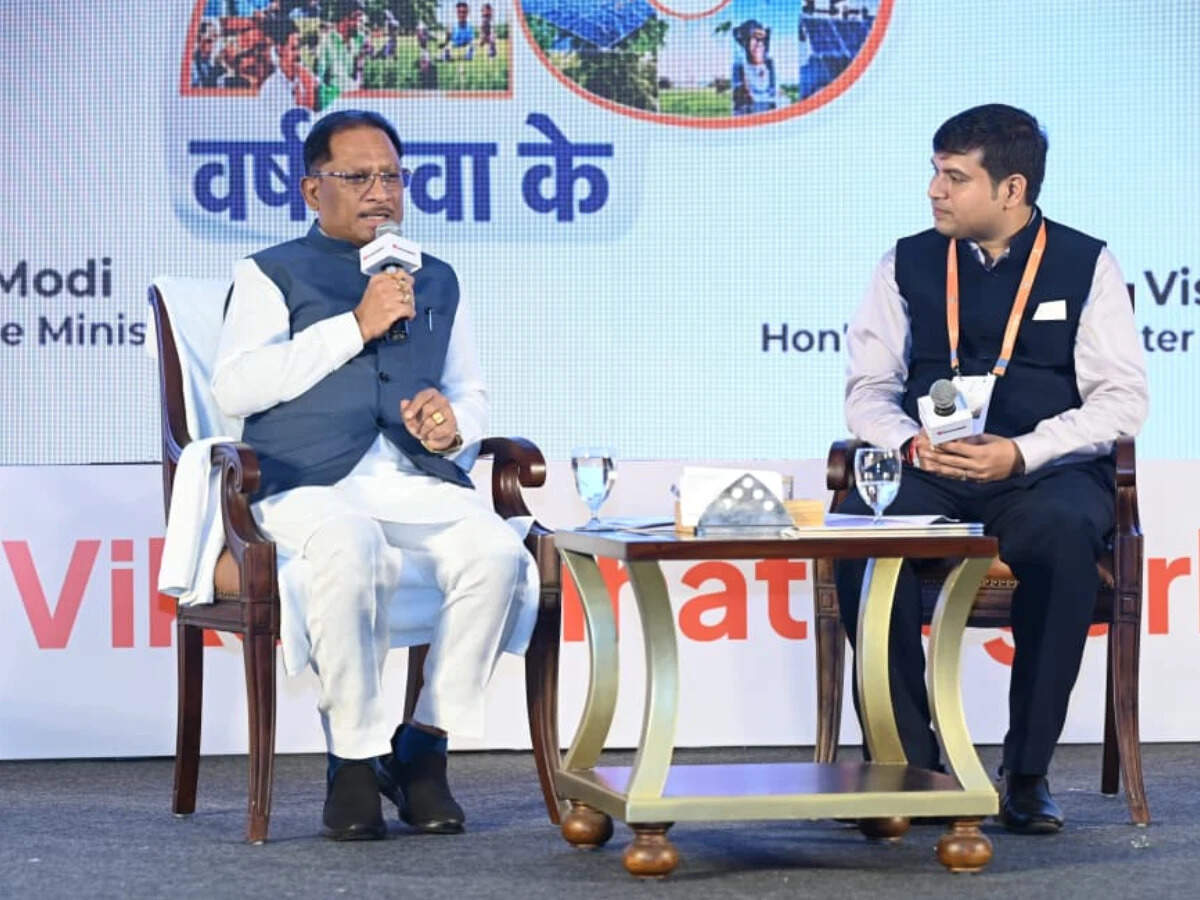
In a discussion on the roadmap for ‘Viksit Chhattisgarh 2047’, the Chief Minister Vishnu Deo Sai outlines an ambitious vision to transform the state into a prosperous, inclusive, and technologically advanced economy. Aligned with the national goal of Viksit Bharat 2047, the state’s strategy marks a deliberate shift from traditional reliance on mining, steel, and power extraction toward high-value manufacturing, green energy, food processing, and IT.
At the core of this economic philosophy is a commitment to social inclusion and grassroots empowerment, ensuring that growth extends from Surguja to Bastar. In conversation with Arpit Gupta, the Chief Minister highlights a distinct ‘Chhattisgarh Model’ that integrates modern industry with natural resources, tribal heritage, and local entrepreneurship.
Through targeted initiatives in tourism, value addition for minor forest produce, digital governance, and expanding the economic roles of women and youth, the state aims to build a sustainable, opportunity-rich environment where every citizen can thrive without needing to migrate elsewhere.
Edited excerpts:
Chief Minister, you have articulated the vision of ‘Viksit Chhattisgarh 2047’. What is the larger economic philosophy behind this vision?
Our vision for Viksit Chhattisgarh 2047 is aligned with the larger national goal of Viksit Bharat 2047. We believe Chhattisgarh can make a significant contribution to India’s development because the state possesses many of the resources required for sustained economic growth; minerals, energy, forests, agriculture, water resources, a young workforce and significant industrial potential.
But development cannot be measured only by industrial output or investment. Our vision is to create a prosperous, inclusive and opportunity-rich Chhattisgarh in which the benefits of development reach every section of society and every region from Bastar to Surguja. We are therefore working on three broad dimensions: strengthening agriculture and rural livelihoods, accelerating industrial and infrastructure development, and creating new opportunities through technology, innovation, tourism and entrepreneurship.
Our objective is to build a Chhattisgarh that is economically strong, socially inclusive and capable of providing its young people with opportunities within the state itself.
Chhattisgarh has traditionally been identified with mining, steel and cement. How do you see the state diversifying its economic base?
Mining and core industries will continue to remain important because Chhattisgarh has substantial mineral resources and an established industrial ecosystem. However, our objective is to move from merely extracting resources to creating greater value within the state.
Our new Industrial Policy 2024–30 has therefore expanded the focus beyond traditional sectors. We are encouraging investments in pharmaceuticals, textiles, food processing, electronics, IT, data centres, technology, green energy and other emerging sectors.
We want Chhattisgarh to become a centre for value addition, manufacturing and innovation. Our natural resources should support industrialisation, but the larger objective is to create employment, entrepreneurship and sustainable economic opportunities.
The state has received investment proposals of more than ₹8 lakh crore. What is the government doing to convert these proposals into actual investments and jobs?
Receiving an investment proposal is only the beginning. The real measure of success is its conversion into a project, production and employment. Since the implementation of our Industrial Policy 2024-30, we have received investment proposals worth more than ₹8 lakh crore. We are now placing considerable emphasis on implementation.
The One Click Single Window System has been strengthened so that investors can obtain necessary approvals through a more streamlined process. Through the Ease of Doing Business Act, 2026, we are also moving towards risk-based regulation, self-certification and reducing unnecessary inspections. Our approach is that government departments should work as facilitators for investors rather than operate in silos. The objective is to reduce the time between an investment decision and the commencement of actual operations.
What are the key sectors where you expect Chhattisgarh to attract the next wave of investment?
We see opportunities across both established and emerging sectors. Steel and cement will remain important, but we are simultaneously encouraging pharmaceuticals, textiles, food processing, electronics, IT, data centres, electric mobility, green energy and modern manufacturing.
We also want to leverage our agricultural and forest resources through processing and value addition. Chhattisgarh produces a wide range of agricultural and minor forest produce. If these resources are processed within the state, they can generate greater value for producers while creating local employment.
Our Industrial Policy provides different incentives related to capital investment, interest, technology adoption, land, stamp duty and other components. There are also additional incentives for women entrepreneurs, Scheduled Caste and Scheduled Tribe entrepreneurs and other identified categories.
Chhattisgarh has a strong energy and mineral base. How do you see the state contributing to India’s industrial growth and the Viksit Bharat 2047 mission?
Chhattisgarh has an important role to play in India’s growth because of its contribution to steel, coal and electricity. Today, Chhattisgarh accounts for a significant share of India’s steel and coal production and has an established power-generation ecosystem. We have set ambitious targets for expanding steel production and electricity generation.
Our objective is not simply to produce more raw materials. We want these resources to support a broader manufacturing ecosystem within the state. The growth of India’s manufacturing sector will require reliable energy, raw materials, logistics and infrastructure. Chhattisgarh is well positioned to provide these inputs while also developing downstream industries that generate greater value and employment within the state.
Logistics is increasingly becoming a key factor in investment decisions. What advantages does Chhattisgarh offer investors on this front?
Chhattisgarh’s geographical location in central India is one of its important economic advantages. The state has more than 3,500 kilometres of national highways and a rapidly expanding rail network. Our location allows industries to connect efficiently with markets across different parts of the country. We are therefore working on strengthening logistics infrastructure and have also developed a dedicated logistics policy.
For an investor, connectivity is not simply about moving finished products. It affects the entire supply chain; movement of raw materials, access to markets, warehousing, distribution and the cost of doing business. Our aim is to make Chhattisgarh an efficient logistics and manufacturing hub for central India.
You have described a distinct ‘Chhattisgarh Model’ of development. What will make this model different?
Chhattisgarh has its own strengths and therefore cannot simply copy the development model of another state. Our model is based on the strengths we already possess: forests and minor forest produce, agriculture, minerals, energy, human resources, industrial capacity and tourism.
The important element is value addition. For example, instead of limiting the economic opportunity from forest produce to collection and sale, we want greater processing, branding, packaging and market access. Similarly, our agricultural economy can benefit significantly from food processing and modern supply chains.
At the same time, technology, infrastructure and skills will be important enablers. We want a development model that combines modern industry and technology with our natural resources, cultural identity and local strengths.
Bastar is central to the state’s development narrative. How do you see its economic transformation in the coming years?
Bastar is entering an important phase of transformation. For many years, the region was primarily discussed in the context of Left Wing Extremism. We now want its identity to increasingly be associated with its natural beauty, tribal culture, biodiversity, tourism and development. With improvements in the security environment, new opportunities are emerging in education, healthcare, infrastructure, employment and tourism.
We are extending roads, rail, electricity, digital connectivity and government services to interior areas. Initiatives such as Bastar Munne and the strengthened Niyad Nellanar programme are aimed at taking development and public services closer to people in remote villages. Our approach is that Bastar’s development must respect its local culture and traditions while opening up new economic opportunities for its people.
Tourism appears to be an important part of your strategy for Bastar. What kind of tourism ecosystem do you want to develop?
Chhattisgarh has enormous tourism potential, much of which remains underexplored. From Chitrakote to Bastar and from the forests of southern Chhattisgarh to the landscapes of Surguja, we have natural, cultural and rural tourism assets. Bastar, in particular, has a distinctive tribal culture, biodiversity, waterfalls, forests, handicrafts and local traditions.
We want to develop tourism in a manner that creates direct economic opportunities for local communities. An increase in tourism can benefit hotels, homestays, transport operators, local food businesses, guides, artisans and producers of local products. It can also create opportunities for young people and women.
Our objective is for visitors to experience Bastar’s nature and culture while ensuring that local communities are active participants and beneficiaries of the tourism economy.
How will tribal communities become participants in this growth rather than merely beneficiaries of government schemes?
Our approach is to move from welfare alone towards participation, entrepreneurship and value creation. Tribal families should not remain limited to selling raw forest produce or agricultural products. Through processing, branding, packaging, market linkages, e-commerce and tourism, we want them to participate in higher-value economic activities.
Forest produce, handicrafts, local food products and cultural experiences can all become part of a larger economic ecosystem. We are also focusing on skills and entrepreneurship so that young people from tribal communities can become entrepreneurs, service providers and professionals. The objective is to make local communities partners in the development process.
Women’s economic empowerment is another important component of the government’s development strategy. What is the next step beyond financial assistance and self-help groups?
Women’s economic empowerment has to move beyond assistance towards enterprise, production and employment creation. Under the Mahtari Vandan Yojana, around 68 lakh women are receiving monthly financial assistance of ₹1,000. At the same time, about 13.85 lakh women in the state have become Lakhpati Didis.
We now want women to move beyond being members of self-help groups and increasingly become entrepreneurs, producers and providers of employment. This requires access to skills, finance, technology, markets and institutional support. When women become economically independent, the benefits extend to the entire family and local economy.
How are education and skills being integrated into your 2047 vision?
Human capital will ultimately determine the success of our development journey. We are strengthening school education while expanding access to modern and technical education. Smart classrooms, science laboratories, internet connectivity and better educational infrastructure are part of this effort.
At the higher-skill level, our focus is increasingly on areas aligned with the emerging economy- AI, data, electronics, IT, advanced manufacturing and other technology-driven sectors. We have also been strengthening skill-development institutions and initiatives related to entrepreneurship and start-ups.
Our young people should not have to leave Chhattisgarh to find every opportunity. We want to create an ecosystem in which they can acquire the skills required by the future economy and find employment or build enterprises within the state.
Digital governance is another major theme of your administration. What role will technology play in Viksit Chhattisgarh 2047?
Technology is an important instrument for improving both governance and accountability.
We have implemented the e-Office system and are increasing the use of IT tools across departments. The GeM platform is being used to improve transparency in government procurement, while the Atal Monitoring Portal is helping us track the implementation of schemes.
For us, digital governance is not about technology for its own sake. It must improve delivery. Our principle is simple: a government scheme should not remain only on paper. Its benefits should reach the intended beneficiary, and the government should be able to monitor whether that is happening.
What is your roadmap for Chhattisgarh’s economy between now and 2047?
The roadmap has to be phased and measurable. In the near term, our focus is on strengthening infrastructure, converting investment proposals into projects, improving ease of doing business, creating employment and expanding public services. In the medium term, we want to build a more diversified economy with stronger manufacturing, food processing, technology, tourism, renewable energy and service sectors.
By 2047, I want Chhattisgarh to be recognised as a prosperous, inclusive and modern state, one that combines strong agriculture, competitive industry and new technology while preserving its natural resources, cultural heritage and social fabric. Most importantly, development must reach the last person. Whether a citizen lives in Bastar, Surguja or an urban centre, he or she should have access to opportunity, infrastructure, education, healthcare and a dignified livelihood.
What is your personal commitment to Chhattisgarh’s journey towards 2047?
My commitment is very straightforward: every person in Chhattisgarh should feel connected with the state’s development journey. A developed Chhattisgarh should mean better opportunities for our youth, greater economic security for farmers, stronger economic participation for women, new opportunities for tribal communities and a better quality of life for every family.
We want development to reach every region and every section of society. I want the Chhattisgarh of 2047 to be known for its prosperity as well as its identity, its natural resources, culture, traditions and people. It should be a state where every young person can dream, work and build a future here. That is the essence of our vision of Viksit Chhattisgarh 2047.