
New Delhi, September 24: As warfare moves rapidly from conventional battlefields into the domains of artificial intelligence, autonomous systems, cyber operations, space, information warfare and algorithm-driven decision-making, India faces a strategic challenge that extends beyond acquiring new weapons.
The larger task is to build the technological, industrial and institutional capacity to design, manufacture and sustain the military capabilities required by a rising power.
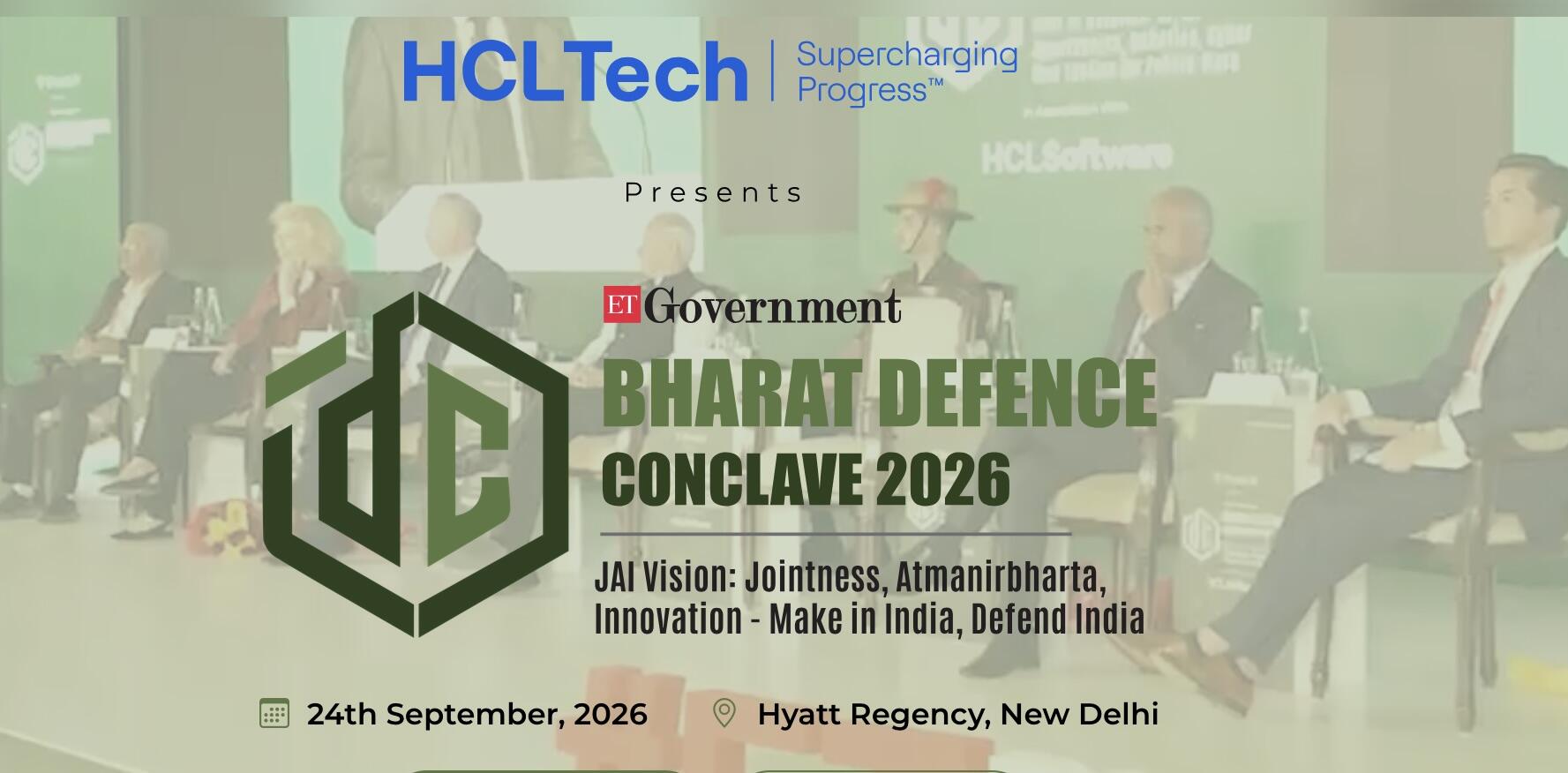
Against this backdrop, the 4th Edition of the ETGovernment Bharat Defence Conclave 2026 is being held today, from 9.30 AM, at the Hyatt Regency, New Delhi, bringing together senior government officials, military leaders, strategic thinkers, technology experts and defence-industry executives. More than 400 participants are expected to attend the day-long conclave.
The central theme running through the discussions will be the transformation of India’s defence architecture through jointness, Atmanirbharta and innovation, with particular emphasis on indigenous technology, advanced manufacturing and preparedness for emerging forms of warfare.
The conclave will open with an inaugural session titled “India’s Defence Vision 2047: Technology, Sovereignty and Strategic Power”, setting the strategic context for the discussions that follow.
The inaugural session will feature Lt Gen Syed Ata Hasnain, Governor of Bihar; General NS Raja Subramani, Chief of Defence Staff and Secretary, Department of Military Affairs; Rajesh Kumar Singh, Defence Secretary and Chairman, Defence Research and Development Organisation (DRDO); and Dr Rajendra Kumar, Secretary (Border Management), Ministry of Home Affairs.
Their participation brings together four important dimensions of national security—the political and strategic perspective, military transformation and jointness, defence policy and indigenous research, and the security of India’s borders.
From defence imports to technological sovereignty
At the heart of the conclave is a question that is becoming increasingly important for India’s strategic establishment: what does defence self-reliance mean in an era when military power is increasingly determined by control over critical technologies?
Atmanirbharta can no longer be measured simply by the proportion of defence equipment manufactured within the country. Genuine strategic autonomy requires domestic capability across the technology stack—from sensors, semiconductors and secure communications to electronic warfare, artificial intelligence, unmanned systems, cyber technologies and advanced platforms.
This distinction between manufacturing in India and possessing indigenous technological capability is expected to run through several sessions.
The first major panel, “Defence Manufacturing 2.0: The Military-Industrial Complex of a Rising India,” will examine the next phase of India’s defence-industrial transformation.
The debate is particularly significant as India seeks to build an ecosystem in which the armed forces, DRDO, public-sector enterprises, private manufacturers, startups and technology companies can move from a primarily buyer-seller relationship towards sustained co-development of military capability.
The objective is not merely to manufacture more equipment domestically, but to create an industrial base capable of absorbing technology, investing in research and development, shortening development cycles and eventually competing in global defence markets.
The battlefield is becoming digital
Another major focus will be the expanding battlespace itself.
The panel “Cyber Conflict, Cognitive Warfare and the Weaponisation of Information” will examine a security environment in which military operations increasingly extend into networks, data systems and the information space.
Cyberattacks can disrupt communications and critical infrastructure without conventional military engagement. At the same time, disinformation, influence operations, deepfakes and manipulation of digital platforms are creating a cognitive dimension to conflict in which perceptions and public confidence can themselves become strategic targets.
For India, the challenge is therefore twofold: strengthening the resilience of military and national digital infrastructure while developing doctrines, institutions and human capabilities suited to conflicts that may unfold simultaneously across physical and virtual domains.
That debate will lead into “Artificial Intelligence, Autonomous Systems and the Algorithmic Battlefield,” a panel devoted to technologies that could fundamentally alter how future wars are fought.
AI-enabled intelligence analysis, autonomous and semi-autonomous platforms, drone swarms, machine-assisted targeting, predictive logistics and real-time battlefield analytics are compressing military decision cycles. Armed forces capable of collecting, processing and acting on information faster than an adversary could acquire a decisive operational advantage. But AI also raises difficult questions.
India must consider how quickly such technologies can move from laboratory demonstrations to deployable systems, how military data should be secured and exploited, how algorithms should be tested under battlefield conditions, and where human oversight must remain indispensable.
The agenda also includes a dedicated lecture on the role of AI in defence, underscoring the growing importance of algorithmic capabilities in military modernisation.
Procurement must translate into capability
Technology and manufacturing, however, cannot be separated from acquisition.
The concluding panel, “Defence Acquisition for Atmanirbhar Bharat: From Procurement to Indigenous Capability,” will focus on one of the most consequential questions confronting India’s defence ecosystem: how procurement policy can be used not merely to purchase platforms but to create enduring domestic technological capability.
India’s armed forces require access to cutting-edge systems on operationally relevant timelines. At the same time, major procurement programmes can serve as instruments for developing domestic intellectual property, engineering expertise, supply chains and manufacturing capacity.
Balancing these objectives requires closer coordination between the Services, acquisition authorities, technology developers and industry. It also demands greater clarity about requirements, realistic development timelines and mechanisms that allow promising indigenous technologies to transition more rapidly from prototype to procurement.
The conclave will additionally feature addresses and industry presentations during the day, as well as a leadership fireside chat with Air Marshal Tejpal Singh, Deputy Chief of Air Staff, moderated by Air Vice Marshal Anil Golani, former Director General of the Centre for Aerospace Power and Strategic Studies.
Ultimately, the Bharat Defence Conclave 2026 is designed around a proposition that is becoming central to India’s national-security debate: the military power of the coming decades will depend as much on technological depth and industrial capacity as on the number of platforms in service.
For India, the road to 2047 therefore runs through more than defence modernisation. It requires an ecosystem capable of converting scientific research into military technology, technology into scalable manufacturing, procurement into indigenous capability, and indigenous capability into strategic power.
As more than 400 participants from government, the armed forces, strategic institutions and industry gather in New Delhi today, the discussions will focus on how India can accelerate that transition—and ensure that the technologies defining the future battlefield are increasingly developed, secured and manufactured at home.