India’s pursuit of self-reliance in defence is entering a more demanding phase. The challenge is no longer simply to manufacture weapons and platforms domestically, but to own critical technologies, integrate capabilities across the armed forces, rapidly convert innovation into deployable systems and build an industrial base capable of sustaining a prolonged conflict.
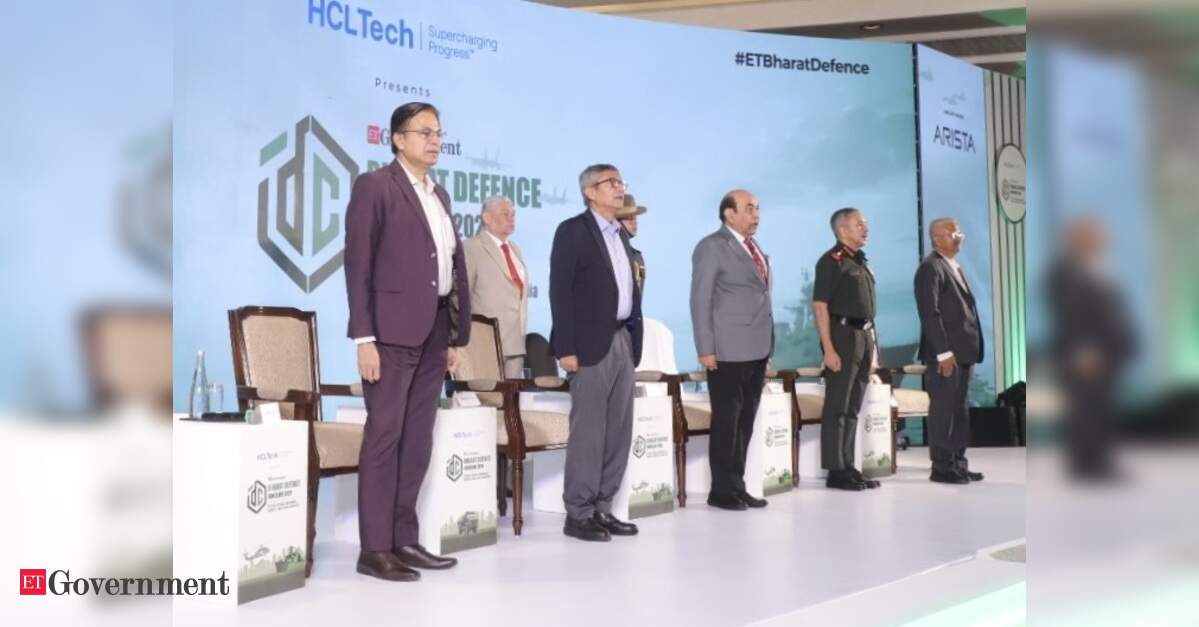
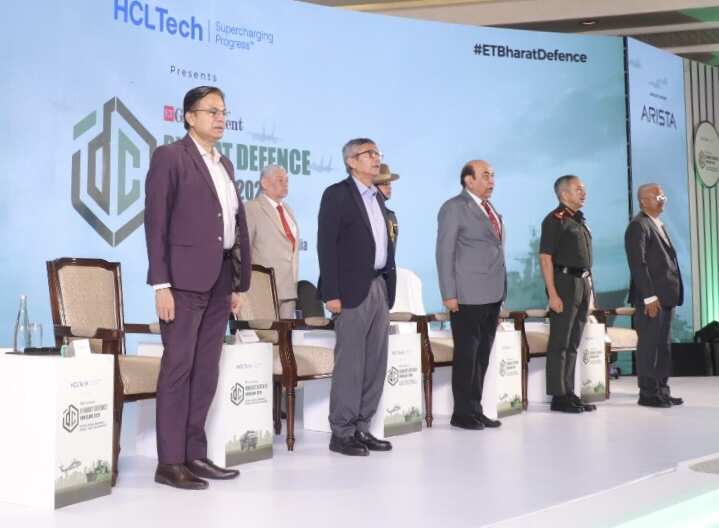
That strategic shift emerged as the central message of the inaugural session of the Bharat Defence Conclave 2026, organised by ETGovernment–The Economic Times at Hyatt Regency, New Delhi, on September 24.
The conclave brought together more than 400 participants, including serving military officers, senior government officials, diplomats, defence attachés, technology leaders, defence manufacturers, startups and other stakeholders in India’s expanding military-industrial ecosystem.
The inaugural session began with a welcome address by Anoop Verma, who outlined the progress India has made in defence innovation, indigenous manufacturing and the emergence of a broader ecosystem connecting the armed forces, government, research institutions, startups and private industry.
He was followed by Dr Rajendra Kumar, Secretary (Border Management), Ministry of Home Affairs; Rajesh Kumar Singh, Defence Secretary, Ministry of Defence, and Chairman, Defence Research and Development Organisation (DRDO); and General NS Raja Subramani, Chief of Defence Staff (CDS) and Secretary, Department of Military Affairs.
The inaugural session concluded with an address by Lt Gen Syed Ata Hasnain, Governor of Bihar, who brought the discussion back to the fundamental test of military technology: whether it works reliably when a soldier, sailor or air warrior needs it in combat.
Self-reliance must ultimately work on the battlefield
Governor Hasnain argued that technological sophistication and indigenous production have little military meaning unless they translate into dependable operational capability.
“If I pull the trigger, the weapon must fire,” he said, stressing the importance of reliability, maintainability, availability of spares, ammunition reserves and the ability to sustain systems under difficult operational conditions.
The ultimate customer of the defence industrial ecosystem, he noted, is not looking merely for an impressive prototype. A field commander wants to know whether the equipment “will work on the 50th day of the war with the same reliability as on the first day.”
That distinction goes to the heart of the next stage of Atmanirbharta in defence. India has substantially expanded domestic production, widened private-sector participation and created new channels connecting the military with startups, MSMEs, academia and technology developers. But manufacturing a system domestically is only the beginning.
“Self-reliance, in military meaning, has meaning only when it induces reliable operational capability,” Hasnain said.
He posed a series of questions that increasingly define genuine technological sovereignty: Can India design the system? Does it own the critical technologies? Can it repair and modify the platform independently? Can it manufacture the system at scale? And, crucially, can production continue if an overseas supplier becomes unavailable?
The answer does not require India to manufacture every component domestically. Rather, he argued, the objective should be to ensure that no critical external dependency can constrain India’s military options when they are needed most.
Recent wars have reinforced another lesson: industrial capacity cannot be calibrated solely for peacetime demand. Equipment, ammunition and platforms are consumed or damaged at extraordinary rates during prolonged conflict.
“We must be able to replenish what is expended, replace what is lost, and repair what is damaged,” Hasnain said.
CDS: Move from operational integration to capability integration
The CDS took this argument further by placing technological sovereignty within the larger transformation of the armed forces.
General NS Raja Subramani said India has made considerable progress towards jointness through joint operations, planning, processes and logistics. The next step, however, requires a more fundamental transition.
“We need to move from operational integration to capability integration,” he said. “The wars of today and the future will not be fought by individual platforms or individual services. They will be fought by systems of data, networks and effects.”
That requires moving away from asking separately what the Army, Navy or Air Force needs and instead defining the military effect that India wants to create and then identifying the integrated capability required to achieve it.
Technological jointness is therefore as important as organisational jointness. Communications systems must interoperate, data must move across services and networks, and platforms must increasingly function as elements of a common operational architecture.
The CDS also described Atmanirbharta as more than an economic or industrial objective. “In my view, it is a strategic imperative. It is a war-fighting imperative,” he said. India will continue to work with international partners, but it must identify technologies that it “cannot afford to be denied.”
“We have to move from assembly to design, from production to intellectual property, from platforms to critical components, from products to ecosystems, and from acquisition to ownership of capability,” he said.
Owning a complete weapon system, he cautioned, is insufficient if crucial components, electronics, software or maintenance capabilities remain externally dependent.
His formulation for the next stage of Indian defence industrialisation was succinct: “Design in India, Make in India, Make for the world.”
Innovation is meaningless unless it reaches the soldier
The CDS also highlighted one of the persistent challenges confronting defence innovation: bridging the gap between technological demonstration and operational deployment.
India, he said, does not suffer from a shortage of talent or ideas. It has scientific expertise, engineering capability, startups, academia and an increasingly vibrant private defence sector.
The critical question has changed from whether India can innovate to whether it can innovate, deploy and scale quickly enough.
“A prototype can emerge in months, but it can also equally become obsolete as quickly,” he said. The innovation cycle must therefore become continuous: idea, prototype, testing, improvement, production, operational deployment and further improvement.
“The test of innovation is not whether you can demonstrate it. Can you deploy fast? Can you scale it? And can you change rapidly? That is the test,” he said.
This becomes particularly important as drones, autonomous platforms, counter-UAS technologies, sensors, artificial intelligence and electronic warfare systems evolve far faster than traditional defence procurement cycles.
The CDS captured the dilemma in another formulation: “Technology without scale remains a demonstration. And scale without technology remains a vulnerability.”
Defence Secretary: Networked warfare changes the equation
Defence Secretary and DRDO Chairman Rajesh Kumar Singh’s address situated the industrial transformation within a rapidly changing battlespace.
Modern warfare, he argued, is shifting from isolated platform excellence towards “connected intelligence”—from platform-centric to network-centric operations and from information superiority towards decision superiority.
The emerging battlespace will increasingly depend on interconnected sensors, tactical and data networks, cloud and edge computing, AI-enabled decision support and systems capable of translating information into action at machine speed.
He identified robotics, cyber warfare, space, information warfare, artificial intelligence and the electromagnetic spectrum among the critical domains that will shape future conflict.
“Whoever controls the spectrum, whoever has dominance over the spectrum, will probably be the winner,” he said, while describing space as an increasingly contested domain and information itself as a weapon capable of influencing perception and decision-making.
The proliferation of autonomous systems also raises a crucial doctrinal question: how much decision-making should be delegated to machines?
Singh stressed that human decision-makers must remain central to lethal targeting and that military doctrine must evolve alongside technological change.
His larger point was that individual technological excellence will increasingly matter less than the ability to connect sensors, information, algorithms, commanders and weapons into a resilient operational network.
The changing concept of border security
Dr Rajendra Kumar, Secretary (Border Management), Ministry of Home Affairs, brought another dimension to the discussion by focusing on the transformation of border management and the growing role of technology in securing India’s frontiers.
His address underlined that the concept of border security itself is changing. The task can no longer be viewed primarily through the prism of physical infrastructure, deployment of personnel or conventional surveillance. Emerging technologies are making it possible to create a more integrated security architecture in which sensors, communications networks, data platforms, surveillance systems and decision-support tools work together.
For India, this has particular significance because of the sheer diversity of its borders. Security requirements vary sharply across mountainous terrain, deserts, riverine stretches and other difficult geographical environments. Technology therefore has to be adapted to operational conditions rather than deployed as a standardised solution.
From manufacturing numbers to strategic autonomy
The inaugural session ultimately pointed towards a significant evolution in India’s defence debate. For much of the past decade, progress in Atmanirbharta has understandably been measured through rising domestic defence production, procurement from Indian companies, exports, startup participation and declining dependence on imported systems.
Those indicators remain important. But the speakers at the Bharat Defence Conclave suggested that the next benchmarks will have to be harder.
Can India own the intellectual property behind strategically important systems? Can its armed forces modify equipment without external permission? Can domestic industry replenish ammunition and platforms during a prolonged conflict? Can innovations move from laboratories and startups into operational formations before the technology becomes obsolete? Can the Army, Navy and Air Force operate through interoperable networks rather than technological silos?
And can the entire ecosystem surge production when national security demands it? The distinction is fundamental. Make in India creates manufacturing capacity; technological sovereignty creates freedom of action.
For a country seeking greater strategic autonomy in an era of contested supply chains, rapidly changing warfare and geopolitical uncertainty, that freedom of action may ultimately be the most important measure of Atmanirbharta.