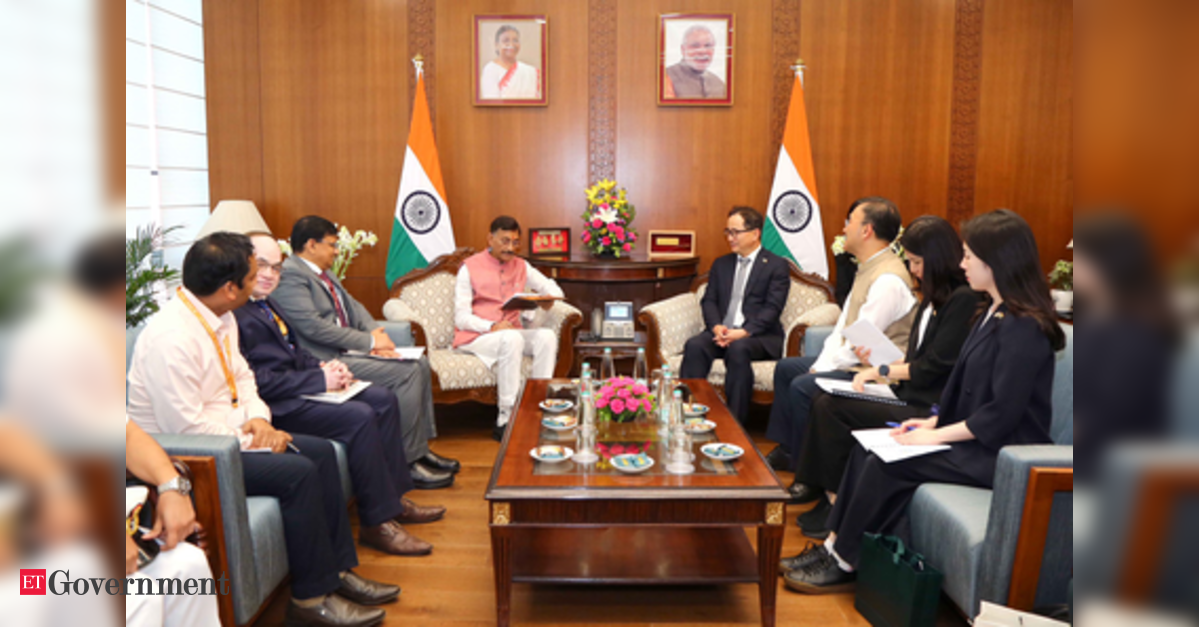
India and South Korea are beginning to move their defence relationship beyond the traditional buyer-seller equation towards a potentially deeper partnership in manufacturing, technology and logistics. The significance of this shift was visible in New Delhi on September 29, when officials and companies from both countries met for the 10th Joint Committee Meeting on Defence Industries and Logistics Cooperation.Co-chaired by Dinesh Mahur, Additional Secretary (Defence Production), and Kim Il Dong, Vice Minister of South Korea’s Defence Acquisition Program Administration (DAPA), the meeting reviewed existing cooperation and explored avenues for expanding defence-industrial and logistics ties. Significantly, the discussions brought together L&T and BEML from India with Hanwha Aerospace, Hanwha Systems, Korean Air, Korea Aerospace Industries and DS Navcours from South Korea.
No new contract, MoU or programme approval was announced. That distinction is important. The immediate outcome was institutional dialogue rather than procurement. Yet the composition of the meeting indicates where the relationship could move: land systems, aerospace, defence electronics, maintenance and logistics, and potentially joint development and production.
There is already a successful template. The K9 Vajra-T self-propelled howitzer programme brought together L&T and South Korea’s Hanwha, combining Korean technology with Indian manufacturing. The original programme involved substantial manufacturing in India, and during the South Korean President’s state visit in April this year, the two countries noted that production of the second batch was progressing and expressed interest in replicating the model in other advanced platforms and technologies. They also decided to launch the Korea-India Defence Accelerator, or KIND-X, connecting companies, start-ups, universities, investors and incubators.The September 29 meeting therefore fits into a broader trajectory. During Defence Minister Rajnath Singh’s visit to Seoul in May, India and South Korea discussed industry, production, emerging technologies, maritime security and logistics, with India encouraging Korean companies to jointly develop and manufacture advanced technologies in India.
For India, such partnerships have acquired greater importance as defence policy shifts from import substitution towards building an internationally competitive industrial ecosystem. India’s defence exports reached a record ₹38,424 crore in 2025-26, while the government has set a target of ₹50,000 crore by 2029. Around 75% of the 2026-27 capital acquisition budget has been earmarked for procurement from domestic industry.
South Korea is particularly relevant to this ambition. It possesses mature capabilities in artillery, armoured systems, shipbuilding, aerospace, electronics and advanced manufacturing. India, meanwhile, offers a large domestic requirement, an expanding private defence sector, engineering talent and the potential to manufacture at scale. A deeper partnership could therefore be structured around co-development, localisation, maintenance, repair and overhaul, and production for third-country markets rather than simply importing Korean platforms.
This has implications beyond the bilateral relationship. Asia’s strategic environment increasingly requires countries to build diversified and resilient industrial and logistics networks. India’s cooperation with South Korea, Japan and the countries of Southeast Asia can become part of a wider architecture in which technological capabilities, manufacturing capacity and supply chains are distributed across trusted regional partners.
Here, ASEAN has a particularly important role. Both India and South Korea participate in the ASEAN Defence Ministers’ Meeting-Plus, which brings the ASEAN members together with eight dialogue partners, including India, South Korea, Japan, Australia and the United States. The framework covers practical cooperation in maritime security, counter-terrorism, humanitarian assistance and disaster relief, peacekeeping, military medicine, mine action and cybersecurity.
ASEAN is therefore not merely geographically situated between India and the industrial economies of Northeast Asia. It provides an institutional bridge connecting South Asia, Southeast Asia and East Asia. Defence manufacturing, maritime logistics, MRO facilities, shipbuilding, electronics and resilient supply chains can increasingly become areas where bilateral partnerships reinforce broader regional cooperation.
This also reflects the evolution of India’s eastern engagement. The Look East Policy originated in the early 1990s, but Prime Minister Narendra Modi formally transformed it into the Act East Policy in 2014, placing ASEAN at its core. The change was intended to move India from primarily economic engagement towards more intensive strategic, connectivity and security cooperation with Southeast and East Asia.
More than a decade later, defence industrial cooperation is emerging as one of the practical expressions of that policy.
The India-South Korea meeting should consequently be viewed as one element of a much larger Asian strategic and economic network. The next test will be whether discussions generate identifiable programmes: joint R&D, technology transfer, production lines, MRO hubs, component supply chains and exports to third markets.
If that transition occurs, India-South Korea defence cooperation could demonstrate how the Act East Policy can evolve further—from diplomatic engagement and connectivity towards an integrated Asian ecosystem of technology, manufacturing and strategic resilience.