

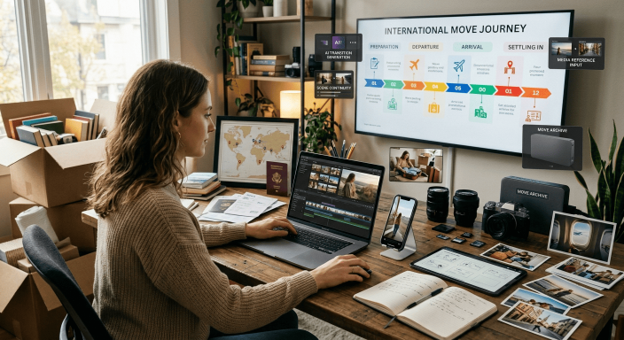
Almost everybody who moves abroad films it, and almost nobody produces anything from the footage.The phone comes out at the airport, at the first viewing, on the first morning on the new balcony. Somewhere around week six it stops, because the novelty has worn off and the admin has started. What remains is four hundred clips of a period that mattered enormously, in no order, watched by nobody.
That is a shame for the obvious sentimental reason, and it is also a missed opportunity, because there is a substantial audience for exactly that material. It consists of people roughly a year behind you, weighing the same decision, who cannot find an honest account of what the process was actually like.
An AI Video Generator with streamlined production workflows through Higgsfield turns that folder into something watchable, largely by supplying the parts you could not film even if you had thought to.
Who actually wants to watch this?
Three groups, and the second is considerably larger than most people expect.
Family and friends left behind, who are the reason most of the footage was taken and who genuinely do want to see it, provided somebody assembles it into something under five minutes.
People consider the same move, which is the large group. Anybody researching relocation to your country is reading forum threads and official guidance, neither of which conveys what the experience is like. A first-hand account from somebody who has just done it is the thing they cannot find, and the demand for it does not diminish, because there is always another cohort a year behind.
And you, later. The period of a move compresses in memory into a handful of scenes, and the detail disappears faster than anybody expects. People who assemble something during the move are consistently glad of it years afterward.
The second group is what turns this from a personal project into something with a reason to be public.
Why does relocation footage never become anything?
Because it was filmed as a reflex rather than with any structure in mind.
Nobody films a move with a story in view, which is the gap an AI Video Generator fills afterwards. They film moments that felt significant at the time, which produces a collection of highs with nothing connecting them. The first morning, the keys, the view, the dog arriving.
Everything between those moments went unfilmed, and the between is where the actual story lives.
Then the period ends, life becomes ordinary, and assembling it moves permanently down the list. Most people also assume editing is beyond them, which was a reasonable assumption and is less so now.
What is missing from what you filmed?
Four things, consistently, across almost everybody’s footage.
There is no beginning. Nobody films the decision, the conversations, the leaving. By the time the phone comes out the move is already underway, so the story starts in the middle.
There is no place. Close footage of a flat, a street corner and a cafe table gives a viewer no sense of where any of this is. The country exists in your head and nowhere in the material.
There is nothing showing time passing. A move happens across seasons, and the shift from arriving in January to belonging by September is the story, and nobody films the calendar turning.
And there is no ending, because the move does not end on a particular day. It simply becomes normal, which is undramatic to live through and impossible to film.
An AI Video Generator addresses all four, which is why it suits this particular job better than it suits most.
Which parts could you not film at all?
The administrative half, which is exactly the half your second audience most wants to see.
Immigration offices, town halls, notaries and banks are frequently places where filming is prohibited outright, and where attempting it would be unwise even where it is not. Nobody wants a residency appointment complicated by a phone.
Other people’s property is similar. Viewings, rentals, an agent’s office. Filming somebody else’s home or business without permission is both awkward and often not allowed.
Officials should not be filmed, and neither should other applicants sitting in the same waiting room, who are dealing with their own circumstances and did not agree to appear in anything.
The result is that the visa process, the property search and the bureaucracy produce no footage at all, while consuming most of the months and generating all of the anxiety. Anybody researching a move wants that portion described more than they want the balcony.
That gap is where an AI Video Generator does honest work, provided it is used to represent a process rather than to fabricate an experience.
What can an AI Video Generator supply?
The connective and contextual material, which is most of what is missing.
An opening that establishes the country and the region, so a viewer knows where they are before anybody starts talking.
Place and landscape context between sections, which does the work your close-up footage cannot.
Seasonal material showing the year turning, which conveys the passage of time that a sequence of undated clips does not.
Representations of the administrative stages, clearly framed as illustration rather than documentation, so the visa process and the property search have something on screen while you describe them.
Transitions between clips filmed months apart on different phones, absorbing the jumps in light and setting that otherwise make a sequence feel assembled.
And a closing sequence, since a move has no natural final scene and one has to be constructed.
An AI Video Generator produces these from a description and reference images, which means supplying photographs of the actual region keeps the material recognisable rather than generic.
What should never be generated?
Two things, and the first matters more here than in almost any other application.
Never generate the country. Your second audience is using this to make a genuine decision about where to live, and material that flatters a place, invents a view or produces a version of a town that does not exist is misleading people about something consequential. Context and atmosphere is legitimate. A fabricated version of a real street is not.
The practical rule is that anything a viewer might treat as evidence about the place should be footage you actually took. Anything clearly functioning as mood or illustration can be produced.
And never generate experiences that did not happen. If the process was slow, say so. If a stage went badly, include it. The entire value of a first-hand account is that it is first-hand, and an audience that senses otherwise dismisses the whole thing.
This also happens to be the better content decision. The honest accounts are the ones people share, precisely because everything else they can find is promotional.
How does Higgsfield handle months of clips?
Higgsfield is an AI creative suite, which here means the generated passages, the assembly and the export sit in one browser tab rather than requiring software on a laptop that has already been packed twice.
Project continuity matters more than usual when an AI Video Generator is producing material across months, because a move takes months and nobody assembles anything in one sitting. Being able to add material as it accumulates, and return to it in a different country on a different connection, is what determines whether it gets finished.
References staying attached is the other practical piece. The photographs of your actual region are what stop generated sections looking like anywhere, and having them available across every passage rather than resupplied each time is the difference between a coherent film and a patchwork.
A saved AI Video Generator treatment keeps material produced in February matching material produced in August, which is precisely the span this covers.
Format variants come from the same assembly, since the version for family, the version for a public channel and the short cut for social are three shapes of one piece of work.
And it runs in a browser, which for somebody mid-move, between homes and on an unreliable internet, is not a trivial consideration.
What shape does a relocation story take?
A fairly reliable one, and knowing it before assembling saves a great deal of time.
The decision comes first. Why this country, why now, what you were leaving. This is almost always narrated rather than filmed, and that is fine.
Then the preparation, which is paperwork, and which your researching audience wants in more detail than your family does.
The arrival, which is the part everybody filmed and where most people wrongly start.
The difficult middle, where the language is hard, the admin is unfinished and the novelty has gone. This is the most valuable section and the least documented, because nobody films themselves having a bad month.
Then the turn, where things start working. A friendship, a routine, a day that felt ordinary in a good way.
And an ending you construct, since the move never formally concludes.
Where does it find an audience?
Wherever people research relocations, there are more places than the obvious one.
A public video channel is the main route, and relocation content has an unusually long life there because the audience renews continuously rather than moving on.
Expat community groups for your specific country, where somebody asking what the visa process is actually like receives written answers and would rather see one.
Relocation forums and communities, where a linked account of the process is welcomed rather than treated as promotion, provided it is honest.
A personal blog or newsletter if you keep one, where the video earns far more attention than another written post.
And privately, as a shorter cut, for the people at home who mainly want to see that you are all right.
What does this cost against the alternative?
Very little, and the alternative is worth naming plainly, because it is what happens to almost everybody.
Higgsfield operates a free tier, enough to produce an opening and a few transitions and see whether they sit properly alongside your own clips before committing anything. For a single relocation film that allowance covers a good deal, since the generated material is a handful of short passages rather than the body of the piece.
Paid plans cover higher volume for anyone who continues the series, which a surprising number of people do once the first one exists. Everything runs in a browser with nothing to install, and the commercial terms per plan are published, which is worth checking if the video ends up on a channel that earns anything.
The comparison is not against hiring an editor, because nobody relocates commissions one. It is against the folder, which is the actual alternative and costs nothing while producing nothing.
And there is a return most people do not anticipate. Relocation content about a specific country to a specific audience tends to find the people it is for, because that audience is actively searching and there is very little honest material competing for them. Several expats have found the video became the thing that brought them consulting enquiries, community connections or an audience that made the second year considerably less isolating than the first.
None of that is guaranteed and it is not the reason to do it. The reason is the folder. The rest is what sometimes follows.
How would the first one be made?
Across a few evenings, and the sorting matters more than the production.
Gather everything into one place first, from every phone and every cloud account. This is duller and longer than it sounds and everything depends on it.
Watch it once and mark what is usable, expecting most of it not to be. What survives is what the AI Video Generator will be built around.
Write the spine as six lines, following the shape above. Decision, preparation, arrival, difficult middle, turn, ending.
Record narration on your phone. Your voice over your own footage does more than any amount of on-screen text.
Produce the openings, the place context and the transitions with an AI Video Generator, anchored to photographs of the actual region.
Assemble to under ten minutes for the public version and under four for the family one.
Then keep the AI Video Generator treatment, because if you post a second one about settling in a year later, it should look like the same series.
FAQ’s
Can an AI Video Generator produce footage of the destination country?
Use an AI Video Generator for context and atmosphere, not as evidence about the place. Anything a viewer might rely on when making their own decision should be footage you actually took.
What about the visa and paperwork stages?
Those are usually impossible to film and often prohibited. Represent them with an AI Video Generator as illustration while you narrate what happened, and make clear that is what it is.
How long should an AI Video Generator relocation film be?
Under ten minutes for a public version, under four for family. The honest sections matter more than the length.
Should the difficult parts be included?
Yes, and they are the reason anybody watches. An account that shows only the balcony is indistinguishable from marketing.
Is it necessary to appear on camera?
Not necessarily, though your narration over your own footage is what makes it first-hand rather than generic.
Is there a way to try this without spending anything?
Yes. Higgsfield operates a free tier, which covers producing an opening and a couple of transitions to see whether they sit properly against your own clips.
Conclusion
Four hundred clips of the most significant six months of your life will stay unwatched unless somebody gives them a beginning, a middle and an end.
The beginning was never filmed, the administrative middle could not be filmed, and the ending never happened on a particular day. An AI Video Generator supplies those three, with Higgsfield holding the references and the treatment across the months it takes to assemble.
Keep the country real, keep the difficult parts in, and remember who is actually watching. Somewhere there is a family a year behind you, trying to work out whether they could do this, and nobody has told them the truth about it yet.
