

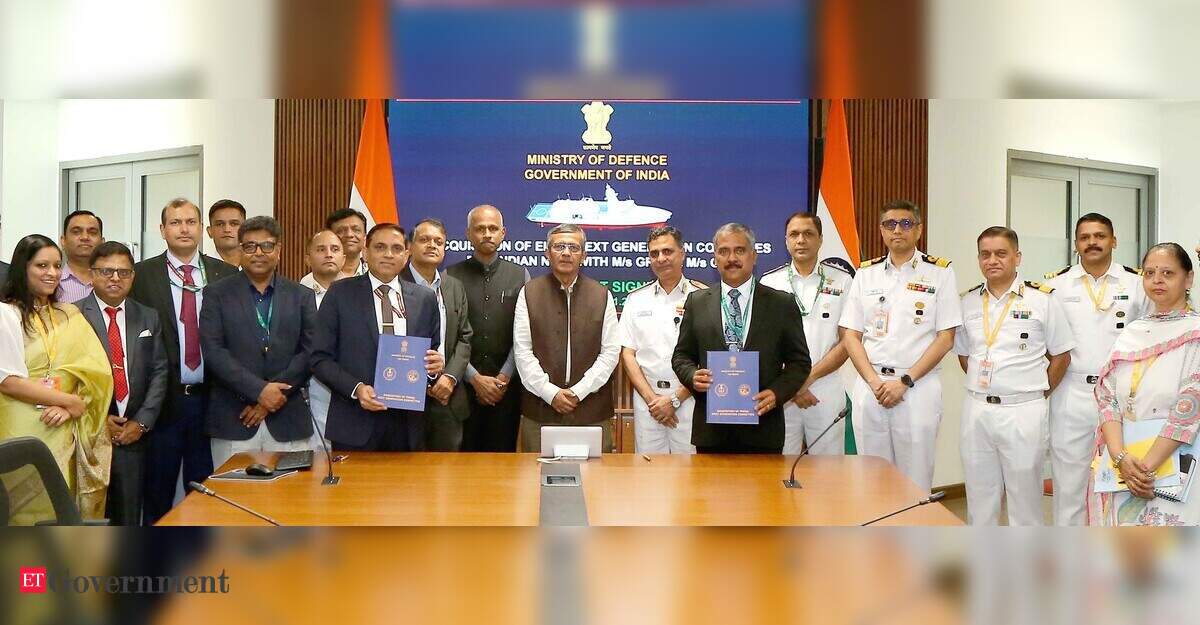
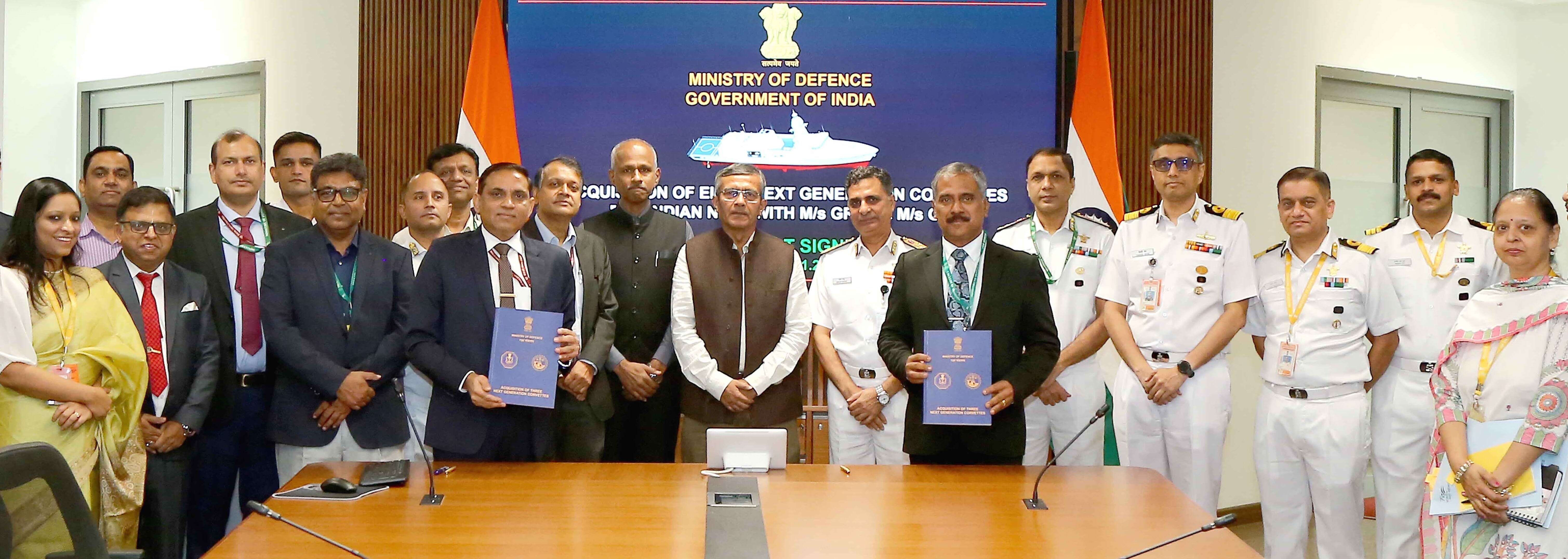
India’s decision to invest ₹53,866.50 crore in eight Next Generation Corvettes (NGCs) represents a significant expansion of its naval modernisation programme and a major commitment to indigenous warship construction.The contracts, signed by the Ministry of Defence on November 2, 2026, with Garden Reach Shipbuilders & Engineers Limited (GRSE) and Goa Shipyard Limited (GSL), are intended to strengthen the Indian Navy’s capabilities in anti-submarine warfare, surface combat, coastal defence and maritime surveillance.Under the agreements, Kolkata-based GRSE will construct five corvettes, while Goa-based GSL will build three. The contracts were signed in New Delhi in the presence of Defence Secretary Rajesh Kumar Singh. Beyond their financial magnitude, the agreements are important for the evolution of India’s defence industrial ecosystem.According to the Ministry of Defence, this is the first project in which warships designed indigenously by the Indian Navy will be constructed by Defence Public Sector Undertakings selected through a competitive process.Strengthening India’s maritime combat capabilitiesThe acquisition comes at a time when maritime security is becoming increasingly important to India’s economic and strategic interests. The Indian Ocean carries critical international shipping routes, including energy supplies and commercial cargo essential to India’s economy. Protecting these routes requires a combination of surveillance, deterrence, sustained naval presence and the ability to respond rapidly to emerging threats.Corvettes occupy an important position in naval force structures. Smaller than frigates and destroyers, they are generally designed for operations in coastal waters, littoral environments and selected offshore missions. Their comparatively compact size can make them suitable for missions where deploying larger warships would be operationally unnecessary or economically inefficient.The proposed NGCs are expected to carry advanced missiles, weapons and sensor systems capable of addressing threats from the air, surface and underwater domains. Their effectiveness, however, will depend on the integration of these systems, including radar, sonar, electronic warfare equipment, combat management systems and communication networks.Anti-submarine warfare is particularly relevant. Submarines present a difficult challenge because their movements are inherently hard to detect and track. Effective countermeasures require coordinated operations involving warships, maritime patrol aircraft, helicopters, underwater sensors and other naval assets.The new corvettes could strengthen this layered capability, although their actual contribution will depend on the equipment installed and their ability to operate within the Navy’s wider surveillance and command architecture.Strategic importance of indigenous warship designOne of the most consequential aspects of the programme is the Indian Navy’s responsibility for indigenous design. India has developed substantial expertise in naval ship design and construction, with domestic shipyards already producing aircraft carriers, destroyers, frigates, submarines and other vessels. The NGC programme extends this experience into a new class of surface combatants.Domestic design capabilities provide strategic advantages beyond manufacturing employment. They allow greater control over vessel configuration, future upgrades, maintenance requirements and the integration of locally developed weapons and sensors. They can also reduce dependence on foreign suppliers for design modifications and lifecycle support.Nevertheless, indigenous construction and technological self-reliance are not identical. Modern warships incorporate complex propulsion systems, electronic components, weapons and specialised materials, some of which may still require imported technologies or components. The extent of genuine indigenisation will therefore depend on the domestic content of critical subsystems rather than simply the location where the ships are assembled.The programme offers an opportunity to deepen India’s capabilities in high-value marine engineering, combat electronics and systems integration. Its long-term industrial significance will be determined by how effectively Indian companies participate in these technologically demanding areas.Economic impact and industrial opportunitiesThe Ministry of Defence estimates that the project will generate approximately 72 lakh person-days of employment within shipyards and another 460 lakh person-days across ancillary industries and MSMEs over ten years. Together, these projections amount to 5.32 crore person-days, indicating the scale of industrial activity associated with the programme.The economic benefits could extend across steel manufacturing, precision engineering, electrical equipment, shipbuilding materials, electronics and specialised maritime services. However, these employment figures are projections rather than guaranteed outcomes. Their realisation will depend on procurement schedules, domestic sourcing and the timely execution of construction contracts.The decision to distribute construction between GRSE and GSL also has industrial significance. Both shipyards are already involved in the construction of Next Generation Offshore Patrol Vessels. Their experience could provide a foundation for executing the more demanding corvette programme, although the integration of advanced combat systems will introduce additional technical challenges.Cost, delivery schedules and execution challengesAt ₹53,866.50 crore for eight vessels, the programme represents an average contractual value of approximately ₹6,733 crore per corvette. This is a substantial investment, making cost discipline, construction efficiency and technological reliability essential.The government’s announcement does not specify individual vessel delivery dates or provide a detailed breakdown of propulsion, weapons and sensor configurations. These details will be important in assessing the programme’s affordability and operational value.Warship construction involves long development cycles, complex supply chains and extensive testing. Delays in equipment deliveries or difficulties integrating combat systems can affect commissioning schedules and increase costs. Coordinating production across two shipyards will therefore require consistent design standards, quality assurance and effective project management.From procurement to operational capabilityThe strategic value of the NGC programme will ultimately be measured by the capabilities delivered to the Indian Navy, not merely by the contracts signed. The ships must demonstrate reliable performance, effective weapons integration, operational availability and manageable lifecycle costs.For India, the broader challenge is to translate growing domestic shipbuilding capacity into a technologically competitive and sustainable naval industrial base. The eight-corvette programme offers an important opportunity to achieve that objective while strengthening maritime security.Its success will depend on three measurable outcomes: delivery within reasonable timelines, meaningful indigenisation of critical technologies and the deployment of warships capable of meeting the Navy’s evolving operational requirements.The contracts represent a significant commitment to Aatmanirbhar Bharat. Their lasting importance will be determined by how effectively that commitment translates into naval combat capability and industrial self-reliance.
