

The digital ecosystem for home services has evolved into a multi-layered environment. To dominate your local market, you must understand how different search channels interact. While organic search engine optimization (SEO) builds your long-term reputation and visibility, it is a slow-burn strategy. In contrast, paid advertising acts as a high-speed faucet that you can turn on or off based on your current capacity and seasonal needs.
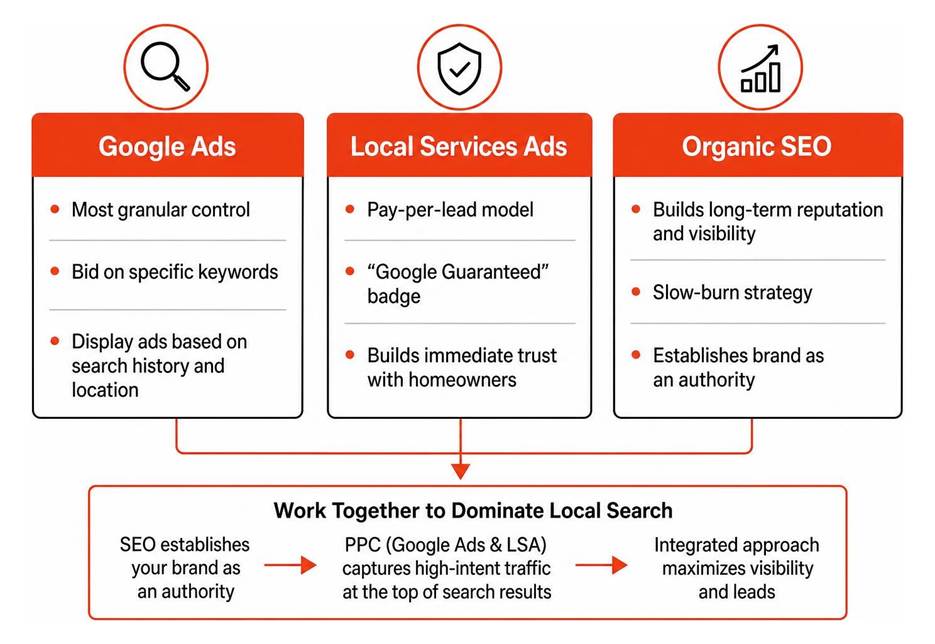
Google Ads provides the most granular control, allowing you to bid on specific keywords and display ads to users based on their search history and location. Local Services Ads (LSA), on the other hand, operate on a pay-per-lead model, featuring the “Google Guaranteed” badge, which builds immediate trust with homeowners. Integrating these channels is essential; while SEO establishes your brand as an authority, effective HVAC PPC management ensures you capture the high-intent traffic that appears at the very top of the search engine results page.
Search Intent and Ad Auction Dynamics
Understanding the “why” behind a search is the foundation of a successful campaign. A user searching for “AC repair near me” has a different intent than someone searching for “best heat pump brands 2026.” The former is an emergency, while the latter is research-driven.
In the Google Ads auction, your ad rank is determined by more than just your max cost-per-click (CPC) bid. It is heavily influenced by your Quality Score, which is a composite metric of your expected click-through rate, ad relevance, and landing page experience. If your ad copy directly addresses the user’s problem—such as “Emergency AC Repair Available Now”—and your landing page provides a seamless, mobile-friendly way to book an appointment, your Quality Score increases. This effectively lowers your actual cost-per-click, allowing you to outrank competitors who may be spending more but offering less relevant experiences.
Key Pillars of Professional HVAC PPC Management
A professional approach to PPC involves more than simply selecting keywords. It requires a robust infrastructure that connects your ad spend to actual revenue.
Successful management includes the implementation of call tracking, which allows you to hear the recordings of the calls generated by your ads. This feedback loop is vital for lead validation—if you are paying for clicks that lead to solicitors or wrong numbers, you must adjust your negative keyword lists immediately. Furthermore, integrating your PPC campaigns with your CRM ensures that you can track the entire customer journey, from the initial click to the final invoi, allowing for true revenue attribution.
Strategic Keyword Research and Match Types in HVAC PPC Management
Keyword strategy is the bedrock of your account structure. We categorize keywords into intent-based segments: emergency, replacement, and maintenance.
- Emergency Keywords: These are your bread and butter (e.g., “AC not cooling,” “heater repair”). They require aggressive bidding and immediate visibility.
- Replacement Keywords: These involve higher-level research (e.g., “HVAC installation cost,” “ductless mini-split quote”). These users are further along in the buying cycle and require more educational content.
- Brand Defense: It is common for competitors to bid on your company name. A proactive strategy includes bidding on your own brand terms to ensure you occupy the top spot and prevent competitors from poaching your existing customers.
Using match types is a balancing act. Broad match can expose you to irrelevant traffic, while exact match can be too restrictive. We recommend a hybrid approach, using phrase match to capture variations of intent while constantly reviewing the “Search Terms Report” to prune out wasted spend.
Landing Page Optimization and Speed-to-Lead Infrastructure
Sending paid traffic to your website’s homepage is a common mistake that ruins conversion rates. A dedicated landing page should be focused on a single goal: getting the user to call you or book a service.
Your landing page must load in under three seconds, especially since over 70% of HVAC emergency searches occur on mobile devices. Features like “click-to-call” buttons, clear value propositions, and social proof (such as star ratings or “Google Guaranteed” badges) are non-negotiable. Once the lead arrives, the “speed-to-lead” factor takes over. Implementing an automated intake workflow—where a lead triggers an immediate text response or a call-routing system—ensures that you don’t lose the customer to a competitor who answers the phone faster.
Hyperlocal Geo-Targeting and Weather-Triggered Bidding
HVAC is a business of geography and climate. There is no point in paying for a lead that lives outside your service area or in a zip code where you don’t have technicians available.
Hyperlocal geo-targeting allows you to restrict your ads to specific zip codes or radius boundaries. Beyond location, you can utilize weather-triggered bidding. When a sudden heatwave hits, search volume for cooling services typically spikes by 60% to 80%. By leveraging automated rules, your campaigns can automatically increase bids during these peak weather events to ensure you capture the surge in demand, then scale back during temperate periods to preserve your budget.
Agency Selection and In-House HVAC PPC Management
Deciding whether to manage your PPC in-house or hire an agency is a pivotal moment for any growing HVAC company.
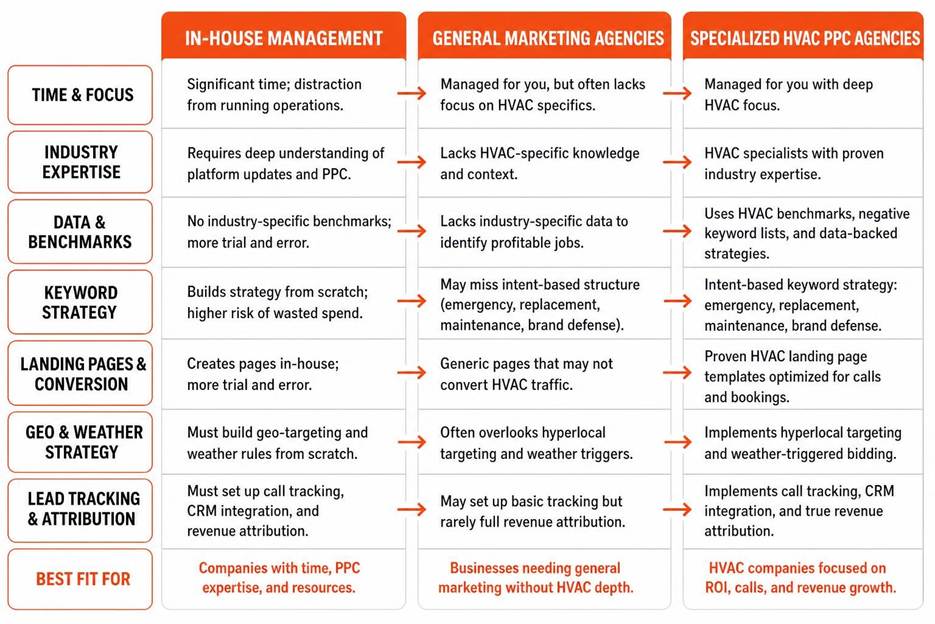
Managing campaigns in-house requires significant time and a deep understanding of platform updates, which can be a distraction from running your actual service operations. Generalist marketing agencies often fail because they lack the industry-specific data needed to identify which keywords actually result in profitable jobs. A specialized agency, however, brings a “tool stack” of industry-specific benchmarks, negative keyword lists, and proven landing page templates that can save you thousands of dollars in “learning phase” waste.
Pricing Models, Budget Benchmarks, and Revenue Tracking
Most agencies utilize one of two pricing models: a percentage of ad spend or a flat monthly retainer. The percentage model can sometimes create a conflict of interest, as it incentivizes the agency to encourage higher spending regardless of performance. A flat retainer model, often coupled with performance-based incentives, usually aligns better with a contractor’s goal of maximizing the return on investment.
When setting your budget, avoid the “arbitrary number” trap. Instead, reverse-engineer your spend:
- Determine your average profit per job.
- Identify your target number of new customers.
- Calculate your maximum allowable cost-per-lead based on your conversion rate.
If you need 10 new customers per month and your conversion rate is 20%, you need 50 leads. If your target cost-per-lead is $60, your monthly budget should be $3,000.
Evaluating Agency Models vs. In-House HVAC PPC Management
The primary advantage of a specialized agency is the feedback loop. An agency that manages 50+ HVAC accounts across different markets has a massive data advantage. They know which keywords perform in specific climates and can proactively apply those learnings to your account.
When evaluating potential partners, ask about their approach to offline conversion imports. Can they feed data from your CRM back into Google Ads to tell the algorithm which clicks actually turned into $10,000 system replacements? If an agency only reports on “clicks” or “impressions,” they are focusing on vanity metrics. You need a partner who reports on “booked jobs” and “revenue generated.”
Common HVAC PPC Pitfalls and Performance Optimization
Even the most well-intentioned campaigns can fail if they fall into common traps.
One of the most frequent errors is mixing “emergency” and “replacement” intent in the same ad group. A user looking for an emergency repair has no patience for an ad about system installation financing. Another major pitfall is failing to use negative keywords. Without a robust list of negative terms—such as “jobs,” “salary,” “DIY,” or “free”—you will inevitably pay for clicks from people looking for employment or free advice rather than professional service.
Finally, avoid “flat bidding.” HVAC demand is anything but flat. If you keep your bids static throughout the year, you are either overpaying during slow seasons or losing out on high-value jobs during peak demand.
Frequently Asked Questions About HVAC PPC
How quickly can an HVAC business expect to see leads from PPC?
You can expect to see traffic almost immediately after launching a campaign. However, the first 30 days are typically a “learning phase” where the algorithm gathers data. By the 90-day mark, with consistent optimization and negative keyword pruning, most HVAC companies see a significant stabilization in their cost-per-lead and an increase in lead quality.
How should an HVAC company determine its monthly PPC advertising budget?
Your budget should be tied to your revenue goals and your capacity to handle new jobs. We recommend modeling your budget based on your desired number of booked jobs, your average close rate, and your average customer acquisition cost. It is often better to start with a budget that allows for consistent data collection rather than a small budget that takes months to learn.
What is the primary difference between HVAC Google Ads and Local Services Ads?
Google Ads is a pay-per-click platform where you compete for ad placement based on keywords and Quality Score. Local Services Ads (LSA) are a pay-per-lead platform where you are charged only when a customer calls you directly. LSAs are often easier to manage but offer less control over the specific search queries you appear for, making a combination of both the most effective strategy.
Conclusion
Professional HVAC PPC management is not a “set it and forget it” task. It is a dynamic, data-driven process that requires constant vigilance, testing, and alignment with your business’s operational capacity. By focusing on high-intent keywords, optimizing your landing pages for speed and conversion, and tracking your success through to the final invoice, you can turn your digital advertising into a predictable revenue engine. Whether you choose to build an in-house team or partner with a specialist agency, the key is to prioritize revenue over vanity metrics and ensure your strategy evolves with the seasonal demands of the HVAC industry.
