

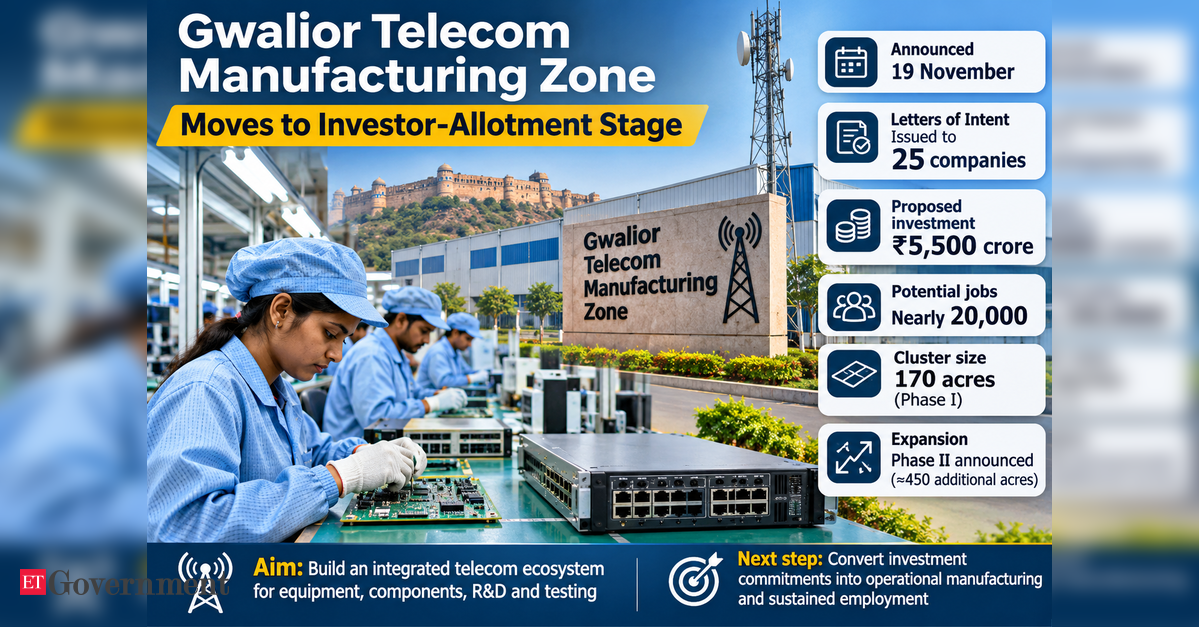
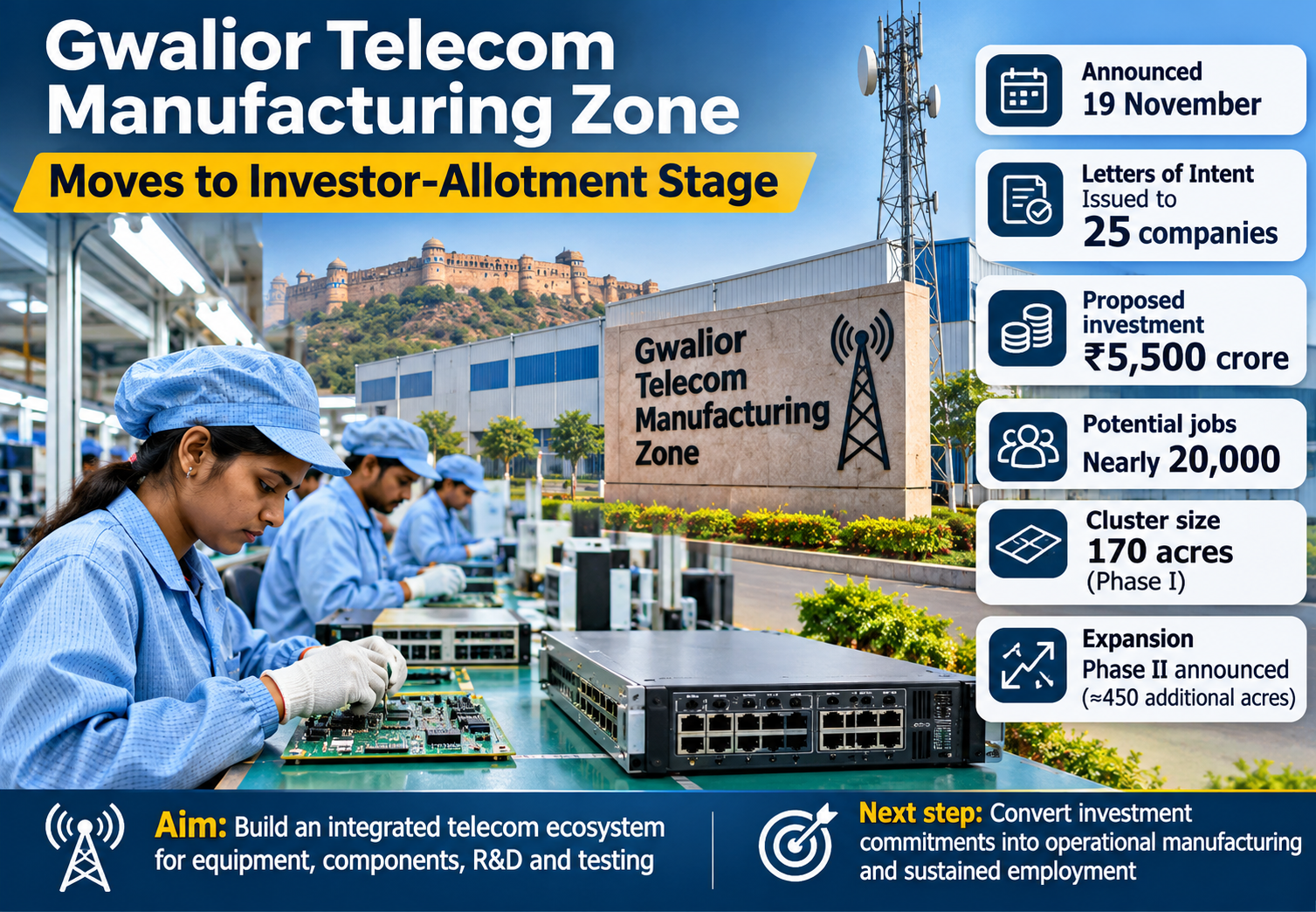
The Department of Telecommunications (DoT) and the Madhya Pradesh government have moved forward with the proposed Telecom Manufacturing Zone (TMZ) in Gwalior, issuing Letters of Intent (LoIs) to 25 companies on November 19 and announcing the second phase of the project.The development marks a transition from investment promotion to the process of industrial land allocation. However, the more consequential test lies ahead: whether the proposed investments translate into functioning manufacturing facilities, sustained production, technological development and employment.The project, initially planned across approximately 170 acres, is intended to establish an integrated manufacturing ecosystem covering telecom equipment, electronic components, optical fibre, software and passive infrastructure. Earlier investor engagements in New Delhi and Mumbai generated proposed investments of approximately ₹5,500 crore, with the potential to create nearly 20,000 jobs. These figures represent investment intentions and employment projections rather than capital already deployed or jobs created.Addressing the LoI distribution ceremony in Bhopal, Union Communications Minister Jyotiraditya M. Scindia articulated the government’s industrial ambition. “We must move from being a services nation to becoming a product nation,” he said, emphasising the need for an ecosystem that enables manufacturers to establish facilities and expand their operations.The distinction is important. India has developed one of the world’s largest telecommunications markets, supported by extensive mobile connectivity, expanding broadband infrastructure and rapid 5G deployment. However, building telecommunications networks and manufacturing the sophisticated equipment on which those networks operate involve substantially different industrial capabilities.India continues to face challenges in developing advanced semiconductor components, radio-frequency technologies, specialised networking equipment and other high-value elements of telecommunications infrastructure. Domestic assembly can reduce dependence on imported finished products, but genuine technological self-reliance requires greater participation in product design, intellectual property development, component manufacturing and research.The Gwalior project seeks to address some of these limitations through industrial clustering. Bringing manufacturers, component suppliers, testing facilities and research institutions into a common geographical ecosystem could reduce logistics costs, encourage supplier partnerships and support specialised workforce development. Whether these advantages materialise will depend on the composition of the participating companies and the nature of their proposed manufacturing activities.Madhya Pradesh Chief Minister Mohan Yadav described the initiative as an example of cooperation between the Centre and the state. “For this zone, we have given approval to 170 acres of land through the Cabinet,” he said, highlighting the government’s role in facilitating industrial development.The state’s industrial strategy is also expanding beyond the initial project. Reports following the November 19 event indicate that Phase II could cover approximately 450 additional acres. Officials have also outlined plans for common research, testing and certification facilities, with central assistance of approximately ₹493 crore reported for the first phase. Such infrastructure could be particularly valuable for smaller manufacturers that cannot independently finance sophisticated testing and certification systems.The initiative also needs to be assessed against India’s experience with the Production Linked Incentive (PLI) scheme for telecom and networking products. Introduced in 2021 with an outlay of ₹12,195 crore, the programme was designed to attract investment, expand domestic production and improve export competitiveness.According to an analysis by PRS Legislative Research, investments under the scheme had reached ₹4,789 crore by November 2025, generating sales of approximately ₹1.01 lakh crore and employment for 29,446 people. These results demonstrate progress, but they also reveal the scale of investment and sustained market demand required to develop a competitive manufacturing ecosystem.Implementation has not been uniform. The Union government’s 2026–27 Outcome Budget noted that only 23 of the 42 approved companies had claimed incentives during the preceding three years. This suggests that obtaining government approval or announcing investment plans does not automatically translate into commercially viable production.DG_1-102_OOMF 2026-27- English 28-01-2026 FinalThe Gwalior cluster will confront similar commercial realities. Telecommunications equipment manufacturing is capital-intensive, technologically demanding and heavily dependent on procurement decisions by a relatively small number of network operators. Manufacturers must satisfy stringent performance, reliability and cybersecurity requirements while competing with established international suppliers.Another critical issue is the depth of domestic value addition. If participating companies primarily assemble imported components, the project may generate employment and some industrial activity without substantially reducing strategic import dependence. Conversely, investments in indigenous design, optical technologies, network electronics, testing capabilities and advanced components could produce longer-term benefits.Transparency will therefore be essential. The November 19 DoT announcement does not provide a company-wise list of investment commitments, detailed product categories, construction milestones or commissioning schedules. Subsequent reporting identifies several prospective manufacturers, but the government has yet to publish a comprehensive implementation timetable for all 25 LoI recipients.The next stage should establish measurable targets covering actual capital expenditure, factory commissioning, production volumes, domestic value addition, exports and employment. Public reporting on these indicators would allow the government and industry to distinguish investment announcements from realised industrial outcomes.Gwalior’s geographical position, improving connectivity and proposed industrial incentives offer a foundation for manufacturing investment. Nevertheless, infrastructure readiness, dependable electricity, skilled technicians, supplier networks and assured market access will determine whether companies can operate competitively.The Telecom Manufacturing Zone has now crossed an important administrative milestone. Its larger significance will emerge only when industrial land becomes productive capacity and manufacturers begin delivering commercially competitive equipment. For India’s telecommunications sector, the ultimate measure of success will not be the number of LoIs distributed or the investment proposed, but the technological capabilities, domestic value addition and export competitiveness that Gwalior can establish over the coming years.
