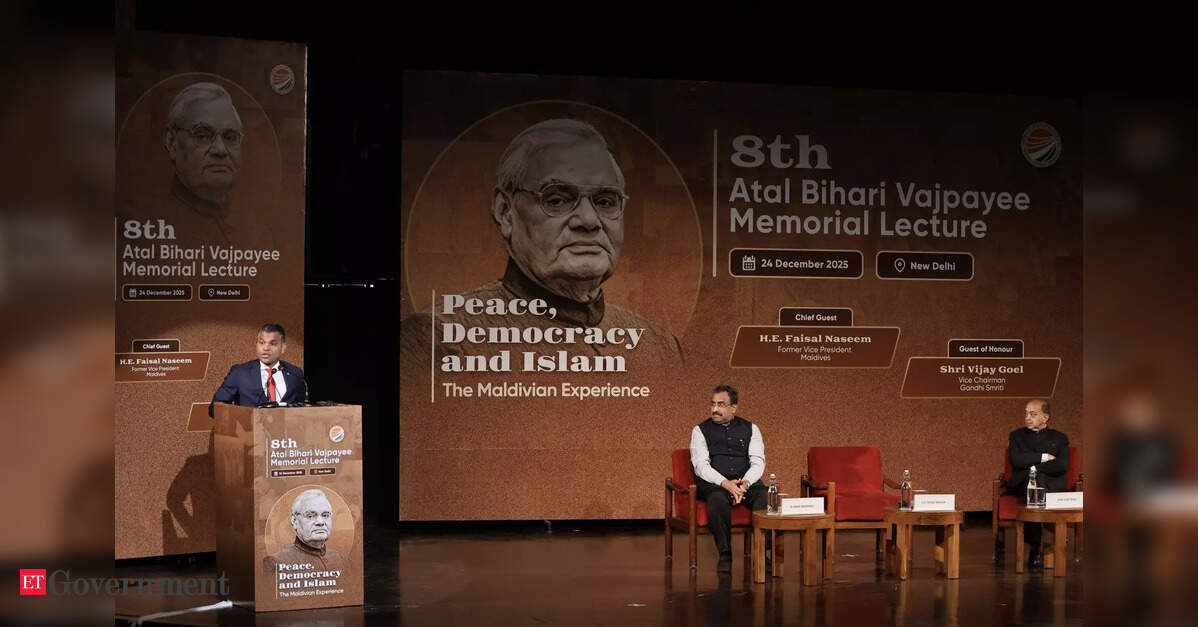
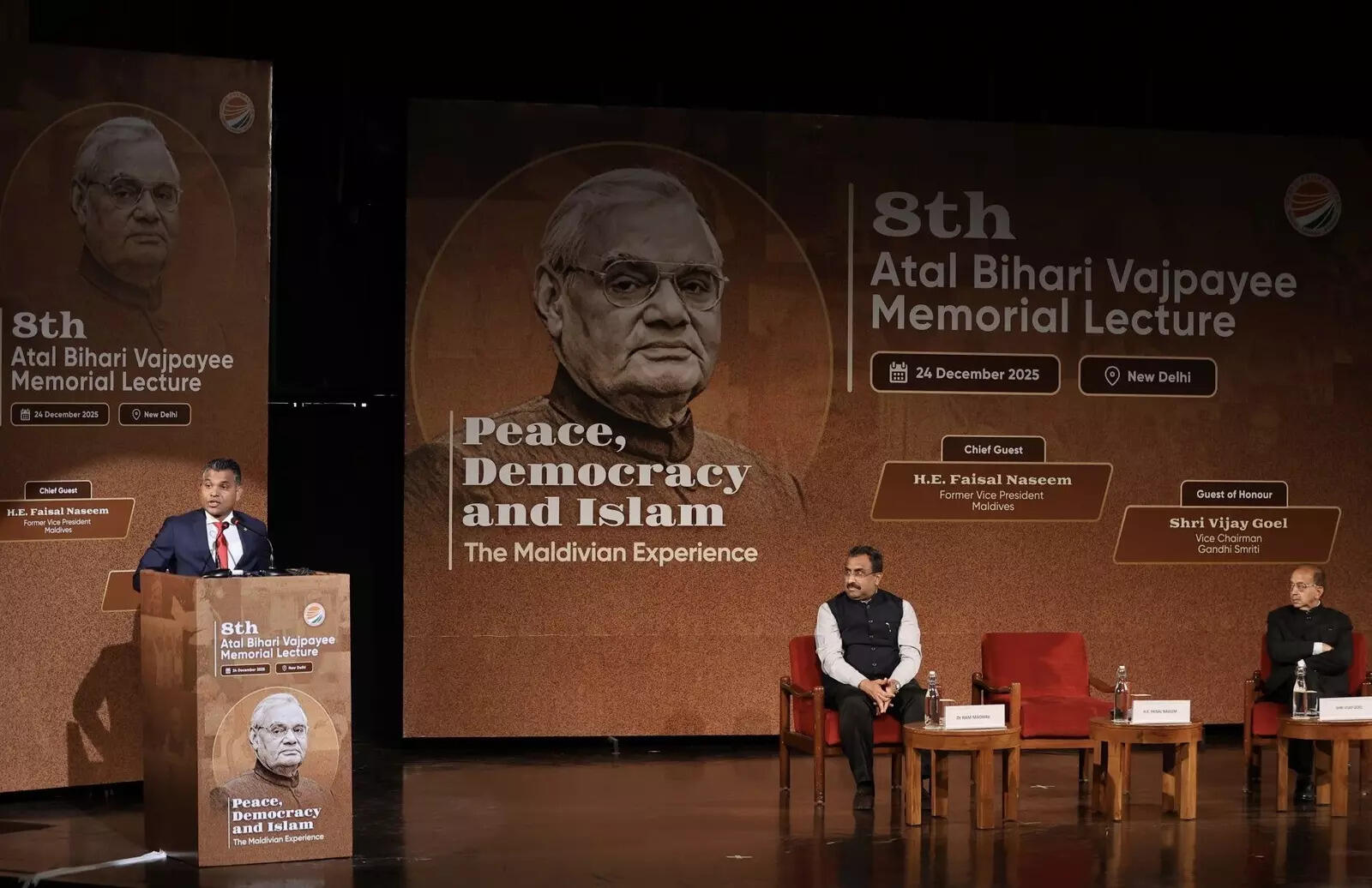
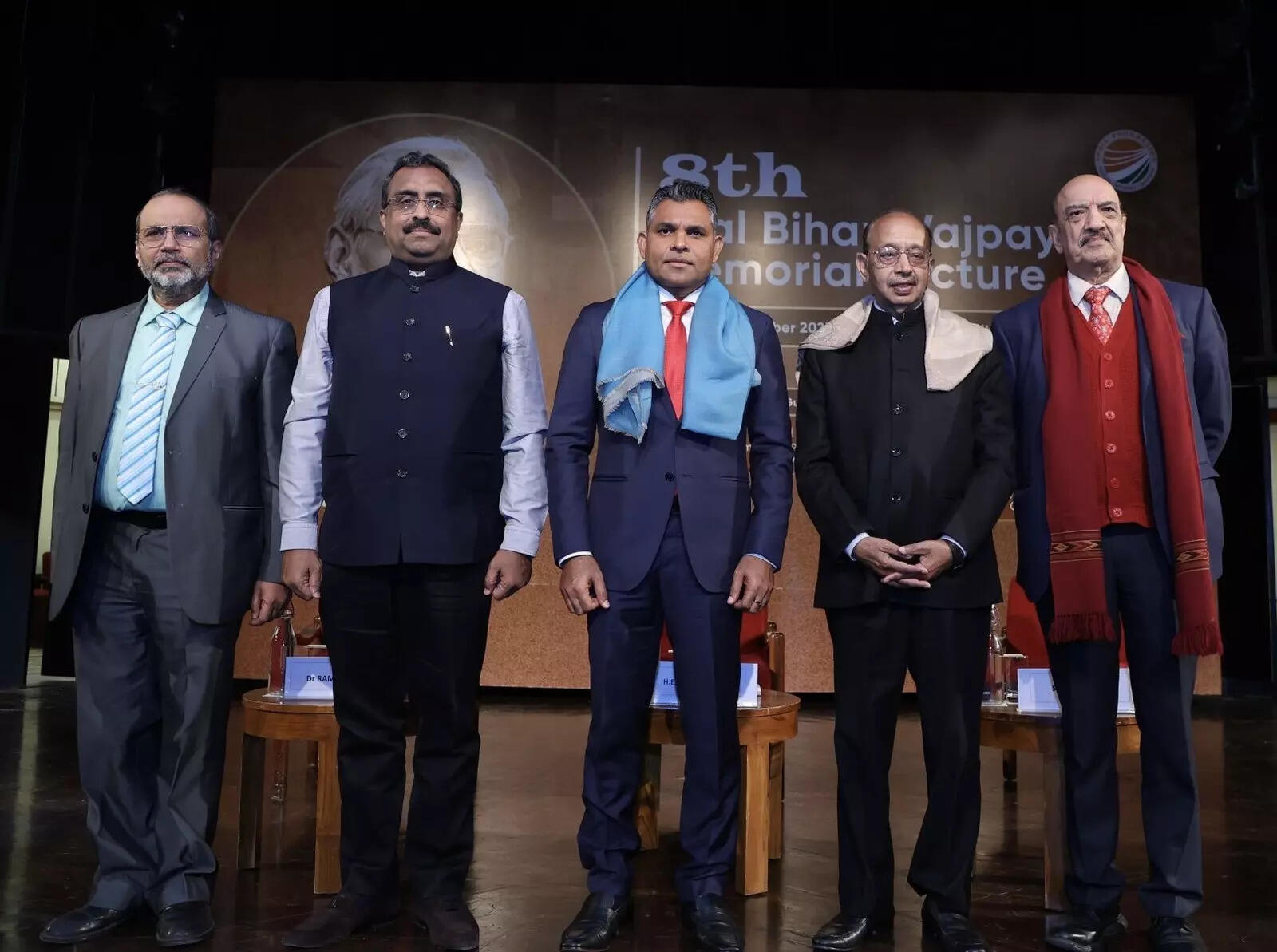
The 8th Atal Bihari Vajpayee Memorial Lecture (ABVML 2025), organised by India Foundation at the India Habitat Centre on 24 December, unfolded as a serious intellectual engagement with leadership, democracy, faith, and regional responsibility.
Coming in the year of Atal Bihari Vajpayee’s birth centenary, the lecture series reaffirmed its purpose not merely as a commemorative ritual, but as a living forum for ideas that shaped—and continue to shape—India’s political and moral imagination.
Opening the evening, Ram Madhav, author, thinker, and President of India Foundation, situated the memorial lecture within the enduring legacy of Atal Bihari Vajpayee as a statesman whose relevance transcends generations. He described Vajpayee as “one of the great leaders produced by independent India,” underlining that his appeal was not confined to a political era but spread “across generations.”
Reflecting on Vajpayee’s historic role, Ram Madhav noted that he was “the first genuinely non-Congress Prime Minister of India,” not merely by arithmetic of coalition politics but by ideological and philosophical independence.
Ram Madhav dwelt at length on Vajpayee’s transformative understanding of coalition governance. At a time when coalitions were often dismissed as political compulsions, Vajpayee, he observed, viewed them as authentic representations of the people’s aspirations. “Coalitions,” he noted, “should not be seen as a compulsion of politics, but as a representation of the aspirations of the people,” recalling how Vajpayee successfully led a 23-party coalition government for a full five-year term.
This achievement, he argued, rested on Vajpayee’s humility, his ability to connect across ideological divides, and his refusal to practise politics as exclusion.
Perhaps most striking was Ram Madhav’s emphasis on Vajpayee’s moral consistency. “One of his greatest strengths,” he said, “was that he was not a split personality. Whatever he was, he was before the entire nation.”
Citing Vajpayee’s 1996 speech in Parliament after losing a vote of confidence, he recalled the statesman’s enduring commitment to democratic values: governments may fall, Vajpayee had declared, but “the nation should remain, and this democracy should always survive.” It was this unwavering faith in democratic institutions, Ram Madhav suggested, that made Vajpayee not merely a successful Prime Minister but a custodian of India’s constitutional ethos.
The keynote address was delivered by Vijay Goel, former Union Minister and Vice Chairman of Gandhi Smriti, who brought to the podium the rare authority of personal association and long political experience. Speaking with visible emotion, he described his presence at the memorial lecture not as a formality but as an act of gratitude. “Speaking from this platform is not a formality for me; it is an emotional responsibility,” he said, recalling that he had known Vajpayee for nearly five decades and had the privilege of working closely with him.
Vijay Goel portrayed Vajpayee not only as a towering political leader but as a practitioner of dialogue, peace, and democratic restraint. He recalled how Vajpayee possessed the rare ability to walk alongside political opponents, to praise them when warranted, and to uphold national interest above partisan considerations.
“He knew how to carry even his critics along,” Goel observed, adding that Vajpayee never indulged in personal attacks, even against his fiercest adversaries. For Vajpayee, he noted, political disagreement never translated into hostility toward the nation.
Drawing on historical episodes, Vijay Goel highlighted Vajpayee’s commitment to national unity and foreign policy maturity. He recalled Vajpayee’s unequivocal support to Indira Gandhi during the Bangladesh Liberation War, noting that Vajpayee had declared that when national interest was at stake, party lines became irrelevant. This credibility, Goel argued, was the reason Vajpayee was later entrusted by Prime Minister P. V. Narasimha Rao to lead India’s delegation to the United Nations on the sensitive issue of Kashmir.
Vajpayee’s approach to secularism, Vijay Goel stressed, was rooted not in denial of cultural identity but in civilisational confidence. When questioned about advocating secularism while being grounded in Hindu thought, Vajpayee had responded, Goel recalled, that it was precisely because of India’s civilisational ethos that it could guarantee trust and dignity to all its citizens. His Lahore Bus Yatra, undertaken with the conviction that neighbours cannot be changed and must therefore be engaged, epitomised this philosophy of dialogue over confrontation.
Vijay Goel also underscored Vajpayee’s deep contribution to India–Maldives relations, citing the Prime Minister’s historic 2002 visit as a moment that gave strategic depth to bilateral ties. That visit, he noted, reaffirmed the special trust forged during India’s timely assistance to the Maldives during the 1988 coup attempt. Vajpayee’s core belief, Goel concluded, was that “true strength flows from dialogue, democracy functions on trust, and religion must unite, not divide.”
The memorial lecture was delivered by Faisal Naseem, Former Vice President of the Maldives, on the theme “Peace, Democracy and Islam: The Maldivian Experience.” Speaking as a representative of a small island nation, a Muslim society, and a young democracy, Faisal Naseem framed his address as a reflection on governance and responsibility in an increasingly uncertain world. He described Vajpayee as a leader who understood that peace is not merely an outcome but “a practice cultivated through restraint, dialogue, and respect for institutions.”
Drawing parallels between India and the Maldives, Faisal Naseem observed that democracy is more than periodic elections; it is “an ethical framework for governing diversity.” Recalling Vajpayee’s long years in opposition, he noted that political protest under Vajpayee never sought to undermine institutions.
“Parliament mattered,” he said, “not because it was perfect, but because it embodied the people’s voice.” For the Maldives, which transitioned to democracy in 2008, this example holds particular resonance. Like India, the Maldives has faced moments of democratic strain, yet its system has endured because of faith in accountability, checks and balances, and peaceful dissent.
Faisal Naseem emphasised that compromise, often misunderstood as weakness, was central to Vajpayee’s leadership. “Compromise is not weakness, and consensus is not indecision,” he remarked, calling this lesson especially vital for young and small democracies. He also highlighted how democracy must deliver tangible outcomes, outlining the Maldivian experience of universal healthcare, free higher education, social security for elders, and income support mechanisms as expressions of democratic responsibility toward citizens.
A significant portion of his address focused on India–Maldives relations, which he described as being built not merely on geography but on trust earned through action. Recalling India’s swift and restrained assistance during the 1988 coup attempt, he noted that such moments leave “a lasting imprint on national memory and strategic trust.” Vajpayee’s 2002 visit to the Maldives, he said, symbolised India’s enduring commitment to its neighbours and laid foundations for a cooperative maritime outlook in the Indian Ocean.
Faisal Naseem argued that Vajpayee’s strategic sensibility recognised the Indian Ocean as a shared space rather than a contested arena. This vision, he suggested, continues to guide contemporary India–Maldives cooperation in maritime security, humanitarian assistance, disaster response, and development partnerships that enhance security without militarising the region. “This is security based on partnership, not projection,” he observed, reflecting Vajpayee’s belief that stability emerges from confidence-building rather than coercion.
Placing these reflections within today’s global context of conflict, climate change, and institutional fragility, Faisal Naseem underscored the importance of India’s democratic voice on the world stage. For small island states like the Maldives, climate change is an existential reality, and India’s approach—grounded in democracy, science, and inclusive global engagement—carries particular significance. Vajpayee’s legacy, he concluded, lies in championing moderation over excess, cooperation over confrontation, and partnership over dominance.
The vote of thanks was delivered by Major General (Retd.) Dhruv Katoch, who acknowledged the distinguished speakers and the diverse audience comprising diplomats, ambassadors, senior government officials, intellectuals, and experts. His remarks brought the evening to a close, reinforcing the idea that the Atal Bihari Vajpayee Memorial Lecture has evolved into a serious forum for reflection on governance, ethics, and regional responsibility.
Taken together, ABVML 2025 reaffirmed Atal Bihari Vajpayee’s enduring relevance—not merely as a former Prime Minister, but as a statesman whose ideas on democracy, peace, and moral leadership continue to illuminate debates in India and beyond. In an age marked by polarisation and uncertainty, the lecture stood as a reminder that democratic leadership, when anchored in humility, dialogue, and ethical restraint, can still offer guidance to nations navigating complex futures.
(Anoop Verma is Editor-News, ETGovernment)